


A $500 Billion Freudian Slip
A couple of weeks ago, I published my Substack on whether AI industry is the new shadow banking system. And I concluded that the answer is, simply, yes.
In it, I argued that investors who liken today’s boom to the dot-com bubble as a way of reassuring themselves that “this time it’s different” are looking at the wrong analogy entirely. You see, the late 90’s tech mania was a story about speculative equity: outlandish valuations, irrational optimism, and a crash that ultimately only hurt a subsection of investors focused on early stage growth, but not the wider financial system.
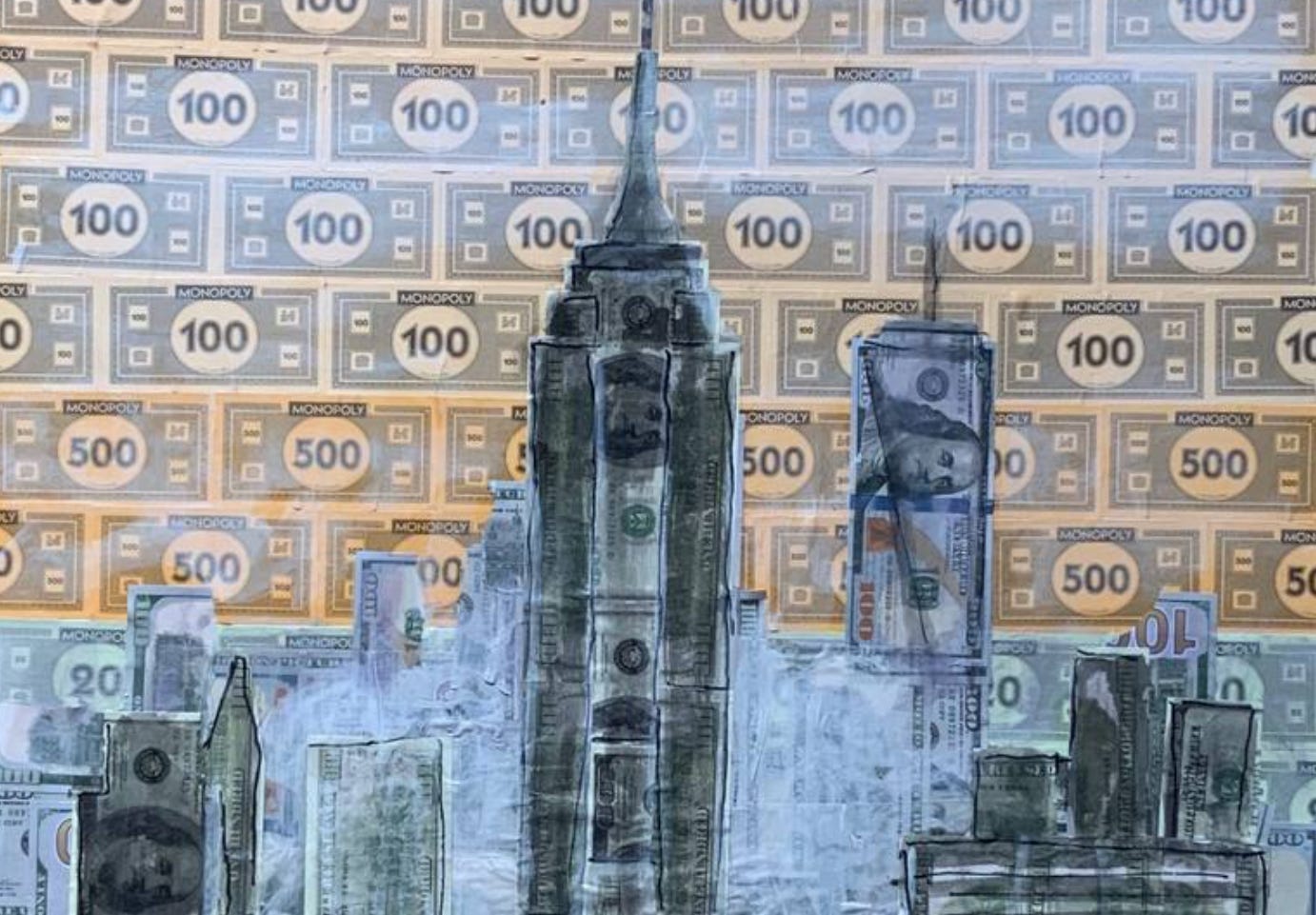
The current moment is something else entirely. The issue today isn’t that stock prices are out of whack (which, by the way, they totally are); it’s that we are living through a credit cycle of dodgy vendor financing, deferred payments, equity-linked leases, and sovereign subsidies that have turned GPUs and data centers into a new class of collateral.
Or, in layman’s terms: the AI boom isn’t being funded with useful things like profits or productivity but with debt. And there’s nothing to underwrite this debt, bar a few dodgy AI-enabled cat memes where the cats have three legs because AI still can’t count.
My last piece tried to unpack what is happening today by looking at 2008.
This one looks at what will happen tomorrow by looking at the same 2008 crisis.
Because just as bankers were bailed out in a way that shattered public trust and rewrote the moral code of capitalism, you can bet your bottom dollar that Sam Altman and his peers will get the same treatment!
So the question for today is not whether the bailout will come.
It’s how.
Coincidentally, as I was having dinner last night, I got a message from Eileen, a San Fran-based corporate CFO with whom I’ve been dissecting this new web of AI credit.
A link and a single text: “LOL.”
I opened it and similarly laughed out loud.
On stage at the Wall Street Journal Tech Live conference, Sarah Friar, the CFO of OpenAI, was describing the company’s search for “an ecosystem of banks, private equity, maybe even governmental partners” to finance its infrastructure build-out.
Pressed on what she meant, she added a single, radioactive word: backstop.
Within hours she retracted it on LinkedIn, saying she had “muddied the point.”
But the point was perfectly clear. At least, to anybody who is actually listening.
It is worth dwelling, for a moment, on how completely, totally, and utterly strange it is to hear a Silicon Valley CFO use that single word “backstop.”
This is not a term that belongs anywhere near the tech sector lexicon. It isn’t start-up slang or a management consultant cliché. It’s not even something I’ve ever heard being taught in business schools. Instead, it is a word drawn from the vocabulary of central banks and specifically bailouts: a term of monetary policy that signals the moment when private liquidity gives way to public rescue.
Indeed, this word usually lives in the minutes of the Federal Reserve, in the footnotes of IMF working papers, and in the testimonies of US Treasury officials explaining why they’ve just stepped in to rescue the banking system.
So to use this word in a corporate-finance context is to imagine a world in which credit has dried up, counterparties are failing, and the only remaining buyer of last resort is the state!
To belabor this point: “Backstop” is not the language of innovation or R&D; it is used only when shit-hits-fans and you’re living in the world of crisis management.
And that is what makes Friar’s remark so significant. Because if Friar is using that word publicly (a word that I cannot honestly recall any C-suite executive of a start-up ever saying on stage) it’s almost certain she’s been using it in private.
Because words like that do not appear by accident; they surface only after they’ve been circulating internally. Somewhere inside OpenAI, that term has entered the conversation. Which means that something remarkable, and faintly nefarious, is taking shape inside the office of a CFO presiding over a company now valued at roughly $500 billion.
(Of course, that number bears thinking about! It places OpenAI’s market valuation at nearly three-quarters of the entire TARP bailout of 2008, the $700 billion emergency package Congress authorized to stabilize the global banking system.)
So yes, the CFO of a company which now commands a notional value comparable to the rescue fund that prevented modern finance from collapsing, has used the word bailout.
Which means that the company has begun to think of itself not as a technology firm, but as a macro-economic actor and a potential node of global systemic risk. The conversation may no longer be about growth or disruption but about solvency.
Further, the coincidence of timing only deepens the point.
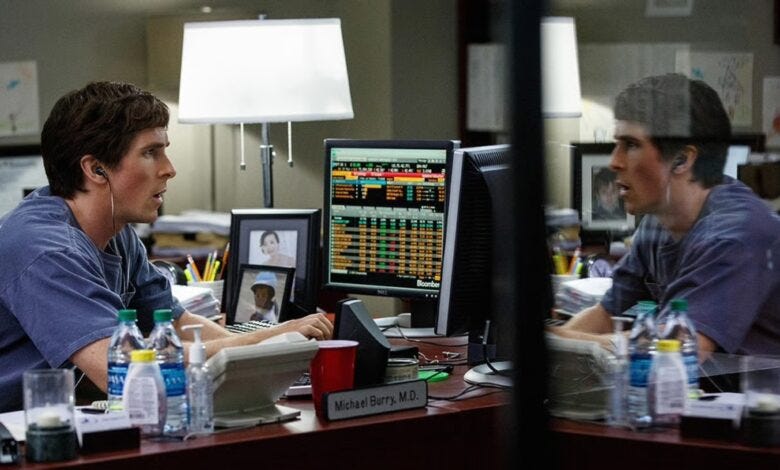
I mean, in the very week Friar supposedly misspoke, Michael Burry, the trader immortalized by The Big Short, announced he was shorting the AI trade. At the same time, Deutsche Bank announced that it is exploring ways to hedge its exposure to data centers after extending billions in loans to the sector.
Executives inside the bank are said to be considering shorting a basket of AI-related equities or buying default protection on the underlying debt through a synthetic-risk-transfer structure (essentially, credit insurance) on the infrastructure of the intelligence boom —> If these words mean nothing to you, that’s totally fine, but just understand this: The last time these words were used in this specific combination was in… *checks notes* 2008.
So when traders start shorting the infrastructure of our latest hype cycle, it usually means the story has migrated from the front cover of WIRED and Forbes 30-Under-30 to the spreadsheets of fixed-income and bond trading desks.
Taken together, these signals confirm what my earlier Substack proposed:
We are indeed living through the AI shadow-banking era.
So, even just for a moment, in this article I’m going to take Friar’s slip seriously.
If OpenAI, the symbolic name underpinning the AI economy, is already speaking the language of central banks, then the conversation has shifted. It has entered the realm where technology becomes monetary policy by other means.
As such, the next great question is no longer asking endlessly: what can AI do?
But instead: Who will backstop it when it can’t?
2008: The Invention of The Perma-Rescue
To understand why a Silicon Valley CFO is now talking like a central banker, we need to go back to 2008: not as a discrete event, but as the beginning of the world we are still very much living in!
You see, the 2008 crash didn’t end the financial crisis; it changed what a financial crisis even is. It created a world in which governments and central banks now stand permanently behind the markets they once only sought to regulate. Instead of stepping in only during emergencies, they became part of the system itself by:
Pumping money into the system whenever credit tightens,
Cutting rates,
Buying bonds,
Quietly ensuring that large institutions never truly fail.
Liquidity (the constant availability of cheap money and credit) became the new organizing principle of capitalism. Thus markets have become nothing more than systems kept alive by the steady drip of constant central-bank support.
What Actually Happened in 2008?
From a technical perspective, the rescue was brilliant. Nobody can fault the speed and precision of the bailout.
In a matter of weeks, the U.S. government and the Federal Reserve assembled a patchwork of mechanisms that together rewired the global financial system, which is an extraordinary achievement:
TARP (the Troubled Asset Relief Program) injected capital directly into the banks, effectively nationalizing solvency.
QE (Quantitative Easing) allowed the Fed to print money to buy long-term securities, flattening yields and backstopping asset prices.
Repo and commercial-paper facilities restored the short-term funding markets that banks and corporations depended on for daily operations.
Swap lines with foreign central banks extended dollar liquidity across the world.
It’s all very complicated with boring-sounding words, but suffice to say this: the government didn’t just step in to stabilize the system, it actually became part of the system itself.
This has meant that every time a private institution has come close to failing since then, the state has extended its balance sheet to catch it. By mid-’09, nearly every aspect of modern finance had been absorbed into public protection.
So yes, this rescue worked… But it created a new paradigm And a new set of problems. What had once been an exception (a bailout) has instead become structural, and automatic.
In fact, put another way: the bailout never actually stopped.
Because as I have also written about recently, this moment marked the true end of neoliberalism.

Sarah Friar, this week, discussing the B-Word.
You see, instead of withdrawing its power from the markets, the government moved from creating legislation in public to making decisions behind closed doors inside the central bank on the down-low (I’m tempted to make a bad joke about the Dow-low, but I shan’t). Now, the government flexes its power not through elections or diplomacy, but by controlling the single most important resource of the modern era: global liquidity.
Thus the moral logic of capitalism inverted.
Risk-taking was privatized, but loss was clearly socialized. “Socialism for the banks,” as it came to be called. (I happened to be working on Wall Street at the time of the protests; it was messy, and for good reason!).
And the government’s safety net that was once created for citizens was removed and pointed upward to the financial elite. Main Street got austerity; Wall Street got the Fed.
Go figure.
From Main Street to Wall Street (And Back Again)
This inversion shaped everything that followed.
The Obama years institutionalized a culture of technocratic competence: crisis managers in suits who could stabilize markets but never sought to rebuild trust. (Because bailing out your backers on Wall Street is inherently distrustful). The public saw bankers rewarded, homeowners evicted, and not a single person held accountable.
Out of this very moral vacuum created by Bush and Obama has come Trump. The populist wave of the 2010s was not a rejection of globalization per se, but of the moral asymmetry it showed: that the system would save capital, just not the people.
The political extremism we are living through across the world today (whether Brexit, Trump, or the far-right’s resurgence in Europe) traces back to the central-banking decisions of 2008, when governments chose to rescue markets and let the social contract fail.
And yet… fifteen years later, the logic of rescue persists! It will not bloody die!
I was having dinner with two bottles of wine on a Friday night in Dublin in 2023 when my phone lit up with Financial Times editors texting around frantically for scoops. Silicon Valley Bank had collapsed. And my only thought? Here we go again.
I was, of course, correct. Regulators again invoked “systemic risk” and guaranteed all deposits (this time including the uninsured ones! Because insurance is for fucking LOSERS!). It was the same mechanism, only faster. The perma-bailout had become a reflex.
Fast forward to the present, and we now live in a world governed by two sides of the same coin.
On one side, the state’s role is to bail out anything that grows too big to fail.
On the other, the investor’s role is to deploy capital so massively, and so entangled across the system, that failure itself becomes a claim on the public purse.
And look at that; the government and investment élite each guaranteeing the other’s survival!
Meanwhile the rest of us, standing outside this arrangement like morons, are the ones wondering when exactly capitalism became a private-members’ insurance club?
The State as Lender of Last Resort… to Itself
The big difference between 2008 and today is simple, and it changes everything:
This time, the bubble isn’t merely tolerated by the state, it’s actually sponsored by it!
As I described in a previous post, this officially sanctioned credit bubble has been built through industrial policy, subsidized capital, and national-security imperatives. The government isn’t standing by at arms-length to these shenanigans, it is already a partner in the bet.
But to be clear, none of this is inherently sinister. We do need this technology, and there is nothing wrong with needing to build, to compete, and to stay ahead. But ambition financed through leverage is still… leverage. And the system that sustains it still needs to behave like… a balance sheet.
Which means that when the cycle turns (note: when, not if), the state will already be inside the wreckage, compelled to defend its own investment.
Hence, the next intervention will not simply revisit 2008; it will be larger, faster, and more politically entangled, because this time the guarantor is not merely complicit, but committed.
So let’s imagine Sarah Friar again:
OpenAI’s growth has stalled; its capital costs have not. Compute demand has plateaued, but the debt behind it is still increasing. CoreWeave is struggling to roll over its leases; Nvidia’s vendor financing book is dodgy at best; Microsoft is starting to carry losses that look increasingly permanent.
In this world, inside the CFO’s office, the word backstop is no longer just misspoken but it’s probably somewhere on a strategy slide deck.
Hence the question on the table is the same one every financial crisis eventually asks: what happens when liquidity runs out?
And just as in 2008, the menu of responses already exists, ready to be dusted off and relabeled for the new era. One can easily imagine the following:
The Compute Liquidity Facility (CLF): imagine the Federal Reserve doing for GPUs what it once did for mortgage securities. When cash runs out, the Fed lends directly against racks of chips or compute contracts, treating them as temporary collateral to keep the hardware market from immediately collapsing.
TLGP 2.0: a modern version of the 2008 Temporary Liquidity Guarantee Program, where the Treasury would guarantee newly issued data center debt. It prevents a run of defaults by assuring lenders that Washington stands behind the paper. (This is kinda LOL because recent history shows that the Trump administration stands behind very little…)
Maiden Lane Silicon: named after the Fed’s post-Lehman “Maiden Lane” vehicles, this would be a special-purpose entity that buys up distressed compute assets and leases, warehousing the wreckage until “market conditions normalize.” (No doubt Kushner’s geopolitical fund would get the investment mandate for this, right?)
Strategic Nationalizations: if an AI company of systemic importance falters, the government takes an equity stake under the banner of national security. It’s not a takeover per se, just a holding pattern until markets recover, at least on paper. (We’ve seen this already with Intel)
Fiscal Absorption: the easiest and most politically palatable option. The Pentagon and the Department of Energy simply start buying the excess capacity, justifying it as defense modernization or energy resilience. It is called procurement but functions as a bailout. (Given current Pengaton directorship, we probably wouldn’t even hear about this!)
Each of these measures has precedent, and each would even look entirely reasonable in a crisis!
And yes, each would push us one step further into a world where the boundary between technology, finance, and the state fully dissolves.
Because once the government starts backstopping GPUs, the AI industry will no longer be a sector, it will be infrastructure that is too important to fail.
Altman gets bailed out, Friar gets her annual bonus, and our taxes increase.
You’re welcome.
The B-Word Economy
Let’s once again remind ourselves of what the 2008 bailout did to our society, where everyone learned a single, corrosive lesson: rules only apply downward.
A collapse of moral coherence (why obey rules that no longer apply at the top?)
A collapse of political confidence (why even vote if decisions are made by central banks? I did a BTTID podcast on this very topic!)
A collapse of social empathy (why believe in fairness when the rewards are rigged?)
Our society has literally never healed from the 2008 mess: it is the disease that has turned into populism, conspiracy, nihilism, and burnout (at least for the sane among us).
And now, we are preparing to compound this rot. An AI bailout will not just be bigger in scale but also in impact, deepening the moral, political, and psychological decay that 2008 began.
Economically, it will complete the migration of capitalism from production to protecting the elite. Every new technological frontier will be pre-subsidized, insured, and politically sanctified (even if not legally, at least culturally this will be the starting assumption of investors).
The aim will no longer be to generate value, but to maintain valuations. The “market” will endure as little more than a theater of price movements in an economy where outcomes are pre-determined by central banking policy.
We’re already living this way, of course, since 2008; we just maintain the polite fiction that some of it is real. (Again, Alex and I discussed this in a previous podcast). But after the next Big Bailout Cycle™, we won’t even bother with the pretence.
Politically, it will accelerate the hollowing-out of the already-weak democratic state:
Once governments guarantee not just banks but VC backed tech companies (and as we saw with Silicon Valley Bank, the VCs themselves), governance moves permanently beyond public accountability. The institutions that will matter most (the Fed, the Treasury, the sovereign wealth funds, the AI oversight boards led by AI illusionists with Oxford philosophy degrees talking about mosquito nets) are precisely those that nobody votes for.
We will have outsourced sovereignty to technocracy, and Peter Thiel will be completely delighted.
Democratically, the consequences will be catastrophic of course.
If 2008 broke faith between citizens and institutions, an AI bailout will break the link between citizens and reality itself!
The infrastructure of perception (the feeds, search engines, and LLMs that increasingly conduct the world) will be underwritten by the same state-market apparatus that already failed to distribute prosperity. Thus when the guarantor of liquidity is also the producer of “truth”, democracy becomes… what?
And it won’t just be data centers or individual companies that need rescuing. These systems are now propping up the entire economy (!), masking the complete stagnation happening underneath (layoffs, affordability crises, mortgage defaults, in other words: a recession). So yes, when “growth” depends on servers that consume capital faster than they return it, the next bailout will actually be as much about saving the entire GDP as much as saving OpenAI.
This is the logical endpoint of the bailout society: not that the AI economy will fail, but that its failure will be indistinguishable from the failure of the state itself. Because what happens when The Fed becomes Too Big To Fail?
And perhaps that’s why, standing on stage in California, Sarah Friar reached instinctively for the word backstop.
She didn’t misspeak. She just happened to say what every CFO, banker, and policymaker already knows but can’t admit:
The next great bailout has already begun.