

Further from Earth
On Artemis II and the meaninglessness of the space industry

Last night, NASA launched four astronauts toward the Moon; the first crewed lunar mission since 1972, fifty-three years. If all goes well, Victor Glover will become the first Black astronaut to travel beyond low Earth orbit and Christina Koch the first woman. They are out there right now, coasting through deep space, further from Earth than any human beings since Apollo 17.
The crew played cards before boarding, which got a little coverage. The launch aired on NASA+, Amazon Prime, and YouTube. Donald Trump congratulated them on Truth Social and moved on to the war in Iran, and the astronauts said it was an amazing opportunity.
And… yeah. So what?
I’ve been trying to understand why I don’t care, because I work in the space industry. I’ve spent my career in and around lunar missions — I’ve even designed one. I know how hard it is to do what those four people did last night, what it costs in money, in years, in the institutional willpower required to keep a program alive through budget cuts and technical failures and political administrations that each have different opinions about whether any of this is worth doing. I know it is extraordinary.
And yet…
A few months ago, a friend who covers space for the Wall Street Journal sent me an episode of How Long Gone, a podcast by two guys in Los Angeles who talk about culture. One of them said, offhandedly, that space is boring and that Neil deGrasse Tyson content puts him to sleep. The other agreed immediately. So did I.
I do TV interviews on space for SkyNews, and when I was in the studio earlier this week to cover the Artemis launch, I was dreading the inevitable question, because I’m a terrible liar with no poker face: “What will the impact of this launch be for kids and generations to come?”
Little to none.
The Colosseum Problem
I was thinking about this when I was in Rome last fall for a space economics seminar.
The morning before it started, I went to the Colosseum. I stood in front of it for less than two minutes and felt very little other than being overwhelmed by what had become a social media backdrop for people in haute couture. I took a photo because it felt like something I should do, and immediately left to escape the tackiness of it all.
The next morning, my friend and I drove past it on the way to a wine bar (yes, morning). She was holding a box of famous pastries we had traveled far to find, and I took a photo of her with the pastries and the Colosseum slightly out of focus behind her. This is my fond memory of the Colosseum.
The first photo has the Colosseum in sharp focus and means nothing to me. The second one has it as an accidental backdrop to a moment about friendship and food and being in Rome with someone you like.
In fact, space has exactly the same problem. We’ve been positioned as tourists; as consumers of far-away-galaxies-as-screensavers; audiences for other people’s (celebrity?) three-minute-zero-gravity missions. You cannot change those vibes by making the screensavers higher resolution.
Going back to the Colosseum for a moment. The building only means something when it connects to a story you’re already inside. If, say, you’ve studied Roman history, or if you understand what it meant that fifty thousand people gathered in that building to watch other people die, or you’re really into Paul Mescal in leather. Then yes, standing there does something to you. The ruins are evidence of something you already care about.
But most of us don’t have that relationship with Rome anymore. And almost none of us have it with space.
Artemis II launched last night and I could not identify anything in my life that will be different when it splashes down on April 10th. And that’s considering that I even work in the space industry, I spent time on NASA’s Mars architecture studies, and I know what went into putting those four people on that rocket! Sure, the mission will test systems for the wider Artemis program, and if it succeeds, the next test flight becomes possible, and eventually, years from now, maybe a landing. Somewhere in that chain there is presumably something that matters to someone, but I cannot find where it connects to the world I actually live in.
Incidentally, this is not how I feel about AI. Actually, I don’t even have to try to care about AI, because it’s a technology with an in-built warning siren: it is coming for my industry, my students’ careers, and all of our assumptions about what expertise is worth. It is unpredictable in ways that keep smart people up at night. I am unsettled by it, absorbed by it, unable to look away from it. It is the opposite of Artemis II.
You see, space is complicated but not complex. It’s an enormous engineering challenge with largely knowable parameters, and when it succeeds, the world is more or less the same world it was before.
Fuck, I’m more curious about deep ocean mapping than about a lunar flyby, which has at least the possibility of new species, unknown chemistries, and ecosystems that have never seen sunlight. These things tell me something about life on the planet I actually inhabit. Artemis II will tell me whether Orion’s life support system performs as designed. And yes, I hope it does, but I can’t make myself care that it did.
What Meaning Actually Looked Like
To understand how space lost a narrative that anybody cared about, you have to see what it looked like when it had one. Now is an appropriate time in an article on spaceflight to travel back in time…
In 1944, a painting of Saturn appeared in Life magazine. The planet rose above a jagged landscape on Titan, and its rings stretched across the sky in a pale arc. The ground in the foreground looked rough and cold; a place where a person might one day stand and look up.
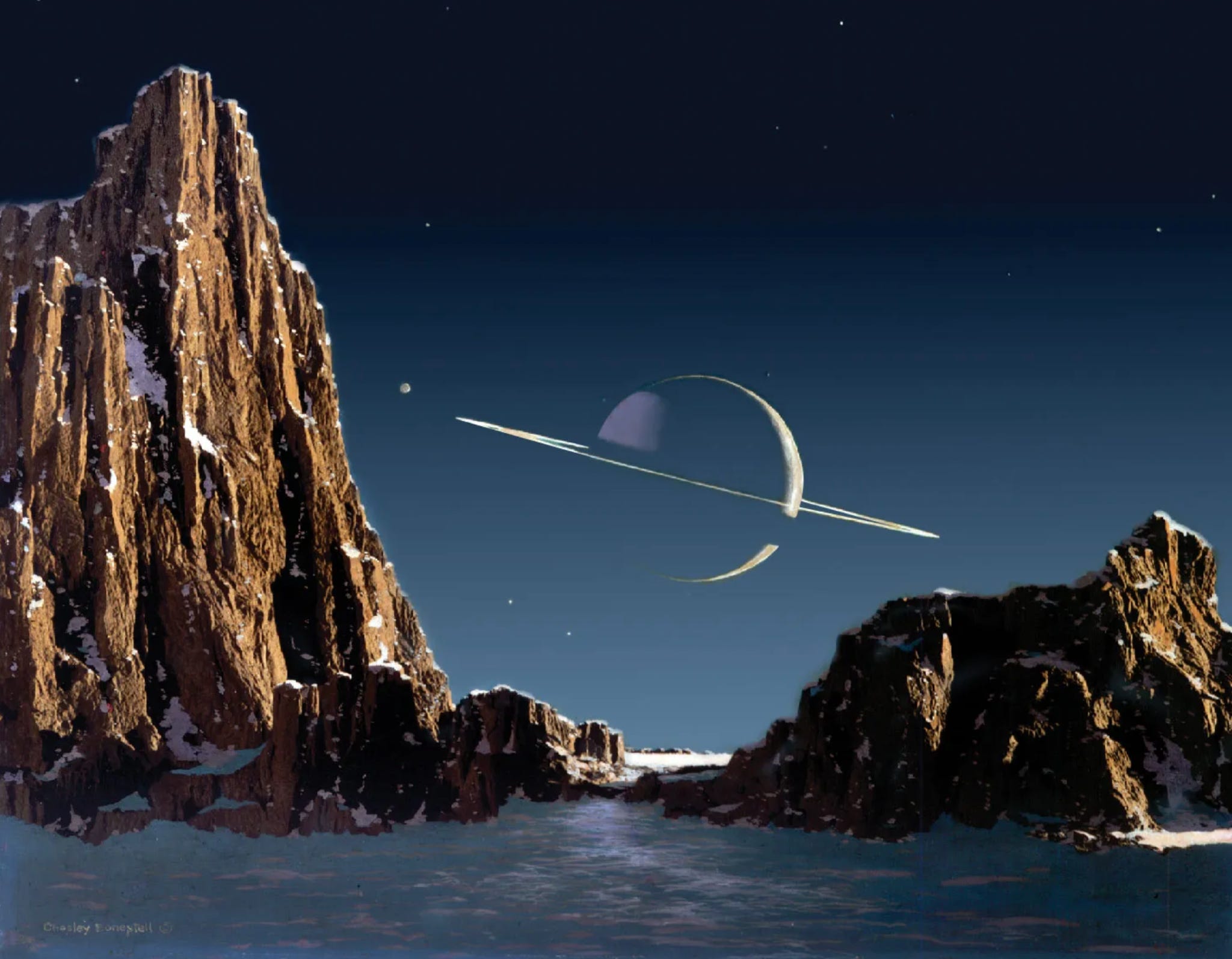
The now infamous painting was by Chesley Bonestell, and what set it apart was that it was built from calculations. You see, Bonestell had trained as an architect before moving to astronomical illustration, and he had a dogged commitment to getting the physics right: the angle of Saturn’s rings as seen from Titan, the color of the light, the geometry of the horizon, all of these he calculated himself and were correct. In doing so, his paintings became actual places! Places that existed, that waited for us, and that could (in principle) be reached.
What made Bonestell’s work important wasn’t the beauty alone, because lots of people can paint stunning depictions of our solar system. Rather, it was who these paintings were talking to. The perspective was a human being standing on a distant surface and looking outward is different from a telescope image, a satellite visualization, or a God’s-eye view from nowhere. A person, standing somewhere, looking at something, says: this place exists, it is reachable, and you (yes, YOU!) are part of the species that will reach it. You will go here.
Importantly, it did not say: you will watch someone else go here.
But a destination without a plan, however beautifully painted, is just a poster.
That’s where Fred Freeman came in. Freeman was an illustrator who worked with the infamous aerospace engineer Wernher von Braun on a series of articles in Collier’s magazine in the early 1950s in an attempt to answer, in public, the question Bonestell’s paintings raised: how would you actually get there?
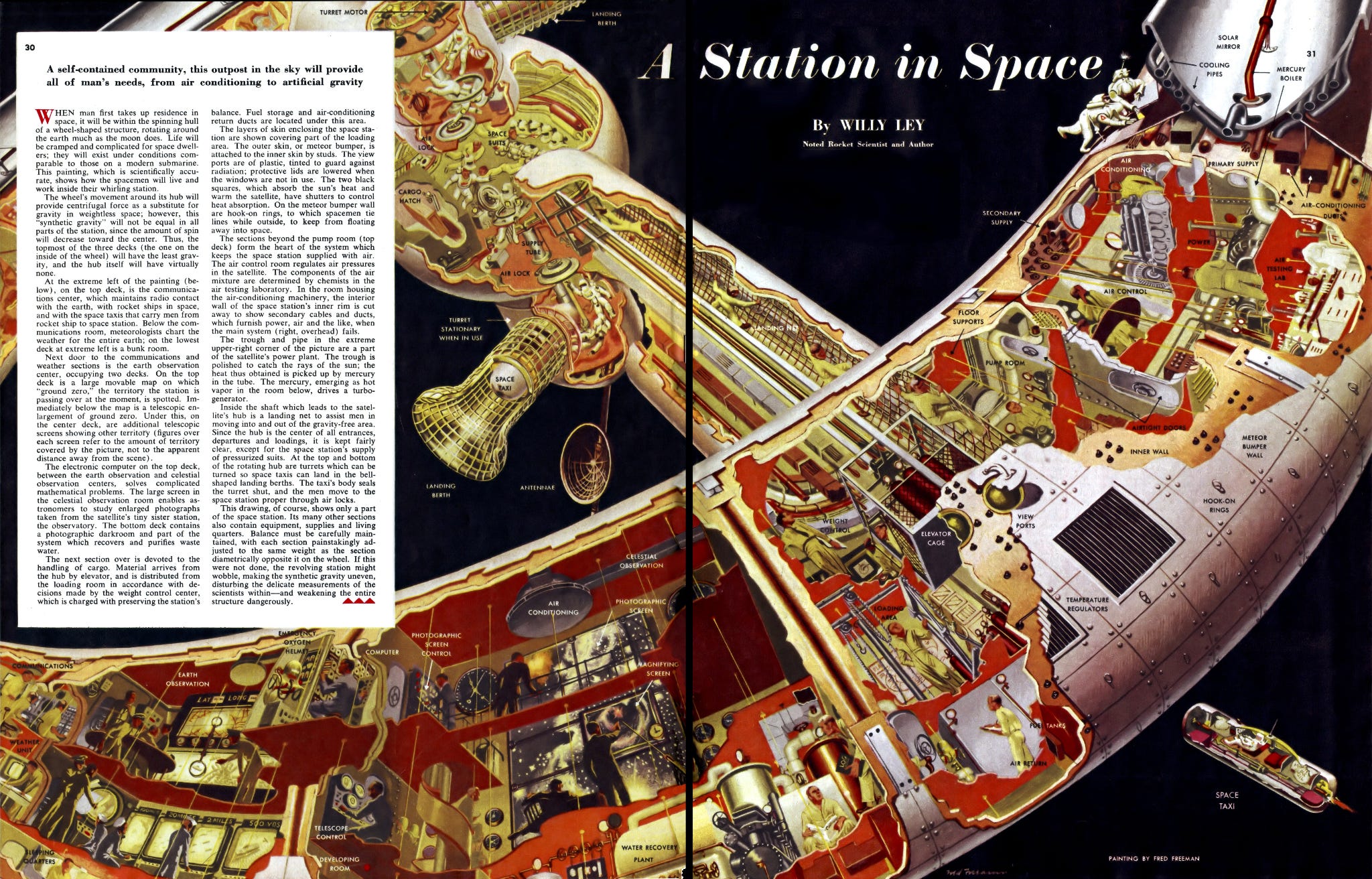
Freeman’s images looked nothing like Bonestell’s, as there were no dramatic skies or alien horizons. Instead he drew rockets opened up in cross-section so you could see the fuel tanks and engine bells and structural frames, orbital mechanics laid out as sequences of diagrams, the interior of a capsule with wiring exposed and pressure vessels labeled. He drew astronauts performing tasks with tools that looked like actual tools, in conditions that looked like actual conditions.
A reader could trace the path through Freeman’s pages: Earth to orbit, orbit to translunar trajectory, translunar trajectory to the lunar surface. Step by step, system by system. It wasn’t a promise that any of this would actually happen, obviously, because only the US government could make that promise, but it showed people that arriving there was physically possible. That someone who understood the problem had thought it through, and that the numbers worked.
Together, Bonestell and Freeman’s importance in inspiring the Apollo era grew because of one key thing: they were published side by side. In the same magazines, the same articles, aimed at the same reader. You couldn’t look at Bonestell’s gorgeous destination without also seeing Freeman’s engineering; the ugly, specific, credible work of how you’d actually get there. And you couldn’t look at Freeman’s engineering without seeing what it was for, depicted by Bonestell.
The person telling you what to visit in space and the person showing you how to get there were collaborating, and neither one could get away with bullshitting because the other one’s work was right there on the next page.
That combination, of ambition checked by engineering, and engineering motivated by ambition, were both answerable to the same audience. And this is what made mid-century space culture feel like it meant something. It wasn’t the paintings alone, of course, but that the paintings came attached to real plans, and the plans came attached to real reasons with government financing, and all of it was addressed to you as someone who would eventually be involved.
The great science fiction writers, incidentally publishing around the same time, worked the same way: Arthur C. Clarke was a radar technician, and Isaac Asimov had a PhD in biochemistry. They could reason about what was physically possible because they had the authority to do that. The fiction was downstream of that reasoning, and the stories felt real because the people writing them knew what “real” entailed.
Today?
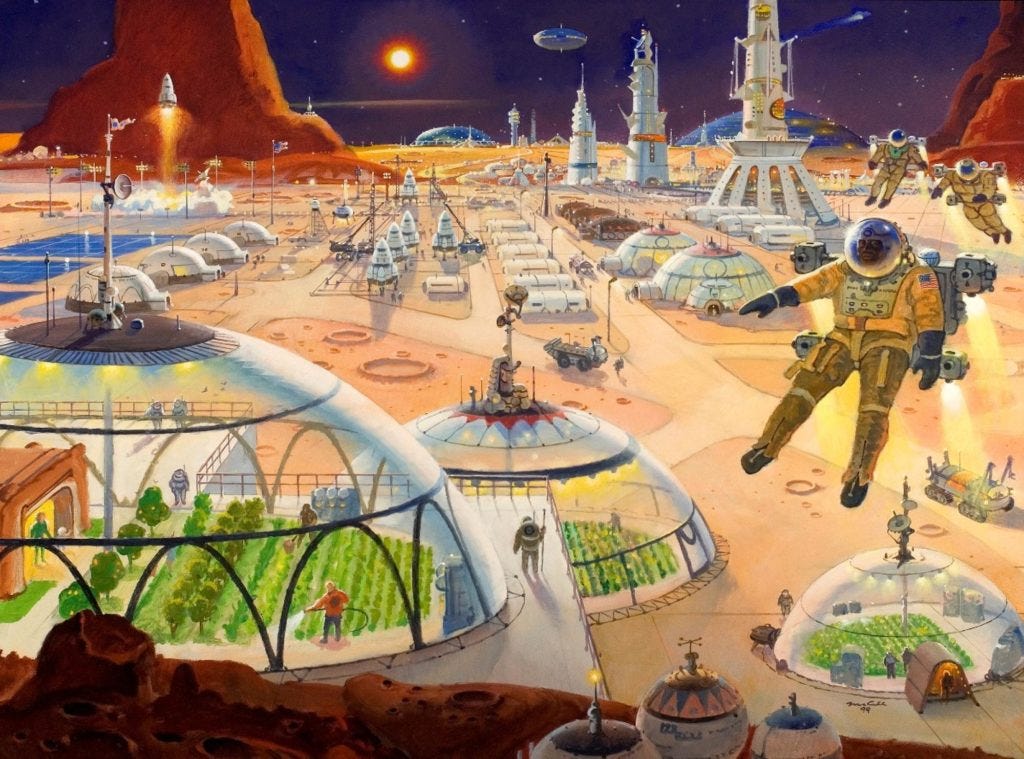
Compare that to a Midjourney render of a Mars city. Or a SpaceX CGI flythrough. Or a Blue Origin promotional video. The AI generating the render doesn’t know whether the pressure vessel is sized correctly for the atmospheric conditions, whether the habitat makes structural sense, or whether the landing pad is oriented correctly relative to prevailing winds. It knows what looks plausible to a human eye trained on prior images of space.
A CGI Mars city looks like a Mars city that has been drawn. It does not look like a Mars city someone has worked out from any engineering sense. And there is nobody standing next to the person who made the render saying, actually, that’s wrong, the atmospheric pressure on Mars is 0.6% of Earth’s and your windows would implode. The engineering check is gone. The ambition floats free from any commitment to actually making anything happen.
(In fact, the closest to a Freeman today that I’ve come across is a Space Architect called Jeffrey Montes, with whom I worked on a project at the Jet Propulsion Laboratory on an asteroid mission. While he is not an “artist” per se, his work is excellent).
Indeed, two years ago, Christie’s auctioned Bonestell and Freeman originals for significant sums. Myself and Alex MacDonald, NASA’s Chief Economist and a consistent agitator on my Substack articles, threw our hats into the ring in an attempt to acquire the works (Alex is a huge collector of space art and went after the Bonestells, while I preferred the Freemans).
The pieces eventually moved from one private collection to another, and sadly to neither Alex’s or mine. But it’s probably worth mentioning that the painting that once said “you, citizen, will go here!” now says “this is worth $180,000 and belongs to a venture capitalist”.
A Bonestell being sold at Christie’s feels like little more than a failed prophecy with a shocking price tag. The future Bonestell depicted sadly never arrived.
The Five Eras
But how did this happen? How did “let’s go to space” end with “let’s pump and dump space stock”?
Think briefly about what Bonestell and Freeman were actually doing in those now-vintage Collier’s magazine pages, because every era of spaceflight since then can be understood as a different answer to the same question:
Are the people explaining the what about us going to space and the people figuring out how to get there still working together, still accountable to each other, still talking to the public as if the public is part of the plan?
For each Space Exploration Era, there is an answer to this.
The Romantic Era (~1903–1957). This includes Tsiolkovsky doing the mathematics of spaceflight by himself in a middle-of-nowhere Russian town, while Goddard was launching tiny rockets from a farm in New Mexico, and Oberth and the German amateurs were testing small rockets on an old ammunition dump outside Berlin. There were no institutions, with almost no money, and yet these people were frequently mocked. I mean, the New York Times published an editorial explaining that rockets couldn’t work in a vacuum. But the researchers kept going because they believed the species was meant to leave Earth, and their belief was strong enough to keep the hope alive. The visionaries and the engineers were the same people; a handful of obsessives who could describe the future and do the math. But a handful of obsessives can’t get to space on their own. They had coherence in their imagination, alas they had no power.
The Heroic Era (1957–1972). Anything from Sputnik to the last Moon landing. This was the era the space industry has been trying to recreate ever since, yet it is the one it least understands. What made it work wasn’t the money and the massive amounts of emergency financing, it was that the visionaries and the engineers that were inside the same institution, reporting to the same leadership, while working towards the same goal on the same deadline. And that goal was… the Moon. The people at NASA who told the public why this was urgent and necessary were down the hall in the same building from the people figuring out how to do it, and both groups could call each other out! Meaning that any too-big promises that couldn’t be engineered got killed immediately, and any engineering that didn’t serve the mission was eventually dropped. That mutual accountability is what produced Apollo.
The Institutional Era (1972–~2004). Here we have the Shuttle, the prime-contractor model, and the slow migration of actual engineering work outwards to Boeing and Lockheed; all the while NASA kept the budgets, the public face, and the speeches. The people explaining why space mattered and the people building the hardware gradually ended up in different organizations with different incentives. So while NASA made the case for space, the contractors built the actually hardware, and because they answered to different bosses, neither group could effectively check the other. The speeches stayed heroic while the engineering started cutting corners (private equity, woo!). The Challenger is the defining moment here — Feynman’s O-ring in a glass of ice water at a press conference, proving in thirty seconds what the agency had spent years not confronting. While the engineers at Morton Thiokol had said the O-rings were a problem, NASA management launched anyway, because the people who knew how the hardware actually worked had lost the ability to overrule the people managing the story, resulting in seven people dying.
The Commercial Era (~2004–2018). Ok, so it deserves credit before I criticize it. SpaceX came along with the correct diagnosis (that the problem holding US spaceflight back was institutional, not technical) and for a while it really put the visionaries and the engineers back in the same room! In Musk’s early years, he could describe the Mars civilization with ferocious intensity on Monday and identify a manufacturing defect in a turbopump on Tuesday; and the people at SpaceX knew it was legit. The ambition was checked by the engineering, and the engineering was motivated by the ambition, and they were accountable to each other because they reported to the same guy. Symbiosis. The first propulsive landing of an orbital booster in December 2015 produced spaceflight innovation hadn’t been felt by the industry since Apollo. I watched the landing, and like many of my colleagues, I felt a new era arrive.
The Grifting Era (~2018–present). Hmmm. What the Commercial Era accidentally proved is that grand visions of space are worth a lot of money on their own. They attract investors, eager engineering grads, media attention, regulatory goodwill, and importantly… the visions are much cheaper to produce than actual rockets. A Mars city render costs less than a working engine just as a founder’s TED talk about the multi-planetary future costs less than a successful orbital launch! You don’t actually need to do the thing, if you can talk about the thing. And once the financial markets figured out the value of the talking-but-not-doing, the business model became obvious: sell the vision, grab the money, and let the engineering fall behind (because we’re never actually going to these places, and by the schmucks figure that out, I’ll have passed the hot potato to someone else!).
The outcome? Well, consider that Virgin Galactic announced suborbital tourism in 2004 and flew Richard Branson to the edge of space in 2021 — seventeen years later! — for thirty seconds of weightlessness in a vehicle that will have no measurable effect on human civilization. Indeed, the SPAC era produced dozens of variations on this theme, most since fallen 80 to 95 percent from their peaks, with the retail investors who bought the vision holding the loss.
And then there’s SpaceX, the visionary company I just praised two paragraphs ago; the one that actually built the rockets, that made you feel something when the booster landed, that for a decade really did have the visionaries and the engineers in the same room checking each other’s work.
Here is what that company looks like now: Musk has quietly deprioritized Mars, the entire stated reason for the company’s existence, at the same time that he announced the company’s IPO, something he had long said he would never do. That IPO was confirmed yesterday, on the same day as the Artemis II launch, at a valuation of a trillion dollars. Meanwhile, NASDAQ has proposed narrowing the holding window for S&P 500 inclusion from 365 days to five, which would mean SpaceX stock gets absorbed into index funds and effectively backstopped by pension money almost immediately after going public.
This matters beyond the obvious obscenity of it, because it means we will probably never find out whether space is a commercially viable enterprise. The question of whether you can build a real business getting things and people off this planet (a question that deserves a serious answer) will be buried under the same toxic retail investment slop that ate meme stocks and crypto. SpaceX’s value will be set by index-fund mechanics and momentum trading, not by whether Starship actually works or whether anyone is willing to pay to go to Mars. The company’s fundamentals will be as irrelevant as its mission statement to regular people. Plus the fact that SpaceX has merged with xAI, folding in X, Musk’s failing social media company, so that the whole enterprise is now a conglomerate whose relationship to getting humans to Mars is, at best, performative. The guy who identified the turbopump defect on Tuesday is now buying social media companies while high on ketamine, valued at a trillion dollars on the strength of a Mars mission he has deprioritized.
This is about as far from the original promise of spaceflight (a public mission, collectively owned, addressed to everyone) as it is possible to get. Even where the engineering is real, and even at SpaceX, the dream has become a financial instrument. The mission is the story you tell to support the valuation.
So yeah… There have certainly been better and more inspirational Space Eras than the one we’re currently trudging through.
Three Visions, None of Them for You
But wait, it gets worse.
Because beyond the actual companies, there’s the small the matter of why.
Space currently has three dominant visions and, sadly, none of them include you. I don’t mean that unkindly, but I do mean it structurally: none of them address an ordinary person as a future participant the way Bonestell’s paintings did, and all three position you as an audience. Back to the Colosseum.
Jeff Bezos has been passionate about space since he was five, and he says so openly, so I don’t doubt it. But I want to ask a question nobody in this industry seems willing to ask: why haven’t your dreams changed? You are one of the wealthiest people in human history, you’ve watched the world transform beyond recognition through the internet, smartphones, genomics, climate change, and AI, and the dream is still the one you had before you could read? Bezos’s vision is an expensive nostalgia project. It is little more than a childhood dream that was never required to update itself, because the person who had it became rich enough to never have to.
Musk is a different and stranger case. His philosophical underpinning is what’s sometimes called TESCREAL, a bundle of tech-optimist philosophies including transhumanism, cosmism, and longtermism… frames humanity as pre-programmed to die unless it escapes Earth. The Mars vision isn’t humanity expanding into the cosmos in any recognizable sense that, I dunno, normal people might think about. It’s quite literally a backup drive (or an in-orbit data center) for civilization, populated eventually by what Musk has suggested could be trillions of AI beings.
This is not a vision that includes you. It’s a vision that replaces you. The people who hold this worldview share something important: they do not particularly like life on Earth, which they consider to be a fragile rock we need to escape before it fails us. Musk’s vision is not about going somewhere, it is about leaving somewhere. You can feel it in the 3d renders, his endless tweeting about how much he hates the world, and his consistent framing of Earth as a lackluster origin point of the human species rather than a civilizational home.
And… Why would you follow someone somewhere they only ended up because they couldn’t stay?
NASA is the third and most sympathetic case because it is actually still trying to do science, and some of that science is extraordinary. The Webb telescope has returned images of the early universe that no human has ever seen (more screensavers, woo!). The planetary science divisions (Voyager, Cassini, Curiosity) do publicly accountable work where the people explaining the mission and the people building the instruments still overlap, still keep each other in check, and still build things that are real.
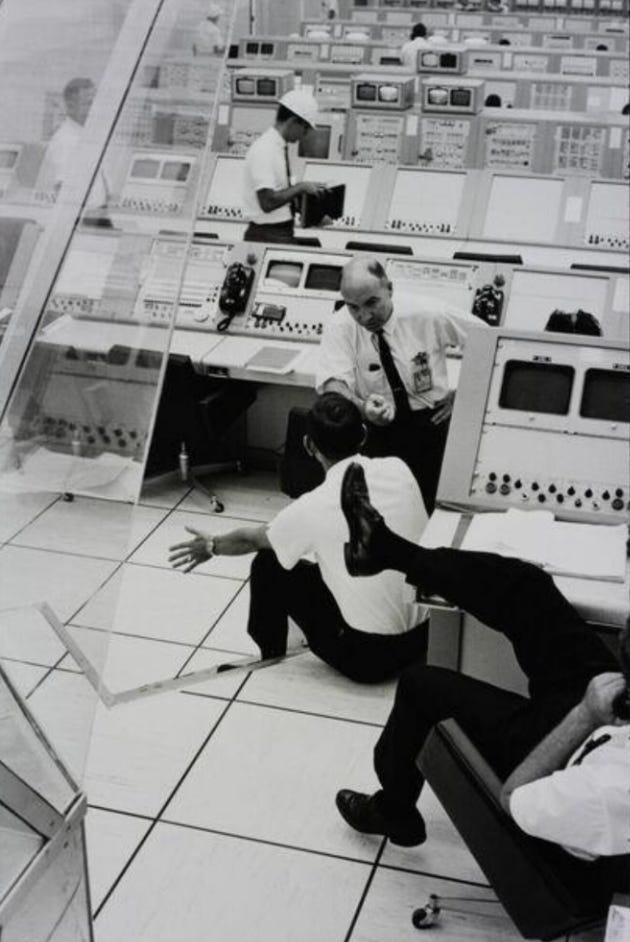
But NASA as a whole has become so disconnected from civilian, everyday life that its missions carry no narrative weight outside the community already invested in its missions.
Artemis II launched last night and will anything in your life will change when it lands? No. People, including me, forget that this wasn’t always the case! I mean Apollo mattered to ordinary Americans and it wasn’t because they were more patriotic or more interested in science in pre-social media days. People often forget that it was because whether the US or the Soviet Union dominated space had real consequences for the kind of world they’d live in. The Cold War was not a marketing campaign; people understood, at a gut level, that the geopolitical contest playing out above their heads would shape the political order they’d inhabit on the ground, in the same way that people in the Middle East right now understand that the outcome of the war around them will determine what their daily lives look like for decades. That’s skin in the game. And nobody watching Artemis II has skin in the game. If it succeeds, your life is the same. If it fails, your life is the same. The mission is disconnected from any contest whose outcome you’d personally feel, and that is the consequence of fifty years of the people who talk about space and the people who build for space drifting into separate worlds.
So sadly, none of these three visions talk to you the way Bonestell’s paintings did. None of them say you will go here, because all of them say watch this content, you tourist. Bonestell could paint from the human vantage point because the space program’s promise was genuinely collective, and that promise has been replaced by something much smaller: this is what extremely rich men are doing with their childhood dreams and their exit philosophies, and you are welcome to watch, and buy stock in the vision, but certainly never complain about it.
And I think the reason the visions are so small despite the vast wealth, despite the engineering talent and the rockets that actually work, is that the people behind them are not very… interesting.
This sounds like a petty observation but I mean it very seriously! Bezos and Musk are men whose imaginative lives were shaped almost entirely by a handful of science fiction novels read before adolescence. Asimov, Heinlein, Tolkien, the usual. And who never moved past them. They are not readers, they are not curious about Earth’s own strangeness, its history, its literature, the depth of what’s already here. They find this planet boring, which is why they want to leave it, and that boredom shows in everything they build. Their visions of space are thin because their experience of life is thin.
You cannot paint a compelling future for humanity if you are not particularly interested in humanity, and you cannot ask people to follow you somewhere new if your entire reason for going is that you found where you were tedious. The collective imagination that made Bonestell’s paintings work; the sense that the future was a shared human project — required people who actually gave a damn about the species as it currently exists, on the planet it currently inhabits. What we have instead are men who read the same five books at twelve and have been cosplaying the protagonists ever since, and the futures they imagine have exactly the depth you’d expect from that.
STEM: Someday They’ll Explain the Mission
The institutional response to the whole “oh no, space is boring!” is STEM outreach: robotics competitions, coding camps, maker spaces, the whole apparatus of yelling at young people that science is exciting, and pointing them at careers in the space industry.
For the obvious reason that I am female, I am constantly asked to do STEM related talks, conferences, mentoring, etc etc. And I always say no for the exact reason that I always really hope nobody on live TV will me about the multi-generational impact of Katy Perry floating in a sky capsule for three minutes: I’m bad at lying and I’m even worse at pretending that any of this matters.
(FWIW, I was actually asked this question about Katy Perry on live TV after they played her long monologue about just how “connected to love” she felt after her quick trip, and was actually speechless. The news anchor had to prompt me twice for a response).
But back to STEM. All it actually does is train people to build rockets and then point them at an industry that has no credible answer to the question of what the rockets are for. STEM produces technically capable people and puts them into organizations whose dominant visions don’t include them, and whose cultural signatures of SPACs, retail investors holding losses, seventeen years of Virgin Galactic promises, is increasingly recognizable to the public as grand language used to move money.
You can train engineers without a mission, but you can’t make them feel the mission means something when no institution is willing to commit to one.
And indeed, when executives and space agency folk realize that STEM isn’t working either, the industry’s next response is always the same: find better storytellers, better photos of a milky way, a more hyped-up marketing plan, and a founder who can communicate.
But better storytelling doesn’t fix this because storytelling isn’t the problem. Consider that the Webb telescope has produced more beautiful and higher pixellated galactic photos than anything Bonestell ever painted, and yet they feel like endlessly boring content that you may find stuck to the roof of your dentist as the drill comes out. So the problem is not what photos to show, it’s that no one is standing behind them with a credible plan, saying: this is what we’re doing, this is how we’ll get there, and importantly that you are part of it.
Bonestell’s paintings were emotionally captivating because they were accurate, and the accuracy was verifiable because someone was standing right next to them. Freeman, von Braun, eventually NASA itself saying: yes, this is real, here’s the engineering, here’s the timeline. That required the people with the ambition and the people with the expertise to be in the same room, answerable to each other and to the public. And when that arrangement exists the storytelling means something. When it doesn’t, you get content.
The question that the industry is concerned with now is not how to to tell a better story but how to rebuild the arrangement between meaning and vision, with real skin in the game, where the story and the engineering are accountable to each other — where the people explaining why we should go and the people figuring out how to get there work together closely enough that neither can bullshit, and both of them talk to ordinary people as future participants rather than spectators.
Which is to say, space does not have a marketing and communications problem but a much harder political and institutional one. Which is exactly the kind of problem that gets left behind when the people who own the narrative of space include a man who has had the same dream since he was five and a man whose dream involves you not existing, amidst an agency whose budget is being cut by the administration that briefly congratulated its astronauts last night before moving on to the war.
Very well written and poignant take.
I personally grapple with the dichotomy of space as an asset class instead of a human mission.
I read your main point as participation > spectating. In art, it's a POV composition bringing a viewer in, with an original artist's POV as the idea itself, all next to an engineering concept.
It was interesting you bring up Chesley Bonestell in particular. I think what made him extra special in his time period is his ability to imagine landscapes that we didn't even imagine having the technology to show us yet. We were at the edge of even KNOWING at all what the landscape looked like (beyond what he could calculate with the position of the light etc.) And most of them were painted before the moon landing. I think his paintings (and many others) are the WHY that inspired the people creating the technology-- as they strived for humanity get that view personally.
And, sidebar, I think it's particularly cool he was also involved in the Golden Gate bridge, a landmark here at home.
Re: "both of them talk to ordinary people as future participants rather than spectators":
Today, we have real photos from the Moon, Mars, Venus. We can generally extrapolate what others might look like (and unfortunately AI will churn that out endlessly), so the romanticism of "a persons idea and point of view" for the place alone is gone.
You probably won't find many casual fans of fine art nowadays. Heck, even printed magazines are rare. What remains dominant in the culture now I think are interesting interpersonal stories set in space, e.g. For All Mankind, Project Hail Mary, IMAX documentaries (A Beautiful Planet, Deep Sky) etc. These do get us to care because the story is told from the point of view of regular people we can understand, living human emotions with space as an interesting setting or goal.
Like you said, I can understand a feeling the James Webb turns out pointless beautiful images because CONTEXT matters. I saw these images in an IMAX theatre. I felt dwarfed and small, and the images gaves me an incredible sense of awe and smallness at the universe. When the regular person sees it on their phone... I can understand that feeling. Some people who help make that better are ex-scientist and engineer space communicators who give it some context.
Re: "This is about as far from the original promise of spaceflight (a public mission, collectively owned, addressed to everyone) as it is possible to get."
I feel MoonDAO is an interesting example of steps towards changing the core framework by involving everyday people in voting on which projects get funded - https://moondao.com/. Although again it is veiled in the dichotomy of being built on crypto, which is not necessarily as accessible as the community dreams it to be.
Anyway. Love this conversation you are starting. Kudos. I might write more thoughts later.
I agree that it will be sad to see investor slop overrun space discourse but this article seems to miss a burning optimism felt by those who grew up in the institutional era and were very pessimistic about spaceflight 10-15 years ago
Eg this NASA scientist is pretty excited:
https://www.youtube.com/watch?v=Li7PsYiwxVc&t