


TL;DR: What if one really good economy and one really bad economy look kind of the same under the hood? Specifically, what does this mean about how we decide on the definition of a good versus bad economy? And are we even measuring the right thing?
At the moment my research comprises of both Irish and Pakistani economic competitiveness. Two very different projects, for two very different reasons.
And last night, I found myself looking closely at the privatization of Pakistan International Airlines (a very exciting Christmas activity, I know). I have a soft spot for airlines, probably because they are unusually data-rich, brutally transparent, and incredibly useful for economic diagnostics (I mean, they sit at the intersection of infrastructure, regulation, labor markets, energy pricing, capital costs, currency stability, competition policy…)
An airline cannot hide from an economy’s underlying coordination failures for very long, and so if you want to understand a country’s economy quickly, look at the airlines that operate within it.

Anyway, what struck me as I tried to benchmark Pakistan’s airline industry against its other domestic industries (again, I should probably have gone to the pub instead), are two things that I have ruminated on all last night.
The first is that Pakistan’s economy does extraordinarily well in a couple of different industries vis-à-vis its competitors, and horrendously badly in most other ways (and I will be writing about some of these former industries in more detail soon). This contradiction, from an economic development perspective, is fascinating of course.
Secondly, which I had not thought of before, is this:
Pakistan produces elite lawyers, engineers, doctors, financiers, and administrators who perform at the highest levels globally! Why then is there no translation of this talent into homegrown industrial success across most industries?
The more I dug into the structure of this topic last night, the more I realized that the shape of this paradox closely resembles the shape of a nearly identical research question of mine in an entirely different economy:
Why is Ireland, home to elite talent and global multinationals, incapable of creating indigenously scaled enterprises of its own?
It turns out that the Pakistani and the Irish economy have more in common than may meet the eye!
What is “Good” and What is “Bad”?
Let’s zoom out and get philosophical.
We like to think we know what economic success and failure look like.
Success, for example, looks like Ireland: high GDP, spectacular productivity figures, a magnet for multinational capital, and an educated, English-speaking workforce that exports pharmaceuticals and software licences to the rest of the world.
And so clearly, by contrast, we can investigate failure by looking toward Pakistan: chronic crises, a permanent residence in IMF bailout lines, weak exports, and a level of political instability rarely seen in large, functioning economies.
These categories of “SUCCESS” or “FAILURE” feel so obvious to most economists that they are never taken for anything other than granted. One is an economic miracle, and the other is a mess. Simple!
Except that this framing relies almost entirely on headline indicators of metrics such as GDP statistics, tax receipts, and export tables. Beneath the surface, however, both economies share a surprisingly similar structural feature that our usual success-versus-failure vocabulary cannot really know what to do with it.
This is me trying to say, may I add, that Pakistan is “like” Ireland, or that Ireland is secretly failing. I mean, Ireland is rich, and Pakistan is not. Also allow me to state that Ireland’s economic achievements are real, just as Pakistan’s economic problems are real. So I’m not going to argue here that these economies are lying about what they are: comparably good and comparably bad.
But the fact that similar economic structures can be labeled as opposites of each other has made me think that:
Perhaps these polar opposite economies have a shared vulnerability which is completely obscured by the way we classify economies in the first place.
And that vulnerability has to do, very specifically, with how “elite capability” (otherwise known as talent) is embedded (or not embedded) within local economic systems.
Consider that in both countries, elite human capital is world-leading. Lawyers, engineers, financiers, doctors, and technologists that are heading up global corporations have come from both Ireland and Pakistan, and both places produce people who can compete anywhere, and often do. Indeed, I’ve met several of both types in the United States doing impressive things at the top of their fields.
Yet in both cases, that elite competence only weakly reorganizes the domestic economy beneath it. By which I mean, in less economic parlance, that extraordinary talent does not produce a correspondingly extraordinary growth engine at home. And this is weird. Because according to Economics™, this should happen.
In both cases, elite talent plays a stabilizing role in similar ways:
Talent keeps money flowing in and out of the respective country,
It makes the country look credible from the outside,
It produces headline outcomes that feel either miraculous (Ireland) or, at the very least, survivable (Pakistan).
But underneath that surface, as one discovers with some poking around as I did, the same problem shows up for both. Namely, that the economy doesn’t build a deep bench of strong, growing domestic companies. Skills don’t spread as widely as we expect. The “middle”, where most of the economy lives in SMEs and national enterprises, stays thin.
Can Ireland really be compared to Pakistan, economically? Well… maybe.
But this creates a larger dissonance, because what we see is that of these two similar structures, one economy is celebrated as a triumph of globalization, while the other is treated as a warning sign.
When Brilliant People Don’t Build Brilliant Economies
There is a fairly standard economic story about how development is supposed to work, and elite human capital sits right at the center of it. In both of the main ways that economists think an economy grows (neoclassical growth and more institutional variants, for those who care), skills that begin as elite skills are not meant to remain bottled at the top with the elite, but impact the whole economy.
Economics tells us that talent raises productivity directly, yes, but it also does something more important: it is supposed to diffuse downwards over time, making everything else in the system more productive and more talented, too.
We are supposed to see this when educated workers move between firms, thus spreading “good” managerial practices like bees with pollen, and in turn reorganizing supply chains such that productivity gains propagate outwards through the economy. In other words, the middle economy thickens.
This is the often undisclosed assumption behind a great deal of economic policy, even when it isn’t stated explicitly:
Invest in education!
Liberalize markets!
Integrate into global trade and capital flows!
Let prices and competition do their work!
In this way, talent doesn’t just earn higher wages for the people at the top; it also becomes a transmission mechanism to make the whole economy greater, and thus make everybody richer! Skills flow into firms, firms scale, and the economy upgrades from within, etc etc.
(Again, for those who care, this is the endogenous growth theory of economic development, for which there are few-to-no generalizable economic models yet).
Indeed, you can see this unproven economic logic embed itself in policy everywhere, as it underpins:
the emphasis on schooling in development economics,
the blind faith in openness and globalization,
the expectation that exposure to multinational firms or global markets will automatically generate spillovers.
Elite capability is treated as the seed from which mass productivity grows.
And in many cases, that story (kind of) holds. Over time, you often see larger firms emerge, managerial depth increase, and best practices migrate from the frontier to the rest of the economy.
But what if that transmission mechanism breaks?
What if elite capability does not diffuse through the domestic economy in the way these frameworks implicitly assume? What if it raises some indicators (like GDP, average productivity, credibility) but doesn’t impact what actually happens in the local economy?
You see, the problem is that this economic assumption often fails in practice. And this is true of both Ireland and Pakistan.
Remember the neoliberal con of trickle-down economics? Which assumes that if you remove competition and allow monopolization, the rich will get richer, and wealth will (somehow??) naturally make its way downward, to the rest of us?
Well, what I’m discussing now is the skills and knowledge version of that economic theory.
Specifically, both rely on the same leap of faith (which has never been defined): that concentration will eventually produce diffusion throughout the economy, without needing strong structures to force it down.
But what we have actually seen, is that when those structures are weak or absent, elite talent does not spread. It clusters in various industries, and then exits. It encloses itself inside firms or sectors that are disconnected from the rest of the economy (I’m talking about Wall Street versus Main Street, of course). And thus, productivity only rises where that talent sits, barely moving elsewhere.
The headline numbers improve, yes, but the underlying system remains shitty and thin and inconsequential.
This is the anomaly I have discovered in these two very different economies, and it is precisely the kind of anomaly that standard success-and-failure narratives tend to miss.
Pakistan: Supposedly Bad!
Pakistan is usually described as a failed or failing economy, for obvious reasons:
Repeated balance-of-payments crises
Weak and undiversified exports
Poor infrastructure
Persistent political instability.
In growth accounting terms, its “productivity growth is low and volatile”; in trade models, Pakistan never escapes the “low-complexity end of the export basket” (meaning that it never figures out how to do higher value manufacturing, like China has figured out).
From this vantage point, the diagnosis seems straightforward: Pakistan = bad economy.
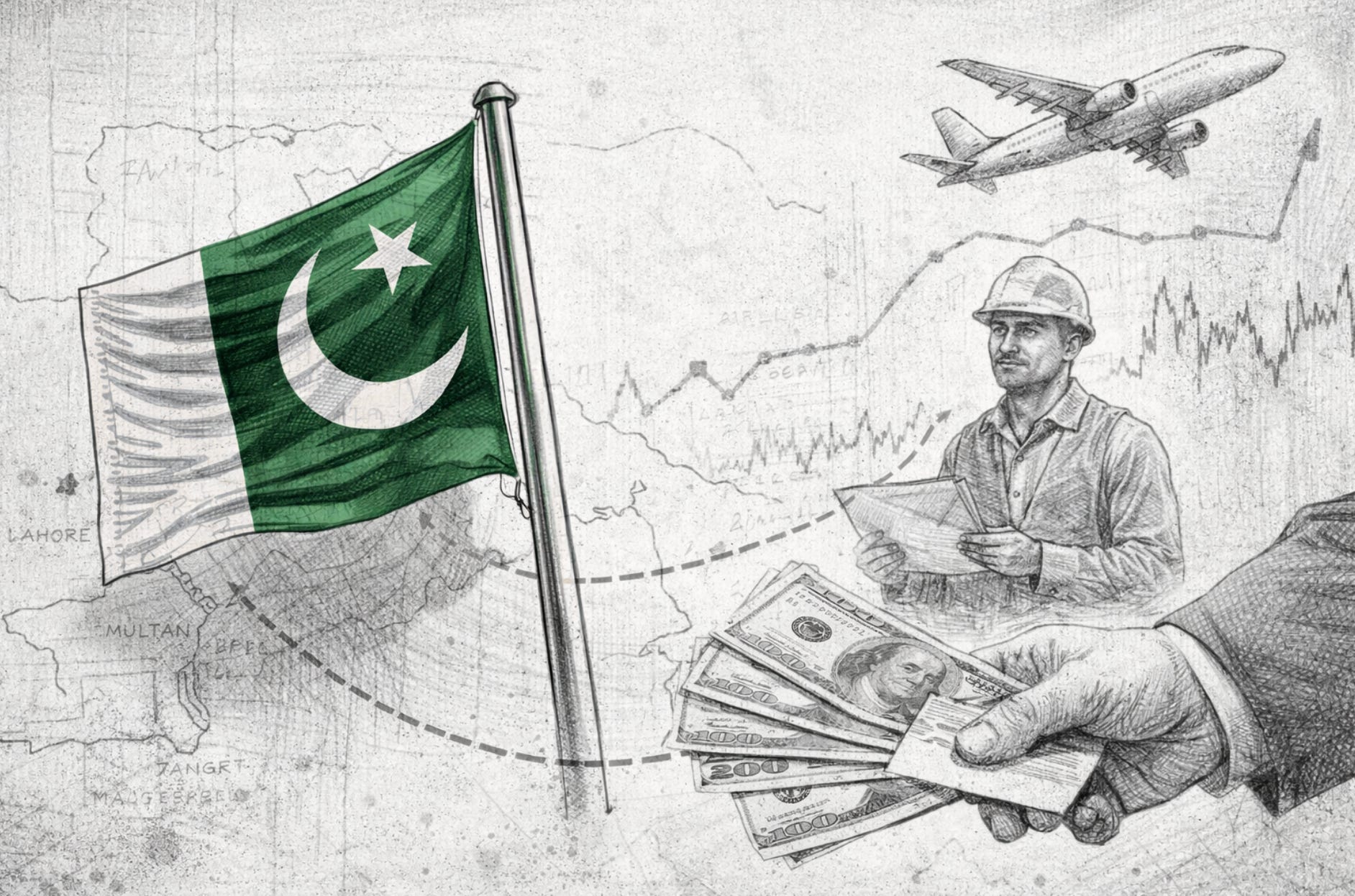
However....
Despite decades of macroeconomic stress, Pakistan has avoided the pretty bad outcomes that economists consistently predict would happen to an economy in this condition.
Consider that:
It has not experienced hyperinflation (this is the very thing I’m researching right now!)
Its banking system has not imploded.
The currency has depreciated, but it has not entered a self-reinforcing collapse seen in places like Argentina or Lebanon.
Payments continue to clear…
… because remittances continue to arrive.
A large and increasingly skilled diaspora remains financially and institutionally connected to the domestic economy.
From a macroeconomic and monetary perspective, this is simply fascinating.
Pakistan as an economy occupies a strange middle ground with very few others like it: it has chronic constraints on its economy, but it seems to somehow always… survive?
This is not the definition of success, to be clear! But it is also not failure in the way it should be. Especially when you consider that typically, economies tend to do one of two things: (1) become successful via transforming its middle economy; (2) collapse.
Pakistan does neither. It has, somehow, created stability without transformation. And… this is a hard thing to do! A useful analogy would be trying to ride a bike very slowly: you have to keep moving just enough to stay balanced, but not enough to actually get anywhere.
What it is doing by staying in a stable failure is essentially harder than actually growing!
So why is Pakistan not growing, if it has this so-called elite talent that is globally competitive? Why does the “talent diffusion” not create homegrown economic growth in Pakistan, instead of other places?
Perhaps the reason lies exactly in how this talent is allocated, not whether it exists or not.
As I’ve said, Pakistan indeed produces elite talent at internationally competitive levels, many of whom perform exceptionally well abroad. But that talent either leaves the domestic economy because of migration, or is absorbed into narrow sectors that do not scale and as such don’t generate widespread productivity spillovers.
In short, Pakistan is missing a way to move talent from the top of its economy through to the middle. Sure, elite capability stabilizes the economy, but it does so in very specific, limited ways: Pakistan’s most capable people either leave, or work in sectors that primarily manage Pakistan’s relationship with the outside world, not its internal productive capacity.
When they leave, for example, they send money home. Those remittances bring in foreign currency that supports local consumption and props up the banking system. This is what keep the country solvent during repeated crises.
But when this talent does actually stay, many work on the Islamabad equivalent of Wall Street sectors (finance, law, administration, consultancy) that reinforce economic scarcity in a niche, rather than expand production.
In both cases, elite talent acts as little other than a shock absorber, helping the economy cope during its many crises, rather than as a capacity enabler.
Thus, what it does not do is build a large, growing class of local companies that scale, train large numbers of people, and pass skills around in honeybee fashion. It does not thicken supply chains or turn small successes into widespread competence. (However there are a couple of examples, the focus of my research, that directly disprove this!).
Hence, the talent stabilizes the system from the outside, instead of reorganizing it from within. Meaning that Pakistan survives and muddles through (barely), but the economy never quite upgrades itself.
Going back to the bike riding analogy; elite talent is what is currently keeping the bike upright, but transmission is the missing part that would let it pick up speed.
The result? An economy that survives repeated shocks without ever quite changing its underlying structure.
Ireland: Supposedly Good!
Now for a pivot!
Ireland is framed as everything Pakistan is not. It is rich, economically and politically stable, highly productive, and deeply integrated into global financial and trading markets.
In economic terms, Ireland is a case study in how economic openness, education, and credibility can be turned into long-term prosperity. I mean, its GDP figures are so spectacular that it is often removed from EU datasets for fear of totally distorting the median. And its measured labor productivity is among the highest in the world! On paper, the country resembles something that Pakistan could never reach.
But when you look more closely at how those outcomes are created, that good-versus-bad economy label becomes less binary.
In short, Ireland’s productivity is what I’m going to call heavily “enclave-based”; in which a relatively small number of multinational firms account for a disproportionate share of output, exports, and tax receipts. And yes, these (often tech) firms are deeply embedded in global value chains, all of which employ highly skilled workers, and have performance that eats everything else in the local economy alive.
So from the standpoint of standard trade and growth models, this should generate powerful “spillovers”, meaning that the multinationals are supposed to transfer knowledge, upgrade suppliers, train managers, and diffuse best practices into the domestic economy. Again, the whole diffusion thing.
And some of this does happen. But… the tiny magnitude of this diffusion, I would argue, is questionable, and is seldom discussed (mostly, I believe, because it would detract from the otherwise miraculous story being told about the economy).

You see, it turns out that indigenous firms, on average, are stuck. They are smaller, less productive, and also less likely to scale into global competitors. In other words, the middle economy is much thinner than headline numbers suggest; which is not a critique of Ireland’s achievements, per se, given that these achievements have delivered high incomes and fiscal capacity that wasn’t previously thought possible! (Ireland got ridiculously rich, and ridiculously quickly).
But it is indeed an observation about where productivity is created. Because like Pakistan, Ireland’s top global talent never quite diffuses through to the local SMEs, with much of Ireland’s elite capability being deeply embedded within global firms that happen to operate on Irish soil, yes, but with little to no transmission.
Very specifically to Ireland, which could be considered an administrative tax haven since much of this elite activity is governed elsewhere (strategically, legally, and financially), the stabilizing benefits of such taxes do not automatically translate into deep domestic upgrading.
While the benefits of this tax regime are obvious — that indigenous companies are protected from collapse by the broader stability of the economy — they are not necessarily pulled upward by it. Irish skills thus remain concentrated within multinational organizations and decision-making power remains external.
(NOTE: There is also some cultural dissonance here, which Ireland shares with other post-imperial, English-speaking economies. You see for centuries, economic advancement in Ireland meant closer proximity to its main external authority: London as the site of power and legitimacy; whereas Dublin was merely an operational outpost. This pattern did not disappear with Irish independence, it was simply turned into a corporate dependence instead of a political one, and moved to Delaware.)
And so in this way, Ireland is the mirror image of Pakistan.
Pakistan stabilizes its economy by exporting people. Ireland stabilizes its economy by importing firms. One sends talent abroad and receives money back; the other receives global capital though tax at home. The mechanisms are different, yes, but the function is the same. Both rely on external anchors as a workaround for their most binding constraints.
And in both cases, those anchors work of course. They smooth economic volatility by supporting consumption and therefore public finances, while preventing crises from moving the economy into total collapse. Crucially, this is about buying time while making the economy seem credible — at least from the outside.
And unfortunately, precisely because these anchors work so well, they remove the internal incentives of the system to become better!
Because when external inflows (whether through Pakistani remittances or Irish multinational balance sheets) repeatedly suck up the cost of weak domestic improvements, the pressure to actually build a self-sustaining system disappears.
And what you see emerge in theory is what we can see happening in reality. That firms are able to survive without scaling, which means that skills cluster inwards but don’t spreading outwards, allowing the economy to functions, but never deepening. This is the danger zone! And where real vulnerabilities lie, because growth eventually becomes reliant on decisions that are made elsewhere, and those out-of-your-control decisions are no longer as stable as they once seemed.
For Pakistan, the stabilizer has always been its population of Pakistani people, however the historical migration of labor and the resulting remittances are now under growing pressure from the outside. Because unless you’ve spent the last two years living under a rock, you’ll know that countries like the UK that have long absorbed Pakistani labor are tightening immigration rules amidst a growing nationalistic sentiment, which is a direct response to political backlash amidst slower economic growth!
Extrapolating this forward, then: if fewer workers can leave Pakistan, its domestic economic shock absorber will weaken, and there isn’t enough of a local middle economy to absorb future (inevitable) crises.
Ireland’s exposure is different, but make no mistake — it is just as serious. Its stabilizer equivalent is multinational capital which is routed through a global system that is now fragmenting. Global tax harmonization policies (something I worked on at MIT), geopolitical shenanigans, and re-shoring/ on-shoring/ friend-shoring pressures are forcing multinationals to rethink hard where they book profits and locate high-value activity. As globalization becomes undone, so does the reliability of Ireland’s external and uncontrolled economic anchor.
And in both cases, the problem is not that these strategies were irrational, because they weren’t, evenly if they are loved or loathed. They worked for a long time! But for both, they worked precisely because they leaned on an external world that is now changing. And when growth depends on migration policy in foreign capitals or tax rules negotiated by governments headed up by the MAGA movement, local firms are not really steering the economy’s future, are they?
Moreover, because elite capability never fully reorganized the middle of the economy, there is little-to-no buffer when those external conditions change. So talent remains staunchly at the top, but it does not form a broad, self-generating and secure base underneath. Skills stay clustered and companies stay small, which is the shared fragility of exposure that both Ireland and Pakistan now face head-on as the global environment they relied on begins to fracture.
So the economic puzzle becomes something slightly more complex than “success versus failure”, as Pakistan and Ireland represent two versions of a nearly identical structural condition; of economies that have learned how to stabilize themselves without fully teaching their talent how to reproduce growth at home.
And yet, while one is punished for it, the other is praised.
Exporting People vs Importing Firms
Why do we call one of these economies a miraculous endeavor and the other a hot mess? Why is Ireland presented as a case study in successful globalization while Pakistan appears as a cautionary tale of reform fatigue?
The answer, I suspect, lies less in deep disagreement about economics than in which parts of economic theory we choose to use.
Most international comparisons reward outcomes that are easy to observe and straightforward to aggregate. What we can measure is what we, ultimately, fix:
Income levels
GDP per capita
Measured productivity
Fiscal capacity.
In standard accounting, and most simply, these variables summarize how much output an economy produces relative to its inputs. (Meanwhile, in the world of balance-sheets, they tell us whether a country can actually pay its own bills).
And against these metrics, Ireland performs spectacularly whereas Pakistan… does not.
But these very frameworks pay much less attention to how those metrics are actually achieved. Yes, they might look at overall productivity numbers, but they do not look at who is productive and who, importantly, isn’t. They assume that skills will naturally spread throughout the economy — by magic? — instead of asking whether that spread actually ever happens in real life. And importantly they tend to ignore who owns and controls the economy, making it seem like the existence of talent and capital in a country is enough, rather than what you are able to do with it.
This is why Ireland clears the scoreboard so cleanly.
Multinational firms operating in Ireland generate extremely high measured productivity, dominating global exports while contributing overwhelmingly to taxed income. In the national accounts, the multinationals’ output counts as Irish output, which obviously then makes the economy looks deeply successful.
Pakistan, by contrast, never generates comparable aggregate data because its elite human capital stabilizes the economy through remittances that are created overseas, rather than exports; which in turn eases its economic constraints without ever needing to raise productivity inside Pakistan itself. The official numbers show then that growth remains low and that local companies rarely upgrade themselves, while exports are stuck in unwanted, low-value categories (hint: not semiconductors or AI).
On paper, this looks like failure. Yet structurally, both economies rely on external anchors rather than internal compounding of local resources.
So Ireland clears the scoreboard, while Pakistan does not. But… perhaps that economic “fact” tells us far more about our scorekeeping than about the long-term strength of either system?
Why do we have so little curiosity about the rates of change of a system, and of how value is moved through the economy over time? Or indeed what that direction of travel even is! Because yes, of course we measure how “big” an economy is, but we don’t measure how much of that economy is learning and improving. In the same way, we track productivity data but not whether that productivity is spreading to new industries or concentrating in silos. And sure, we obsess over fixed levels that are rather arbitrary (income today, output today, tax receipts today) while we ignore whether the underlying economy is becoming more autonomous or more fragile over time.
In other words, we measure where economies are, not what they are becoming.
Part of the reason is practical, obviously, since static levels are easier to observe than moving processes. And I’ve discussed many times before that most economic models don’t possess the mathematical rigor to measure anything more complex than a singular level.
So yes, it’s far simpler to rank countries by GDP than to figure out what the quality of the local talent is, and where it exists, or whether it is actually turning into durable firms; essentially, if yesterday’s success is capable of making tomorrow’s growth happen. Those questions are inconvenient, hard to calculate, and infinitely harder to fit into a league table.
The similarities between Ireland and Pakistan show this exact limit of our economic modeling approach beautifully, as both economies show that elite capability can coexist with the local economy even if it spreads weakly; but both also suggest that openness to global markets or labor mobility (the things we say we want most!) don’t necessarily reorganize domestic capabilities into something more meaningful. Which suggests that stability (whether through remittances or multinational taxes) is not the same thing as economic transformation.
But there is also something more… psychological… let’s say, at work.
Levels feel more concrete and they give us what processes don’t; a sort of sense that a country has definitely “made it” (Ireland) or definitively hasn’t (Pakistan). Rates of change, au contraire, force us to bask in our own uncertainty by asking whether today’s success is even really success, and whether today’s failure might continue beyond tomorrow. This is scary for the human mind!
The implication of this, surely, is that we may be rewarding economies that look good for external validation rather than for being resilient, because we praise the high scores on the static metrics, even if their growth is externally dependent. Just as we dismiss the countries that fail to pass the arbitrary tests created by such scoreboards, even when they have built remarkable mechanisms for survival that get no acknowledgement.
But since “how rich” an economy is today doesn’t tell us much about the future, perhaps a better question is whether a country has built the capacity to turn talent into a broad, self-generating growth engine that can create prosperity for tomorrow.
Numbers That Lie?
Alright, I wanna zoom out once more.
Much of modern thinking about economic development (i.e. how economies grow and shrink), and especially about industrial strategy, rests on the following paradox:
On the one hand, there is increasing agreement that the markets alone do not reliably produce structural transformation.
On the other, there is a lot of skepticism that industrial strategy actually “works,” largely because the mathematical evidence appears thin, inconsistent, or highly context-specific (again, we don’t have the models!)
And the Ireland–Pakistan comparison helps explain why that evidence base is so unsatisfying!
Industrial strategy is, at its core, about this diffusion, this transmission. It is an attempt to build an economy that turns talent → firms, firms → industries, and industries → durable advantage. (This durable advantage, by the way, is called competitiveness).
Industrial strategy thus operates on processes rather than endpoints:
Learning-by-doing,
firm scaling,
supply-chain formation,
capability diffusion,
ownership anchoring.
These, as it happens, are slow, cumulative dynamics that rarely show up clearly in GDP figures or short-run productivity statistics. Yet most evaluations of industrial strategy ask the wrong questions. They look for immediate changes in output, export shares, or headline productivity. When those don’t appear quickly (or appear only in narrow industries), the conclusion is that industrial policy failed.
What gets missed, however, is whether the underlying transmission mechanisms strengthened at all, and Ireland and Pakistan both illustrate this blind spot brilliantly!
In Pakistan, repeated efforts to reform the economy are dismissed as failures because they do not raise measured productivity or export complexity. In Ireland, the absence of indigenous scaling is nearly always overlooked because multinational performance inflates the metrics we’ve just discussed. In both cases, the numbers don’t tell us even half of the story; in fact they only tell us whether stabilizers worked (they have), not whether transformation can or has occurred (we don’t know).
This helps explain why industrial strategy so often appears ineffective in the data. It is not necessarily because industrial strategy policies (like coordination, sequencing, or targeted intervention) are futile. Actually, it is because we continue to judge them using indicators designed to measure levels, not learning. Put another way, we reward outcomes that look impressive from afar while penalizing processes that are still under construction. I.e., Ireland = good, Pakistan = bad.
The resulting paradox is that economies that rely on external anchors (like remittances and multinational capital) score well on conventional metrics only if those anchors inflate GDP, exports, or fiscal capacity. Whereas economies that attempt to build internal capability but do not yet clear those thresholds look unsuccessful, even if they are actually strengthening the very mechanisms that make long-run growth possible.
This suggests that the problem is not simply that understanding development or industrial strategy lacks evidence; it is that we have been looking for evidence in the wrong places. If development is defined as the ability to reproduce growth internally, then industrial strategy should be evaluated by whether it strengthens transmission of talent and productivity, not whether it immediately boosts headline numbers.
Seen this way, the failure of industrial strategy is actually not a mathematical fact (which is the running assumption!) but a measurement problem.
This has consequences, and huge ones. One that my pal William was working on at the World Bank. These sorts of measurement shenanigans encourages governments to chase headline gains rather than internal capability. Of course, it also rewards economies that look good today rather than those that are building for the future. And it leaves us chronically surprised when systems that scored well on every dashboard turn out to be brittle, while those written off as failures continue to endure. (I already wrote about how this is indeed the case for China!).
Perhaps the deeper mistake in all of this is that “Capital-E” Economists assume that economic development shows up cleanly in GDP tables, productivity rankings, and league charts. In reality, development often shows up in unexpected places, unevenly, and is incredibly hard to see while it is happening, or for a very long time. Real development makes itself known in data only through the painstakingly slow accumulation of industrial competence, by way of firms that learn how to scale, in supply chains that deepen, and (importantly!) through decisions that begin to be made locally rather than elsewhere.
Once more for those at the back: Development shows up in processes, not metrics.
But until economists learn how to measure that, and see economies not just as they are in a static data point, but as they are becoming, we will keep mislabeling against-the-odds economic survival as an economic failure, and continue mistaking stabilization for a miraculous success.
There's the (now) classic Why the Emperor's New Clothes Are Not Made in Colombia : A Case Study in Latin American and East Asian Manufactured Exports. David Morawetz. Oxford, 1981.
A lot of related development economics literature picks up on your themes. Small (domestic) markets. Education (and status) systems that direct the ambitious to become lawyers or go into finance. Lack of appropriate infrastructure. On and on. Or for the US, stuff by Bill Lazonick on financialization, or the network of people in the Industry Studies Association.
But that sort of stuff isn't central in the most recent vintage of graduate development economics texts (well, I last scanned those ca 2015), they're all about applied micro empirical studies, if you don't have a regression, you don't get published.
Now in my experience many of the really good researchers may turn out empirical work but have accumulated a lot of wisdom along the way. Of course, I label as good someone who exhibits wisdom, others are hacks who apply without reflection standard techniques (more publishable with the latest regression techniques over an exhibition of familiarity with institutions and context).
A country can limp along for a long time. What's underrated is how much energy that takes. The whole system is spending its capacity just staying upright, with nothing left to move forward. Pakistan must be exhausted.