


TL;DR: Our economy is a sick crackhead kept alive by free money, bad policy, and a markets coordination mechanism that died in 2008 but was never replaced. Trump is trying to fix it with tariffs. Biden tried to fix it with subsidies and woke slogans. Both missed the point entirely.
This piece is part of a series that has been shared more times than I could have imagined! Here’s the full series:
Part 1: Identifying the real problem of our crackhead economy
Part 2: A framework for fixing our crackhead economy
Part 3: How to actually implement such a framework.
A couple of weeks ago in a piece about an OpenAI bailout, I argued that the global economy now runs on a permanent drip of US central-bank liquidity. I wrote that we’ve built a form of capitalism that is completely addicted to the crack cocaine of free money, and that the 2008 rescue never ended; it simply became structural. That every downturn since has been met with the same reflex of stabilizing prices, expanding balance sheets, and postponing the reckoning.
After reading the piece, Alex MacDonald, former NASA Chief Economist, texted me asking:
So, what’s the solution?
Great question! Well, this is where it gets interesting.
It’s tempting to create a long list of policy reforms that could help rewire the nervous system of our addicted economy (new lending rules, fiscal buffers, macro-prudential reforms), but that would be premature.
Because the issue here is not that we don’t have a long list of policies (as you’ll see in this piece), but that we’ve really fucking badly misunderstood the problem for the last fifteen+ years!
So before we can prescribe anything (which I will in Part II), we need to understand what actually broke first.
Bear with me, because this is the part nobody ever talks about. It’s the boring-sounding but actually fascinating and crucial question that is actually behind every crisis we see today:
How did we get here, and where even is “here”?

What Exactly Are We Fixing?
To fix the economy, we have to realize that we cannot fix “the economy” in the abstract with a vague set of policies that are nothing more than politically appetizing soundbites. Rather, we need to define the economy as a collection of complex and interconnected parts, each with their own solutions.
But today, I’m going to scale the number of those parts waaay back, and simplify it as much as we can without losing any meaning in the process.
So here’s a clear way to see it. Every political economy (the thing we’re trying to fix) can be thought of as having two moving parts:
A coordination mechanism:
This is the part of the economy that decides who produces what, using what resources, at what scale, and under which constraints?
It’s the organizational infrastructure that makes production possible: prices, standards, contracts, zoning rules, permitting, procurement, credit conditions, and the institutions that enforce them. When people say “the economy,” they’re usually talking about this layer, even if they don’t know it.
2. A distribution logic.
This is the moral lens that decides who the system is for. Who gets the surplus? Who eats the losses? Whose failure triggers government rescues, and how does failure be disciplined? Do we cushion households or banks? Do we socialize risk at the bottom (universal insurance) or at the top (guarantees for firms)?
Distribution is not an afterthought. It is the actual set of mechanisms that makes coordination legitimate. Most importantly, it is the story that convinces people the machine is worth belonging to!
Thus, you can think broadly of any economic system as a combination of mechanics + morals to various degrees.
For example, consider through this lens some economic systems that we’re already quite familiar with:
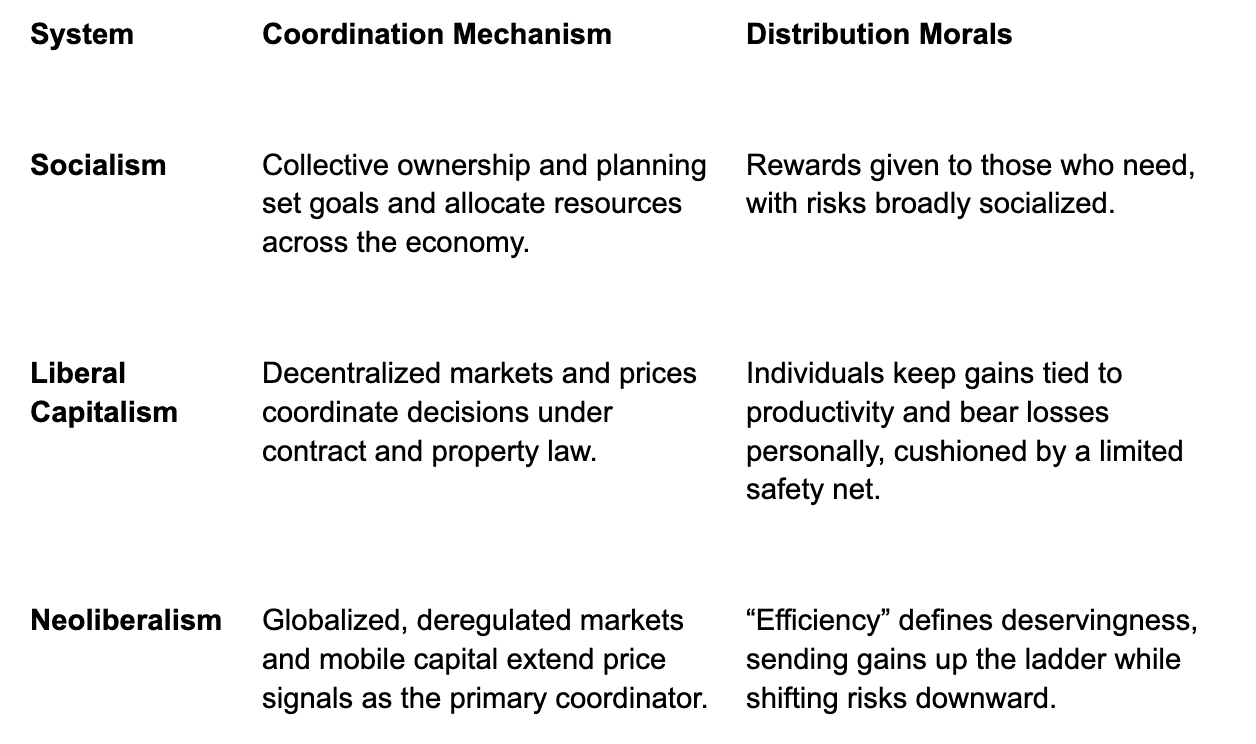
As you can see from the table, these economic frameworks are combinations of both (1) coordination and (2) distribution mechanisms. And these combinations have obvious pros and cons!
Liberal capitalism lets markets set prices quickly (think supply and demand) and innovation happens through competition, but this model tends to under-build social safety nets and amplifies inequality, with boom–bust cycles in the capital markets.
Neoliberal capitalism scales markets globally and allocates capital ridiculously fast, however it financializes the real economy (hence you can’t buy a home) and concentrates gains at the top while shifting risks downward (hence Elon Musk might become the world’s first trillionaire).
Socialism makes sure everyone gets basic services and can rally for big, state-led projects, but coordinating prices centrally is near-impossible given the sheer amount of information, so adaptation is slow, if not impossible.
A Short History of How We Got Here
To understand the dynamics of the current economic model that we’re trying to fix today, we need to walk through how we got here and understand the key transitions that changed how economies coordinate themselves.
(I’m no history buff, but this is actually quite interesting! Although I’m clearly biased, given that I’m writing about it…)
So let’s rewrite the clock several hundred years (and assume that most of history before this is largely irrelevant for this conversation- lolz):
Mercantilism: ~1500s.
From roughly the 1500s to the 1700s, Europe ran on mercantilism. Think gunpowder and misery. This was a world in which the “state” (mostly royalty, not governments!) coordinated the economy through control. Monarchs granted trade charters, set tariffs, awarded monopolies, and used lots of colonial extraction to build national power. The goal wasn’t “growth” in the modern sense of the economy; but more increased geopolitical strength.
Coordination = from the state
Distribution = flowed upward to the crown and its allies.
Liberal Capitalism: ~1800-1930s
The Industrial Revolution arrived, and with it came enormous economic activity. By the early 1800s, economies had simply become too large and too complex for kings and ministries to micromanage. “Markets” (by which I mean decentralized decisions guided by prices, contracts, and competition!) turned out to be better information processors than imperial bureaucracy.
This shift created a move to liberal capitalism, where innovation exploded (alongside inequality and volatility).
Coordination = competitive markets
Distribution given to individuals based on their productivity.
Neoliberalism: ~1980s-2008
After the turbulence of the 1930s-70s (Great Depression, war, oil shocks, stagflation, etc), a new model emerged: neoliberalism. From the 1980s-2008, the idea was to take the market coordination principle of the 19th century and turbocharge it, world over!
Hence: deregulate finance, liberalize trade, free capital flows, let prices allocate resources across borders. “Efficiency” became the guiding economic principle. If a price connected supply to demand, it was presumed to be correct. In this sense, markets weren’t just useful as per the liberal capitalism era, they were infallible. Who were we, mere mortals, to question the markets! And for a while, this model delivered: growth, globalization, technology, capital markets.
Coordination = globalized markets
Distribution = flowed upward to owners of capital and high-skill elites under the banner of “efficiency.”
Post-Neoliberalism: 2008–present
After 2008, we didn’t transition into a new grand ideology so much as slide into a different flavor of economic model. With interest rates pushed to zero (and kept there artificially for years), asset prices no longer reflected genuine market discovery. In fact, asset prices really only reflected the cost of money (which is why even the dumbest investors were making so much money during these years!).
Capital allocation was shaped less by fundamentals and more by central-bank policy, political backstops, and expectations of bailouts. Cheap liquidity drove investment decisions, inflated valuations, and altered risk-taking across the entire system.
Industrial policy also returned in force. Governments began steering capital into “strategic” sectors (chips, energy, supply chains, AI) using subsidies, tax credits, procurement, and trade barriers. Markets still existed, of course, but they were no longer the primary coordinator. Markets were increasingly guided, cushioned, or corrected by policy levers.
Coordination = state direction layered on top of policy-driven markets
Distribution = flows upward through asset inflation and strategic protection
Why Do Economic Models Change, Anyway?
For as long as I’ve been alive, people have been calling for the abolition of capitalism and the creation of a fairer system. But it hasn’t happened, has it?
That’s not because people don’t give a shit about equality (although, many don’t). In fact, it’s because economic models don’t fall apart just because distribution feels unjust!
An economic model, if we look back through time, has only ever collapsed when the other half of the system fails. By which I mean the part we rarely talk about: the coordination mechanism.
Recall that every political economy has two components: coordination (how we decide what gets built and how) and distribution (who gains and who loses). If distribution unfairness alone killed systems, mercantilism would’ve collapsed in the 1500s and neoliberalism would’ve died in the 1990s. But they didn’t, simply because distribution issues (the unfairness of who gets what) burn slowly and agitate populations incrementally over decades or even centuries.
Coordination failures, on the other hand, are what blow up regimes because issues here cause immediate shocks to the system that forces immediate functional change.
Let’s look at why models failed in the past:
Mercantilism failed because it couldn’t coordinate a rapidly growing, increasingly complex world. Once economies scaled beyond what royal decrees, charters, and tariff walls could manage, the old top-down model jammed. Bureaucracy simply couldn’t process the abundance of economic information fast enough.
Liberal capitalism failed (in the 1930s) because unregulated markets produced wild instability. Competition coordinated production remarkably well, but without guardrails it generated boom–bust cycles, bank panics, monopolies, and mass unemployment.
So fast forward: why did neoliberalism fail?
The reason the 2008 crisis is the crux of the modern era is not just because banks failed or homeowners suffered, but because the core coordination mechanism of neoliberalism failed.

How? Well, neoliberalism’s entire engine relied on a simple idea:
Let markets discover prices, and those prices will coordinate everything.
But in 2008, that obviously blew up spectacularly. The financial system had become so enormous, so complex, and so deeply interconnected that when a small piece of it cracked (subprime mortgages) nobody could tell what anything was worth anymore.
Banks didn’t trust the value of their own assets, let alone anyone else’s. (Anecdotally, having worked on a bank’s securitized assets around this time, let me tell you: the banks’ official mortgage books were more fictional than a Harry Potter story on ayahuasca!)
So of course, banks stopped lending to each other. And when banks stopped lending to each other, the plumbing of the whole system froze. Businesses couldn’t roll over credit and households couldn’t borrow to make loan repayments or buy things. Markets couldn’t clear. The entire price system (yes, the thing neoliberalism relied on to coordinate the world) quite literally vanished.
In a market economy, that’s like losing gravity.
So the US Federal Reserve stepped in. Because I guess it had to; there was no alternative. And once the central bank became the one institution keeping the price system from collapsing, the neoliberal model was effectively over.

Because here’s the key insight:
Neoliberalism only works if markets can stand on their own. The entire model assumes that prices can rise, fall, and adjust freely, and that those movements will guide investment, discipline bad decisions, and reward good ones.
But the moment markets need constant support, like now that the central bank has to step in over and over again to keep the system from seizing up, neoliberalism’s basic premise is gone. A system that needs a safety net all the time isn’t coordinating itself anymore. It’s being kept alive by the US Federal Reserve.
And once you understand this, you suddenly see and understand the social fallout everywhere!
When interest rates are kept artificially low for years, asset prices explode because money is cheap. That’s why houses in ordinary cities now cost ten times the average salary. That’s why rent feels like a second mortgage. That’s why every asset (stocks, bonds, crypto, tech, farmland) is inflated far beyond what wages can support.
Cheap money didn’t make life affordable, as you might intuitively think. It did the opposite: it made assets expensive.
Neoliberalism promised that markets would reward effort and innovation. And sure, it kind of did. Initially. But the regime shift after 2008 rewarded something else entirely: ownership. Thus if you already had assets, you’ve been on a rocket ship the last fifteen years! And if you didn’t, well… you’re fucked. Better luck next time.
By the way, this “some people got ridiculously rich” phenomenon isn’t because landlords or tech founders or Elon Musk or billionaires suddenly got smarter (although they insist that it’s true), but rather because the economic coordination mechanism died, and the central bank replaced it with liquidity.
It is quite literally that simple.
The result?
Housing became a financial asset first and shelter second.
Wages decoupled from living costs.
Homeownership became a generational privilege.
Productive investment took a back seat to speculative flows (i.e. bubbles).
Inequality widened not because markets “chose winners,” but because policy propped up balance sheets.
In other words, and very importantly:
The social ills we blame on capitalism today are the symptoms of a system that’s no longer coordinating through markets but through permanent central bank rescue!
So what you’re feeling at the moment, this unaffordability and stagnation and enshittification of our lives? Yeah, that’s the feeling of liquidity becoming the economic coordinator instead of prices, competition, and real signals.
And that’s the world we’re living in now.
How Can We Fix The Economy?
Here’s the thing: almost every attempt to “fix” the economy since 2008 has been pointed blindly at the wrong half of the system.
Policy after policy has tried to soften the distribution problem (inequality, wage stagnation, unaffordability, regional decline) by adding subsidies, tax credits, stimulus, missions, or new rhetoric about abundance and rebuilding.
All of that is emotionally satisfying, sure, and sometimes politically necessary. But it has almost nothing to do with the actual failure point.
Because the real problem was never just distribution. The real problem was that our coordination mechanism broke, and nothing else works until that is rebuilt. If you don’t fix how the economy decides what to produce and how, you cannot fix who benefits from it.
After 2008, when markets stopped coordinating themselves, we never built a replacement. We patched, we improvised, we extended facilities, we widened guarantees, we lowered rates, we moralized investment, and we narrativized growth, but we never rebuilt the underlying machinery that translates market signals into prices into outcomes.
To this day, we are still allowing the central bank to do this for us! And badly!
[And when I say we, I really do mean the morons that were voted into office; you and I are personally absolved of this crime!]
The result is the weird limbo we live in today:
a market system that only “works” when the central bank is feeding it crack cocaine (free money),
an industrial-policy revival routed through the same plumbing that seized in 2008,
a political class that keeps addressing symptoms in households while ignoring the broken circuitry in the coordination system itself.
In other words:
We keep fucking treating the distribution problem, as if it’s going to solve the coordination problem!
And it makes me want to scream! Because until we fix the coordination mechanism, all the distribution tweaks in the world (and boy, you can add as many nice morally-guided equality-seeking policies as you want) will keep collapsing into asset inflation, corporate capture, and political resentment.
This is why all the post-neoliberal “fixes” feel unsatisfying. Because… they are. It is clear that the policy responses to our crises are inadequate because the people coming up with these hair-brained ideas don’t fully comprehend the problem they’re trying to solve.
Consider the following:
Bidenomics added investment, but kept the same wiring underneath.
This was the most ambitious attempt to rebuild the economy: CHIPS, IRA, infrastructure, industrial policy. And yet nearly all the investment flowed through the same financialized channels: tax credits, private-sector intermediaries, subsidy pipelines designed for incumbents, not challengers. Instead of fixing the coordination market, the administration simply poured more funding into a broken system and hoped the direction of the money would fix the outcome. Obviously, it didn’t. The central bank-led coordination mechanism did not suddenly start to redistribute wealth and opportunities. Duh.
Mazzucato-style mission thinkers added purpose, but not plumbing.
These policy folks diagnosed the failure as a lack of national ambition. Their solution? “Missions”: moonshots for climate, health, AI, infrastructure, etc. Even if it looks good in that ridiculous book favored by the public sector, it’s totally meaningless in reality because missions don’t run on slogans. They run on institutions: standards that define the rules, eligibility rules that narrow the field, procurement systems that reward actual performance. None of that was built.
So the “missions” simply blasted idealistic ideas through the same corporate incumbents, credit pipes, and influence networks that created the stagnation in the first place. Without a functioning coordination infrastructure, a new and improved moral layer has nowhere to land! “Purpose” without a new coordination mechanism is just… branding?
The Abundance movement adds optimism, but not coordination.
Ok, so this Silicon Valley gang’s diagnosis is psychological: the problem is “pessimism”, not broken institutions or distorted price signals. Their solution? The famous techno pep talk: build faster, believe harder, ship more. Which sounds fine in a manifesto or on a podcast, but like “missions,” it collapses when it touches reality. Creating real “abundance” requires structures and capital markets that allocate based on fundamentals rather than zero-rate fantasies.
Thus, it relies on a fixed coordination mechanism unless it wants to pour its new-found optimism into the same distorted macroeconomic plumbing we already have: the same cheap-money dynamics, asset-inflation loops, private-power choke points; the same fragilities that made everything feel scarce in the first place
Ok, so you get the idea. We keep trying to solve issues surrounding distribution mechanics (where the issues show up in a much more obvious way in our lives), instead of solving the coordination mechanics (from where the issues actually perpetuate, but are hidden to the average Joe).
But just in case you’re still not convinced, here’s a longer list of some of the “fixes” we’ve seen, and so that you don’t have to, I’ve already labeled them as to whether they target coordination or distribution problems:
CHIPS Act: Distribution
IRA tax credits: Distribution (subsidies)
Infrastructure Act – Distribution (spending)
Student loan forgiveness: Distribution
Child tax credits / expanded benefits: Distribution
Zero interest rates (ZIRP): Distribution (asset inflation up the ladder)
Quantitative easing (QE): Distribution (rescues assets)
Standing backstop facilities: Distribution upward (balance sheet stabilization)
Rate hikes (2021–22): Coordination correction (restoring price signals) Wooo !!!!!
Macroprudential regulation: Coordination (but weakly applied) Woo !!!!
Universal Basic Income (UBI): Distribution
Wealth taxes: Distribution
Universal housing/ rent caps: Distribution
Green New Deal: Distribution-heavy (with vague coordination goals)
Public banking proposals: Coordination (but rarely implemented)
“Economic nationalism”: Distribution
Protection of specific industries (steel, autos) – Distribution
Restricting immigration – Neither
“Bring jobs back” subsidies – Distribution (but disguised as coordination)
So you can see that every major idea or “fix” of the last fifteen years does not actually resolve the core problem of our economic framework issue! And going further, each of these policies fits neatly into one (or several) of what I shall call four “traps”, none of which actually repair the coordination mechanism we lost in 2008:
The Liquidity Reflex Trap: When in doubt, pump money. The financial equivalent of “drill, baby, drill.” Everything still runs through credit expansion, low rates, quantitative easing, and asset inflation.
Incumbent Capture Trap: New ideas and funding flow through old power structures. Industrial policy becomes corporate welfare; public purpose gets absorbed by private balance sheets.
Direction Without Design Trap: Grand goals that cannot be executed (“abundance,” “missions,” “build!”) because there are no new institutions or coordination mechanisms to translate purpose into actual incentives and constraints.
→ Example: green “missions” announced without fixing permitting, or “build housing!” with no zoning reform.
Moralized Storytelling Trap: Stories that stand in lieu of goals. “Purpose,” “fairness,” “resilience,” “prosperity,” “abundance” are all narratives that never touch the underlying machinery.
→ Example: Bidenomics speeches about the “dignity of work” while the gig economy still treats workers as disposable infrastructure.
I’m going to say it again, and please now say it with me:
EVERYTHING SINCE 2008 HAS BEEN ONE LONG ATTEMPT TO FIX A COORDINATION MECHANISM PROBLEM WITH DISTRIBUTION TOOLS!
Which means that for more than fifteen years we haven’t been fixing the economy at all! We’ve literally just been stabilizing its collapse! Slow-rolling ourselves into the abyss!
Are you screaming with me yet? Because you should be.
We’ve been holding the system together with liquidity and increasingly manic and weird slogans, poking the dead economy with a stick and yelling: move, you fucking dead monster.
But Wait: Is Trump Saving the Economy?
Here’s a weird half-truth for you: in one sense, yes.
Trump actually is trying to change the coordination mechanism instead of just the distribution mechanism. In fact, he was the first major political leader in decades to openly reject neoliberalism’s guiding principle that global markets, not governments, should coordinate economic life.
Say what you will about Trump, but in that capacity he did what Biden never could: he has correctly understood what the actual problem is that needs to be solved.
Our collective issue now, however, is how Trump is trying to solve it.
Despite the chaotic ways in which they’ve been rolled out, Trump’s tariffs, export controls, industrial favoritism, reshoring rhetoric, and national-champion impulses are not random chaos. They are a deliberate attempt (however clumsy!) to drag the US back toward to mercantilism: the system where the state steers production, protects strategic sectors, and aligns markets around national power rather than global efficiency.
Again, think about living through a modern interpretation of Les Misérables.
[for reference, here’s our outline of this economic model from earlier:]
Mercantilism: ~1500s.
From roughly the 1500s to the 1700s, Europe ran on mercantilism. Think gunpowder and misery. This was a world in which the “state” (mostly royalty, not governments!) coordinated the economy through control. Monarchs granted trade charters, set tariffs, awarded monopolies, and used colonial extraction to build national power. The goal wasn’t “growth” in the modern sense of the economy; rather it was increased geopolitical strength.
Coordination = from the state
Distribution = flowed upward to the crown and its allies.

Me, in a decade if Trump’s neo-mercantilism persists.
Love him or loathe him, Trump is executing the only and most clear attempt at fixing (or at least changing) the coordination mechanism we have seen in modern times.
But is he saving the economy, or just changing it? Here’s where the yes becomes a very big no.
You see, despite the fact that Trump did in fact create a new and modern coordination mechanism, the issue that we face now is that this new coordination mechanism? It’s the Oval Office. It’s Trump himself.
As in: the markets don’t decide the prices or who trades in what, Trump does! A single human being! So far, he has intervened directly in steel and auto prices; pressured companies by name; used tariffs as de-facto price floors and ceilings; created exemptions and penalties on the go.
This is manual price-fixing cosplaying as “governance”, in an egregious effort to direct production and trade from the Oval Office in real time. And what has emerged as an outcome is not the coordination of mass-market price signals, nor the institutional discipline of a planning state, but the improvisational brain fart of a fucking idiot.
The result we see today of what I will call “neo-mercantilism,” which aims to reassert state control over production while piggybacking on the venture-mercantilist ecosystem that already allocates technology, capital, and innovation, is something that superficially resembles mercantilism but… functions nothing like it
Because in short, real mercantilist systems of the past controlled production through rules, stability, and administrative norms. Trump’s version operates through surprise, pressure, and personal discretion.
In this version, firms don’t align with a national strategy so much as they scramble to predict the next shock and appease him before it arrives. Supply chains aren’t re-routing themselves because the state has built a coherent planning regime. In fact, they are shifting opportunistically to avoid tariffs or sanctions that might be reversed weeks later.
Simply: this isn’t coordination he’s given us, and the markets, it’s sheer volatility.
And there is an even deeper issue here, which brings us back to the post-2008 world that the US never escaped. Trump layered his neo-mercantilist instincts and so-called new system on top of an economy still governed by an increase, not decrease, of the same central banking dynamics as before: permanently low interest rates, asset inflation, cheap capital chasing yield, and implicit central-bank backstops.
Ok, so this is all very bad, of course.
But Trump did something else, something more consequential than most people have fully absorbed:
By pulling the coordination mechanism into the Oval Office, he gained enormous leverage over the other half of the economic model: the distribution mechanism.In other words, who gets what. Because once you control the signals that firms must respond to (tariffs, exemptions, permissions, threats, access), you are not only steering production but allocating advantage.
And here’s the insight that Biden never grasped despite his industrial reform: you cannot meaningfully influence distribution unless you control coordination. If you don’t shape how decisions get made, you cannot shape who benefits from them.
Trump understood this intuitively. Biden never has.
And the effects are written directly into the economy we see today:
Tariffs are raising consumer prices but shielding politically favored industries.
Subsidies and carve-outs are flowing toward existing corporate allies, not new entrants.
Regulatory pressure is landing hardest on disfavored firms or regions.
Capital, already primed to chase returns in a cheap-money environment, is flowing into sectors that are politically insulated rather than economically productive.
Trump showed, in real time, that distribution follows coordination, and that whoever controls the coordinator controls the distribution of who gains and who loses.
In other words: Trump’s attempt to centralize coordination allowed him to tilt the distributional field as well, and unsurprisingly not toward the public!
And he tilted it upward toward asset holders, corporate incumbents, and firms with political access.
For us, the plebs, reality is getting worse.
Housing is more expensive, wages are lagging, small producers are crushed by tariff pass-through costs, and wealth is concentrating even faster than under Obama (!). A system already fucked over by a decade of liquidity has became even more skewed once political discretion became part of the coordination mechanism.
So we have ended up with a strange hybrid:
Neoliberal finance + Mercantilist coordination + Zero institutional reform.
Trump may have finally attempted to change the coordination mechanism of our economic model, however he has given us a different form of dysfunction, not a functioning alternative.
And that brings me to the next unavoidable question:
If neither neoliberal markets nor neo-mercantilist improvisation can coordinate a modern economy, what can?
How do we keep capitalism’s informational efficiency while restoring the state’s moral and strategic direction, all while avoiding the trap of laissez-faire chaos or captured mercantilism?
That’s for Part II!
Curious, not one mention of the implication the creation of the Federal Reserve has had on the value of our economic medium of exchange: the US dollar. And no mention of who created the Fed, that the “Federal Reserve” is not “federal” nor has any kind of “reserve”