

How To Fix A Crackhead Economy Addicted To Free Money (iii)
An Implementation Guide for Chaotic Times

This piece is part of a series that has been shared more times than I could have imagined! Here’s the full series:
Part 1: Identifying the real problem of our crackhead economy
Part 2: A framework for fixing our crackhead economy
Part 3: How to actually implement such a framework.
Right, time to fix our crackhead economy again!
If you’ve been reading along since Parts I and II, you’ll remember the central diagnosis that somehow continues to evade policymakers, economists, and nearly everyone who has tried to “fix” the economy since 2008:
Every political economy, no matter how technologically advanced or ideologically adorned, runs on two mechanisms.
The co-ordination mechanism: the part of the system that actually decides what gets built, where capital flows, which sectors expand or contract, and how the underlying machinery of production fits together. It’s the layer made of rules, standards, institutions, price signals, permitting, credit conditions, and supply chains.
The distribution mechanism: the moral and political layer that determines who gains, who loses, who bears risk, who gets cushioned from downturns, and who gets rescued when the system wobbles. It is the part of the economy most visible in everyday life because distribution is where the pain shows up: stagnating wages, unaffordable housing, inequality, debt loads, regional decline.

The problem (and the reason our economic shit show keeps deepening) is that for fifteen years we have tried to fix only the distribution engine while completely ignoring the fact that the co-ordination engine broke in 2008 and was never rebuilt.
In Part II, I finally proposed a way out of this cul-de-sac: the Architect State. Not a return to central planning, nor a bigger, blunter government. Instead, a modern co-ordination framework built on rule-bound institutions, transparent standards, shared infrastructure, and predictable constraints. The structural architecture that allows a complex 21st-century economy to actually coordinate itself.
The Architect State is the alternative to both neoliberalism’s “let markets sort it out” theology and Trump’s more recent experiment in “let one politician sort it out through a series of disjointed brain farts.” It restores the capacity of the system to interpret signals, allocate resources, process shocks, and maintain coherence.
But this raises the most difficult question of all, and the theme of Part III:
If we know the Architect State is the right model, how do we implement it? How do you rebuild the co-ordination machinery of an entire political economy?
You cannot answer this with a menu of hundreds of disjointed policies, as has been tried thus far. Implementation depends entirely on the structure of the system you’re trying to reform:
The way it transitions,
How it absorbs pressure,
What types of reforms it is even capable of adopting.
And that leads us directly into the two lenses that shape this piece.
ONE: How does an economy transition? As I wrote about here, the US and the EU both face failing co-ordination systems, but they transition into new equilibria in profoundly different ways. The US can only change through its economy collapsing entirely and being rebuilt. Europe, by contrast, transitions through slow, negotiated, technocratic layering. These modes are not moral judgments, by the way, but structural facts, and they fundamentally constrain how an Architect State can be implemented in each context!
TWO: Does large-scale institutional redesign require destruction first? This lens comes again from a thoughtful reader, Andreas, who noticed something important! My Architect State bears a strong resemblance to post-war German “ordoliberalism”, the intellectual and institutional framework that guided the famous reconstruction effort the Wirtschaftswunder. But ordoliberalism had one huuuuge advantage that we do not have today: Germany’s existing economic order (cartels, monopolies, political elites, industrial barons) had been wiped out. There was no resistance left. The incumbents who might have blocked reform were simply… gone.
So: if Germany could only implement a new co-ordination architecture because the old one had been physically and politically destroyed, then how do we do this today? When our incumbents are alive, powerful, well-funded, and deeply invested in keeping things exactly as they are?
How do you re-architect a system whose existing power structures benefit from the dysfunction you are trying to solve?
Understanding Transition Stability
Before we can talk about how to implement an Architect State, we need to zoom out and revisit something I wrote about recently here: the idea of transition stability.
The short version is this: systems often look stable not because they’re well-designed, but because nothing has asked anything difficult of them yet. A political economy can appear calm, functional, and even prosperous while the underlying architecture is actually rotting. Stability in equilibrium tells you almost nothing about a system’s true capacity. The real test only comes when the environment changes and the system is forced to transition.
A transition is when an old economic model stops working and the system must move into a new equilibrium. That is where you see whether institutions can adapt, whether rules can adjust, and whether co-ordination mechanisms can update without making the economy’s shit hit the metaphorical fan. Importantly: most systems cannot. They either freeze, fracture, or explode.
And this distinction matters enormously for implementation, because you cannot build an Architect State (or any co-ordination mechanism of an economy) without understanding the transition mode of the system you’re working inside. Because successful implementation is successfully designing something that a given political economy can actually absorb.
This is where the US and Europe diverge so sharply!
In the US, transitions happen through rupture and collapse. Thus, reform only becomes possible when the existing model collapses so dramatically that the political system is forced to act. You see this pattern everywhere:
The New Deal after the Great Depression,
The homeland security state after 9/11,
The financial regulatory overhaul after 2008.
Because of how the US is politically structured, it simply cannot coordinate proactive, preemptive change. Let me say this again: it cannot build new architecture while the old system is still standing. It has to break first.
Europe, meanwhile, transitions in a completely different way.
The EU reforms through negotiation, not collapse. Change happens in the most European of European ways: slowly, consensually, and in painstaking layers (treaty by treaty, directive by directive, and compromise by compromise). Crises don’t produce constitutional explosions in Europe. Unsurprisingly, they produce… *drum roll* committees, white papers, and eventually new institutions. It is maddeningly slow, yes, but also remarkably steady!
These different transition modes are not just quirks of political culture. They are structurally engineered into constitutional design, administrative capacity, and social legitimacy.
And because they are structural, they completely determine the implementation strategy for the Architect State.
A co-ordination architecture that might be built in the EU through gradual institutional layering would be impossible in the US, where nothing moves without a crisis. Conversely, a crisis-driven reconstruction moment (aka the American pathway) would be politically and institutionally unthinkable in Brussels or Berlin.
Route 1: US’s Collapse-Driven System
The US is a country designed, quite explicitly, not to change easily.
Its political architecture is intentionally fragmented: power is split across branches, chambers, states, agencies, committees, courts, and a never-ending series of veto points. In theory, this prevents tyranny. (Seems hard to believe, given our current administration). In practice, it prevents exactly what we’re trying to create: coordination.
No single institution can pull the system in a coherent direction, and almost any well organized incumbent interest can block reform indefinitely. Add in decades of institutional decay and the current era of political polarization, and VOILA, you get a system that is extraordinarily good at surviving, yet extraordinarily bad at adapting.
This means something very important for implementation: the US cannot build an Architect State in “normal time.”
It simply cannot coordinate preemptive, proactive structural reform. The system doesn’t have the levers, the coalitions, or the institutional bandwidth to do it. In America, transitions happen only when they are unavoidable. As in: only when the existing equilibrium breaks so dramatically that the political system is forced to reinvent itself.
This rupture-driven pattern repeats again and again, as I’ve already mentioned with examples. At every turn, the sequence is identical, and as follows:
Crisis exposes systemic failure.
Power centralizes temporarily (usually in the executive branch or in a technocratic body)
New architecture is built under emergency conditions.
The reforms become permanent once the system stabilizes and political attention moves elsewhere.
This is not dysfunction per se; it is simply the American mode of transition. Yes, it is chaotic, costly, and unpredictable, but it is also the only moment when the system can overcome its own veto points.
And so the implementation strategy for the Architect State in the United States becomes clear:
You prepare the architecture in advance (the institutions, the standards, the legal scaffolding, the operational playbooks) and you deploy it when the rupture hits.
America needs an Architect State reconstruction kit, not an incremental reform plan. That is how you implement structural co-ordination redesign in a country that only turns when the wheels come off!
Route 2: Europe’s Negotiated Transition System
Europe, by contrast, lives in an entirely different political universe. While the US jumps from rupture to rupture, Europe evolves through negotiation, which allows Europe to manage transitions without institutional collapse.
The EU’s great advantage is legitimacy. Europeans generally trust their institutions more than Americans trust theirs, and European welfare states cushion the distributional pain that often makes reform politically lethal in the US. Add to that a thick layer of technocratic bodies (the Commission, the ECB, various regulatory agencies, blah blah blah) and you get a political economy that can coordinate far more coherently than the US ever could, even if it moves with the speed of continental drift.
European transitions follow a completely different script:
Crises do not produce collapse; they produce co-ordination
Institutions respond through standards, treaties, or regulatory expansion.
Reforms accrete slowly, layer by layer, directive by directive.
Where the US rebuilds after destruction, Europe rebuilds through sequenced institutional harmonization:
The creation of the Single Supervisory Mechanism and the Single Resolution Mechanism after the Eurozone crisis
The strengthening of the Emissions Trading System (ETS), or the NextGenerationEU joint debt instrument created during the pandemic
A co-ordinated, cross-border reconfiguration of energy flows in response to Ukraine’s energy shocks
This is Europe’s mode of adaptation. It’s less about shock therapy and more about institutional layering. Europe is, in effect, an oil tanker. Painfully slow to turn, but once the turning begins, highly stable and almost impossible to capsize.
And because this is Europe’s transition mode, the implementation of the Architect State here must look entirely different from the American case.
There is no crisis window that allows for wholesale reconstruction or a constitutional collapse moment. Instead, the Architect State must be implemented incrementally, through the tools Europe already knows how to use:
Rule-setting
Common standards
Procurement reform
Digital identity infrastructure
Interoperability mandates
Cross-border governance mechanisms
The Architect State in Europe is not the dramatic rebirth that it would be in the US. It is a slow, steady, technocratic growing-in. You build the co-ordination architecture piece by piece, absorbing each reform into the acquis until the new model becomes the default operating system of the European economy.
Ordoliberalism, meet the Architect State
This brings me to the second lens shaping the implementation question, and it comes from a thoughtful reader, Andreas, who noticed something interesting about the Architect State. He pointed out that the framework I’ve outlined bears a striking resemblance to ordoliberalism, the intellectual and institutional foundation of West Germany’s post-war Wirtschaftswunder.
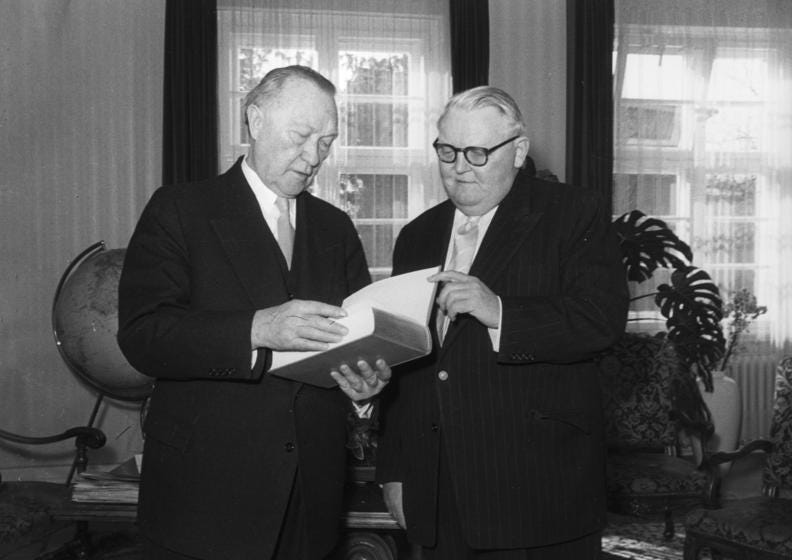
Ludwig Erhard, German Minister of Economics, 1956
And he’s right. The parallels are real. Both models:
Place enormous weight on rules-based co-ordination rather than improvisational politics.
Reject the idea that markets can function without a carefully built architecture beneath them.
Insist that the state’s role is to design the playing field, not micromanage every move on it.
Aim to align individual incentives with collective outcomes so that the economy doesn’t constantly veer into cartelism, chaos, or capture.
But Andreas also highlighted the difference that sits at the heart of every attempt at deep structural reform:
Ordoliberalism succeeded because WWII had already wiped out the old economic order.
So: does implementing something like the Architect State require destruction first? And if not, how do we overcome entrenched interests that are very much alive, powerful, and determined to keep the existing dysfunction exactly as it is?
This is the real implementation problem! And it’s the question we have to confront directly if the Architect State is ever going to be more than a theory.
Further, consider that the comparison to ordoliberalism is useful, but only up to a point.
The ordoliberals were designing for a mid-20th-century industrial economy. Think national (not global) scale; relatively siloed; modest financialization; weak cross-border dependencies; supply chains that still moved at human speed. Institutions were smaller, feedback loops were wayyyy simpler, and the number of veto players was far lower. The designer could realistically sketch the rules of the game!
We, by contrast, inherit an economy that is orders of magnitude more complex:
Globally integrated supply chains
Hyperscaled tech monopolies
AI-driven production systems
Financial markets that transmit shocks at light speed
Energy, data, compute, and logistics chokepoints
Vast derivative networks and balance-sheet lattices (aka a fucked up monetary system)
Informational chaos amplified by algorithmic chaos
Institutional fragmentation across dozens of overlapping jurisdictions
This is not a world where you can just “set the rules” and walk away à la Germany. Today’s co-ordination mechanism is a pseudo-planetary-scale distributed system with thousands of interacting parts.
And most importantly, unlike post-war Germany, our incumbents did not disappear. They consolidated and learned to arbitrage political fragmentation and built lobby shops larger than entire industries. They captured regulators not through corruption but through complexity itself.
So while the ordoliberals inherited a blank canvas, we must enact change whilst enduring the opposite:
Deeply entrenched incumbents,
Calcified institutions,
Co-ordination mechanisms that have failed but refuse to fucking die,
Political coalitions too brittle to absorb real shocks,
Information systems corrupted by noise and fragmentation,
No external force capable of imposing a clean slate.
Whatever co-ordination architecture we build must be constructed inside a system that will resist it. At. Every. Stage.
This means the Architect State cannot rely on the ordoliberal “post-war reset.” It must learn how to rebuild inside a living system that still has veto players, capture dynamics, and powerful actors whose business models depend on the dysfunction we’re trying to replace.
Fortunately, there are mechanisms for doing this without total destruction(ish).
ONE: Use Crisis Windows Strategically (The US Model)
In rupture-driven systems like the United States, the only viable moments for structural reform are during crises! When the old equilibrium has already failed, or when incumbents suddenly lose their political invincibility, or when the state temporarily regains enough authority to rewrite the rules. Under normal conditions, every entrenched interest has a veto. During a crisis, those vetoes evaporate!
This is why bailouts function as huuuge constitutional moments in the US political economy. They are more than just financial transactions; they are renegotiations of the social contract between the public and the private sector.
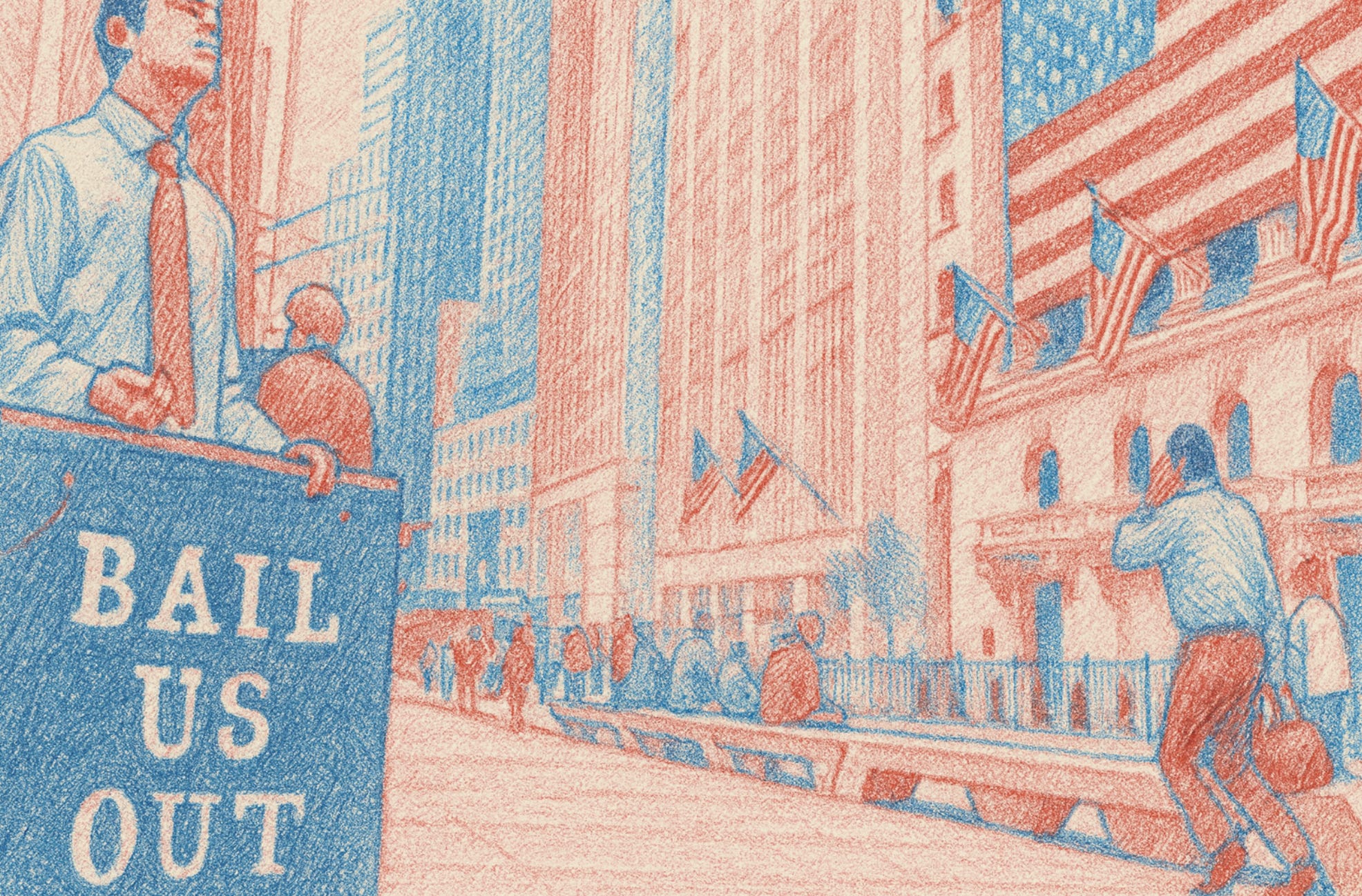
A bailout is indeed the one time when the direction of power reverses. Instead of firms dictating the terms of regulation, the state becomes the indispensable party! If a sector wants rescue, it must accept new architecture. The price of liquidity is institutional redesign.
This is where reciprocity can be finally created. The state can wedge structural requirements into the bailout process in a way that would be politically impossible in ordinary time:
Open interfaces: as a condition of receiving public guarantees
Transparency requirements: written directly into rescue terms
Competition rules and anti-chokepoint obligations: tied to central bank facilities
Resilience standards: baked into eligibility
Reporting obligations, data access, and audit mechanisms: triggered automatically
These are massive structural rebalancing tools. They change how the system coordinates, not just how it… feels. They shift the underlying architecture by rebuilding the pipes through which risk, information, and power flow.
Crisis compresses the political time horizon: everything accelerates, coalitions rearrange, and the cost of inaction exceeds the cost of redesign. So, the key for the Architect State is to attach the architecture to the rescue.
You do not wait for Congress to pass sweeping reform, you embed the new structures inside the bailout terms, the emergency authorities, the institutional protocols that activate during distress. Once the system stabilizes, those new rules have a way of becoming the default.
This is how the US has historically modernized itself. Crisis is the only real crucible in which the American state gains the authority to rebuild itself.
And this is how you implement the Architect State in a country that cannot redesign anything in peacetime. You don’t wait for total destruction per se; you only wait opportunistically for the next crisis. And then you build the upgrade into the rescue, so the architecture outlives the crisis that made it possible.
TWO: Build Architecture in “Unsexy Zones” (EU Model)
I’m fully aware that my use of “un-sexy” here suggests that other parts of this essay may have seemed “sexy”. (Time to create an OnlyReforms account??).

So, Europe offers a completely different pathway for implementing an Architect State, that relies less on crisis leverage and more on some sort of architectural judo. The EU cannot bulldoze incumbents, and it cannot rely on rupture to clear the field. Instead, it changes the co-ordination system by discreetly redesigning the structure underneath it, in precisely the domains where political resistance is lowest and structural leverage is highest.
The magic of this approach is that it works in “unsexy zones” of policy: data standards, interoperability rules, reporting formats, permitting requirements, grid interconnection protocols, procurement templates, safety certifications, infrastructure governance mandates. I could go on, and on, but I won’t.
None of these make front-page headlines. None provoke mass protests. And crucially, none trigger the full lobbying fury of Europe’s industrial incumbents, because they appear (at first, anyway) to be minor administrative adjustments.
But this is exactly why they are so powerful. It is the same loophole through which Huawei embedded itself across Europe for a decade!!! Small, technical procurement standards; quiet interoperability rules; unremarkable network certifications; and seemingly innocuous vendor eligibility criteria. Nobody noticed the structural implications until it was far too late and half the continent’s telecom infrastructure was running on Chinese equipment. In other words: architecture always wins in the end, even when no one has the political imagination to see where it leads.
The same dynamic applies when Europe uses standards as a tool for reform. These “minor” adjustments accumulate, and once they’re in place, they reshape the co-ordination environment in ways no incumbent can ignore.
It’s essentially the policy equivalent of Clayton Christensen’s disruption theory: the big players don’t resist because the change looks trivial, irrelevant, and beneath their notice. Until suddenly the entire landscape has shifted under their feet and the old business model no longer works. Disruption, in this sense, isn’t driven by a new technology; it’s driven by institutional rearrangements that make the previous equilibrium structurally impossible to sustain.
This is the European advantage: reform by tectonic shift rather than volcanic eruption. Instead of fighting powerful interests head-on (an unwinnable battle in Brussels) the EU builds new institutions and standards underneath them until the old equilibrium simply loses its footing. It’s slow, yes. But it avoids the social and institutional trauma that rupture-driven systems endure.
In this model, the Architect State arrives not with a grand constitutional moment, but through a thousand small pieces of infrastructure, rule-making, and administrative design that eventually cohere into a new co-ordination architecture.
THREE: Tie Power to Institutions, Not Individuals
Finally, the Architect State relies on something that sounds almost quaint in an era of charismatic strongmen, presidential improvisation (!), and billionaire-led policy experiments: depersonalized, rule-bound governance.
The core idea is simply to shift power from people to processes. That’s it.
Because when decision-making flows through neutral mechanisms (transparent standards, eligibility criteria, open interfaces, predictable procurement rules, automatic stabilizers) no single politician, regulator, or corporation can steer the co-ordination mechanism for its own advantage. The architecture becomes the constraint set, and hence actors must adapt to the rules rather than bending them.
This is, of course, about competition theory and antitrust. Effective competition isn’t just about having multiple firms in a market, it actually depends on an institutional environment that prevents dominant actors from leveraging discretion, opacity, or privileged access to entrench their power. In other words, competition is not a natural state. It’s an engineered outcome! (This is such an important part of the problem at the moment that it kind of deserves its own essay. Maybe soon…)
And this is crucial in an era of extreme monopolization. Powerful firms can lobby legislators, capture regulators, or negotiate bespoke loopholes, yes. But they cannot easily override interoperability requirements, open data standards, automatic triggers, or rule-based eligibility systems that have been imposed already. In other words, neutral architecture disciplines monopolies in ways markets alone no longer can.
So, you don’t begin by breaking the monopolies outright (not possible); you begin by breaking the mechanisms through which they exercise arbitrary power.
Over time, this scaffolding erodes veto points and reduces capture. Eventually, institutions instead of personalities become the entire backbone of the system and predictable rules replace discretionary interventions.
Putting It All Together
By now, if I’ve adequately explained this, you should see: the Architect State isn’t a single blueprint that can be replicated across countries. It is a co-ordination architecture, and like any architecture it must be built on the foundation that already exists! That means implementation looks radically different in the US and in Europe, because the transition mechanics of each of these systems is different.
In the US, implementation can only happen through rupture. The system does not permit proactive structural reform, so the strategy must always be to prepare the architecture in advance and deploy it during a crisis, when political veto points dissolve and incumbents temporarily lose their grip.
Bailouts become the delivery vehicle by deploying a “rescue comes with rules” mantra. Standards, transparency, open interfaces, and eligibility criteria (all the core elements of the Architect State) are attached to emergency programs, written into facilities, or embedded in executive authority.
In Europe, the pathway could not be more different. The implementation strategy is slow, negotiated, and becomes a profoundly technocratic “standards-first” approach.
Here, change happens through institutional layering rather than upheaval. New reporting rules here, interoperability mandates there, procurement reforms tucked into climate legislation, digital identity frameworks folded into single-market governance.
Each reform is modest (read: boring) on its own, but together they eventually accumulate into a de facto co-ordination architecture!
So, two different pathways, shaped by two different transition logics, but ultimately converging on the same place: a political economy with a functioning co-ordination mechanism once again.
Going back to Germany; if ordoliberalism taught us anything, it’s that coordination does not arise naturally. It has to be designed with a deep understanding of how economies behave under stress. And if the last fifteen years taught us anything, it’s that stability in calm periods is meaningless. Transition stability, the ability of a system to move from one equilibrium to another without tearing itself apart, is the real test of an economic model.
Thus, the Architect State is not an attempt to relive post-war Germany, nor is it nostalgia for a lost constitutional moment. It is simply an attempt to answer the most important economic question of this century:
How do you rebuild the coordination mechanism of a complex, interconnected, shock-prone economy without first burning everything to the ground?
And the answer is not as complex as we might initially think:
By understanding the transition modes we’re working within.
By using crisis windows intelligently: treating bailouts as opportunities for constitutional redesign rather than desperate patches.
By building in the unglamorous institutional zones where real coordination happens: standards, interfaces, reporting rules, procurement systems, data architectures
If you’ve made it this far, thank you very much for reading!
I know how satisfying it is to wrap up a project, and finally be finished with a great work of analysis! Congratulations on a wonderful series!
After you've woven such an incredible tapestry of ideas, it would be rude for a reader to start tugging at threads to work out if any aren't snug. And doubly so when the pattern seems just about perfect. But you also appear to have had some fun with this, and so, with hope for one more in the series, and an apology, here's a firm yank at a loose end I found:
The series still hasn't explored a most central issue: governance is the process of encoding _values_ into structures.
The way a democracy (s)elects the value hierarchy to implement is politics.
In politics we don't **have** to be denied _pro forma_ choice to be denied _de facto_ choice.
Failing to address that distinction directly, enables electoral authoritarianism, and addressing it means talking choice architecture.
Here, both the cognitive science and economics has advanced considerably since ordoliberalism. Kahneman, Thaler and Cipolla (if expanded, with updated labels) all add elements. If the Architect State's choice architecture for rules creation were clarified to be distinct, and updated, compared with ordoliberal governance, its advantages would be more evident.
# Problem Summary
Constitutional reforms have high barriers. (Painstaking consensus-building in Europe; 2/3 of both US Houses and 3/4 of all statehouses in the US.) The current political landscape is aligned to a social (non-economic!) axis, comprising distinct and disjoint Overton windows, epistemic isolation, captured traditional media (since Zucker), and social media microtargeted into manipulation-for-hire (since Zuckerberg), and that with strategic regulatory interests superceeding profit motives in customer selection.
Yikes!
If that is left alone, we've already seen how the movie ends. When [false bifurcated framing](https://www.foreignaffairs.com/europe/multiculturalism-failure-community-versus-society-kenan-malik?utm_medium=newsletters&utm_source=fabackstory&utm_campaign=NEWS_Backstory_121425_The%20Failure%20of%20Multiculturalism&utm_content=20251214&utm_term=A) in all parties were forged up to 2015, we got first Brexit and then Trump1. Neither conspiracy nor corruption are required (though both exist as well) to align net political forces toward social tribalism. These structural driving forces themselves need to be realigned in advance of, or at least in tandem with, any reform.
Hypothesis: Without revising political framing of economic issues, governance reform can't exist, either initially or over time.
# Solution
Choice architecture is needed simultaneously on two levels, both (1) economically to ensure the Architect State doesn't retain ordoliberal governance limitations, and also (2) politically to implement reforms.
"Rules over discretion," logic becomes less sufficient with complexity, as does nominal, after-the-fact transparency. Clarifying limitations for human reasoning about complex systems and how an Architect State would implement consequences would complete the picture.
To be effective at modern economic pace and scale, _de facto_ transparency requires new, technology-forward automated reporting structures, which need to integrate with and draw directly from digital corporate accounting systems, in near-real time. These should be aggregated using algorithmic weightings, far beyond simple additions of balances and flows, to explicitly include both velocities and other factors for stimulus, and externalities (eg. pollution, labor abuses, systemic risk) for taxation. The same weightings would reduce interstate "race-to-the-bottom" environmental and labor dynamics, by embedding more complete assessments of risk-weighted growth.
Importantly, this works best when tracking _before_ limiting thresholds are crossed, through distributed and gradual/continuous incentives and taxes, assessed not quarterly or annually, but automated and per transaction. Only in this way can the assymetric pace and complexity across the public/private interest divide be managed. Not just transparency, but radical transparency to permit already present and distorting radical complexity. Values could be reported out of government in coarsely weighted aggregates only, but also instantly available at the company level with automated output to regulators by subpoena.
Companies already collect taxes per transaction, why should they not submit them on the same basis? (For sales taxes, individuals do!) The technological workability objection is simply outdated. Even for the tiniest companies that use QuickBooks, or Quicken, this could simply be another software update, free to download and install, with direct electronic transfers to/from one more account.
This eliminates, at once, the use of assymetric legal gamesmanship, and excessive burden of investigation. It pairs the privilege of benefiting from vast complexity, and the concommittent risk caused by that complexity, with the obligation to be regulated at the same pace and the same resolution as the benefit. And if something becomes too big to fail, it can be monitored so it can't, with a resolution that permits assigning individual, corporate-veil-piercing, responsibility to efforts to evade monitoring, SOX-style, but stronger.
Digital security, barriers to disclosure, and independence of oversight need to be paramount for this to function, but the need for overhaul of these is already evident, so an opportunity to build correctly in the next crisis iteration is conceivable. The infrastructure is nearly extant.
I don't know if this is what you meant, when you said:
- **Open interfaces:** as a condition of receiving public guarantees
- **Transparency requirements:** written directly into rescue terms
- **Competition rules and anti-chokepoint obligations:** tied to central bank facilities
- **Resilience standards**: baked into eligibility
- **Reporting obligations, data access, and audit mechanisms:** triggered automatically
These **could** be interpreted to include the radical transparency above. Or to exclude it. I'm curious where the Architect State would draw that line, and why. Even if this falls outside the framework, could it be used as a negotiation starting point for what _might_ happen should more moderate reforms be resisted?
Because everything above is just the economic side. It's the political side that actually makes reform viable at all, and that is where a more dramatic solution is more badly needed. There's only so much political passion that can be summoned for admittedly "unsexy" work.
Reporting after the fact, using existing overly simplistic metrics from bygone eras, is insufficient to restore the balance between public and private interests. The lie is not just about what the numbers mean, the lie is in the numbers themselves, in their formulation and usage today. Not all jobs are equally beneficial, not all dollars of revenue or growth are equally desirable. Different "colors" of money already exist, and businesses know that, and act on it. "Why does our government still pretend there's no difference?"
I would argue that the demand for the polity to be able to assess and act faster, to have governance occur on the timescale that business does, is simple enough to make into a rallying cry. It's one of few messages that created positive feedback with the "burn both sides, they have joined to cheat the little guy" sentiment that initially spawned both OWS and the Tea party, way back before segmentation devolved each end into mutual loathing along social lines. This shift reversal in dialogue will be hated by the party machines, but that's also precisely why it would work to realign the grassroots level toward economic objectives.
It may even be the framing that reunites disaffected across all parts of the political spectrum again. If groundwork against opacity is laid now, messaging could be distributed enough to surge spontaneously when crisis arrives. One could start, for example, by gleefully torching the careers of the entire list of names (equally, on all sides) in the Epstein files, but with a focus on exposing their connections not only to his "entertainment" but emphasizing particularly his deliberately opaque and the shady financial dealings of his whole network. For once, anti-elitist messaging and moralizing could be used for public benefit, instead of public theft.
I don't think we lack causes for outrage.
I really like this thinking! Fantastic!
However, a note of caution; ["Ordoliberalism: A German oddity?"](https://ces.fas.harvard.edu/uploads/files/Reports-Articles/Ordoliberalism-A-German-Oddity-By-Hans-Helmut-Kotz.pdf) speaks to the considerable challenge of attaching structural reform to bailouts in an initially neoliberal environment, and the subsequent drift back toward neoliberalism over time as local political forces favor more "pragmatic" solutions. Retaining credibility throughout a process that can take as long as a decade to show real effects from first implementation is a considerable challenge in a democracy. More exogenous crises, over shorter time-spans ([eg. COVID](https://www.ifo.de/sites/default/files/docbase/docs/sd-2022-11-entlastungspakete-tankrabatt-uebergewinnabschoepfung.pdf#page=15)) have also been looked at, though still less thoroughly. I think the efficacy of driving architecture through crises is worth examining more closely, if one intends that the changes endure.
One detail to consider is that while some work has been done on evaluating trust in systemic architectures, (eg. [Columbus et al.](https://www.ifo.de/DocDL/cesifo1_wp10591.pdf)), I don't think these go nearly far enough to reflect current reality. Levels of trust in the polity today are not just low, they are (in my opinion) actually negative; meaning not merely a low confidence that an institution will do the right thing, but an active belief that given the slightest chance, it will do the wrong thing, as much as it can, and as fast as it can. This leads to skewed behavioral economics that has to be included for models to be remotely meaningful.
I'm thinking this behavioral system might be modeled in an agentic approach, with agent population distributed over all 8 Cipolla semiquadrants (subdivided with x=y, x=-y). Prospect theory could be applied (including with fractional weighting for sub-cultural tribal attachment) and the stability landscape and transition stability assessed, both for smooth, and phase-boundary manifolds.
Results could be compared to economic and polling data in previous crises, including examples such as COVID, Euro crisis, US mortgage crisis, Great Depression, periodic recessions, US oil shocks, and other exogenous shocks. Strictly political events could also be matched to separate time-constants of tribal-affiliation shifts (using polling data) for Watergate, Iran-Contra, Lewinsky, and others, and the combined results could be fit for different systems, and populations.
I'm particularly interested whether net-parasitic economic sectors show up differently than mainstream production/consumption sectors, and whether tolerance for them has changed since the failure to prosecute after 2008. Other events to look at could include the US Banking act of 1933 and the Gramm-Leach-Bliley Act of 1999, The Bipartisan Campaign Reform Act of 2002, and the 2010 Citzen's United case. One could even look at whether a shift from Kahneman System 2 to System 1 in media consumption (via social media news consumption) [changed the characteristic time constant](https://hbr.org/2026/01/marketing-at-the-speed-of-culture?utm_medium=email&utm_source=newsletter_various&utm_campaign=specialrec_Active&deliveryName=NL_HBRRecommends_20251204), and whether Cambridge Analytica's work in Brexit and US 2016 could be simulated.
Sufficient evidence, paired with a strong narrative, could be a compelling driver for structural change, perhaps even enough to overcome McNamara-fallacy negativity regarding the political viability of systemic change.
What do you think? Might such a model be a starting platform from which to drive change? Or is this jumping too far, too fast?