


I wrote the following essay for Tomasz, with whom I greatly enjoy chatting all things Curtis Yarvin over dodgy bottles of red wine in Dublin pubs!
Here are the vibes going into 2026:
Elections happen, but they don’t seem to do much.
Institutions still exist, but they feel hollowed out and more performative than operative.
Markets technically function, but prices no longer tell us anything reliable about scarcity, value, or risk.
Policy, endlessly announced and re-announced ad nauseam, doesn’t even try to fix problems; it just stabilizes them enough so that we can keep going in the general direction of decline.
In short: everything might still work, but nothing is being resolved.
The result, as was discussed at my New Year’s Eve dinner party, is a flat, corrosive and ever-increasing exhaustion from being trapped inside a system that can do nothing but manage its own demise.
(And most people can feel this, even if they can’t quite name it!).
Enter Curtis Yarvin.

Over the past week, his new essay has been circulating widely in certain corners of the American political internet (eyeroll).
It has been shared, broken down, and argued over with an intensity that suggests it has struck an intellectual nerve. Not because it introduces radically new ideas, of course, but because it openly highlights the above stalemate.
So, let’s rewind:
In case you are lucky enough to not know of Curtis Yarvin, he is a long-standing, so-called “political theorist” of the post-liberal right, best known for how much he despises democracy, loves a good monarchy, all while insisting that modern states are no longer meaningfully governed by elections at all. (Sure, there’s some truth to this).
And for more than a decade, he has argued that real power has migrated away from formal democratic institutions and into a diffuse, self-perpetuating administrative and cultural apparatus (what he once called “the Cathedral”).
His oeuvres are read closely by a small but influential audience of you-know-whos: tech bros, VCs, and a growing cohort of younger conservatives desperately looking for frameworks that can relabel their political frustration as victimization by an illegitimate system.
Anyway, in this essay, Yarvin’s core claim is the following:
That democracy has failed functionally, and not just in some moral sense, but a deeply structural one.
That elections no longer meaningfully give a leader control.
That institutions persist long after their coordinating function has decayed.
That “governing” has become a set of rituals performed atop a system whose real levers are no longer visible to voters, politicians, or even, in many cases, to those nominally in charge.
The new essay pushes his usual argument further than before by framing the second Trump administration as a tragedy (for the opposite reason that I believe it to be so!). He says that this second term contained a moment in which genuine change was possible, and was briefly glimpsed, but then forever lost.
Yarvin argues that this overwhelming failure was not just external resistance, but an internal hesitation because of a fear of power, amidst a refusal to act decisively enough when the window for change was open. (Remember TACO?!).
Cool. But why am I writing about Curtis Yarvin?
Well, it is certainly not because I find his conclusions persuasive! But in fact because I want to take seriously a question that is too often waved away.
You see, in some circles (my circles), Yarvin is dismissed as an unserious crank. He is a monarchist fantasist, a contrarian provocateur, even an internet oddity whose ideas collapse under even the lightest introspection. In other (aforementioned) circles, he is treated as a quasi-prophet! A clear-eyed realist willing to say what polite politics cannot, and therefore someone whose work deserves careful attention.
However, like a lot of the discourse around anything Silicon Valley related, I find that there’s an even more nuanced middle ground that goes undiscussed.
In my opinion, Yarvin is not a crank shouting at the margins, nor some strange cartoon villain plotting democracy’s demise. But he certainly is far from the prophet or serious intellectual that people discuss him as.
What makes Yarvin hard to categorize, in fact, is that his work begins from premises that are often legitimate, but… somehow ends in conclusions that are not. The result is just as I mentioned; neither crank theory nor rigorous political analysis, but some strange form of quasi-reasoning that borrows seriousness from very worthwhile diagnoses, while forfeiting any serious intellectualism on his path to explaining such diagnoses.
For example, we usually see that his intuition resonates strongly with the (mostly) right-leaning because it starts from a place many people already occupy: the sense that something fundamental is broken, and that pretending otherwise is no longer credible!
(We are, left and right, in agreement here, I suspect).
The question, then, is not whether Yarvin is diagnosing a real unease (because he is) but whether his diagnosis points toward an intellectually serious path forward? Or does it just feel like what he is saying is decisive enough to feel intellectually satisfying?
In other words: is his latest essay a hard-eyed realism take about power in the twenty-first century, or an elaborate fantasy built on a misreading of what actually broke?
Let’s get stuck in…
What Yarvin Is Actually Arguing
Before assessing Yarvin’s diagnosis, it’s worth being clear about what his latest essay actually claims (and to do so I must strip it of its endless rhetoric, metaphors, and provocations!).
At its core, the piece contains three interrelated arguments.
First, Yarvin argues that the second Trump administration has already failed, because it has misunderstood the nature of power in the current political system. The failure, in his words, is tragic rather than farcical; there was a brief window in which genuine regime change was possible, and that window has now permanently closed.
Second, he argues that modern democratic systems are no longer capable of producing real political change through normal means. Elections, in his view, have become rituals that confer legitimacy without authority. In this way, institutions persist, maybe, but largely as empty shells, performing governance theatrics rather than actually exercising it. Power, he claims, now resides in a permanent administrative, legal, and cultural apparatus that is effectively insulated from electoral challenge.
From this perspective, Trump’s mistake was actually restraint! Not incompetence or ideological incoherence, as per the main critique of previous leaders. Yarvin argues that Trump and those around him were unwilling to seize power decisively enough at the moment when resistance was weakest. They governed within the system rather than against it, and by doing so, allowed themselves to be absorbed, neutralized, and utlimaterly… constrained.
This leads to the third and most consequential claim: that incremental reform is no longer viable, and that only a total rupture can restore political agency. Yarvin proposes the creation of what he calls a “hard party” which is essentially a centralized, disciplined political organization whose members fully delegate their political judgment upward, vote as instructed, and treat elections not as deliberative exercises but as instruments of coordinated force. (He uses the Chinese Communist Party as one such example of a hard party).
The purpose of such a party would not be to negotiate within existing institutions, but to capture the state in its entirety and rapidly dismantle the old regime, once and for all.
In Yarvin’s eyes:
Legitimacy follows victory rather than preceding it (the opposite of how we traditionally think of democracy);
Governance becomes possible only after opposition has been structurally eliminated, not in light of it;
Stability is achieved through irreversible consolidation of power, not through pluralism or consensus.
Throughout the essay, which is kind of batshit crazy, Yarvin frames these points as a necessity, stating that partial authority is worse than none at all, and that any attempt to govern without whole power simply invites retaliation.
In this way, the choice he says that we face is stark and importantly, binary: total victory to those on the extreme right, or eventual destruction for everybody.
Hmmmmm.
Look, whether you agree with this conclusion or not, the argument is at least internally consistent (!). Yarvin is not proposing reform to be clear. He is proposing total replacement of the current system, and calling for the removal of the conditions in which democratic governance can exist at all.
This is the claim on the table, made by a political theorist whose work, whether you agree with it or not, is taken seriously in at least some circles of power.
So my task with this essay is not to decide in advance whether Yarvin is a crank or a serious political theorist, as many others are doing right now, but to evaluate him by the only standard that actually matters!
First: does the claim he is making rest on a correct understanding of what the problem is? That is, is he identifying the real point of failure in the systems he criticizes, or is he mislocating cause and effect in ways that merely feel explanatory to him and his followers?
Second: even if the diagnosis has merit, does the proposal he advances follow from it in a way that is analytically sound and practically coherent? As in, could the destructive alternative he gestures toward plausibly be built in the world as it exists, and would it actually solve the problem he claims to be addressing?
What Yarvin Gets Right (and Why That Matters)
Before turning to where Yarvin goes wrong (a much longer list), it’s worth being precise about where he is right, because the parts he gets right are exactly why his argument is resonating right now.
And I’ll give him this: at the core of Yarvin’s diagnosis is a set of distinctions that many mainstream political debates still refuse to make.
First: that elections do not equal control. Correct, unfortunately. Winning office no longer guarantees the ability to direct outcomes in any meaningful way. Electoral legitimacy and operational authority have drifted apart dramatically, with chaotic consequences.
Second: that policy is not the same thing as power. Correct, again. Announcing initiatives, passing bills, or issuing executive orders does not ensure that anything actually changes downstream. In fact, it often does little more than act as another source of chronic exhaustion into an already-tired system.
Third: that current reform is surface level only, and does not materially change anything. He is right to say this. Well done, Yarvin. Tweaking rules inside a system whose basic wiring no longer functions does not restore its ability to act coherently. In fact, it merely makes us more exhausted by the minute.
Fourth: that distributional fixes do not repair system failure. Subsidies, transfers, tax credits, and symbolic commitments may soften the social consequences of breakdown, but they do not address the mechanisms that produced it in the first place. Correct, correct, correct.
On these points, Yarvin is not wrong.
In fact, this diagnosis aligns closely with what I’ve argued in great detail about the post-2008 political economy, was I’ll summarize here:
The defining feature of the last fifteen years has not been ideological confusion so much as mechanical failure, because when the global financial system seized in 2008, the market-based coordination mechanism that neoliberal capitalism relied on collapsed. Hence, prices stopped transmitting reliable information needed to run the economy because of the amount of money being printed! Risk could therefore no longer be assessed, and capital allocation ceased to reflect fundamental indicators of our economy.
Central banks stepped in because they had to. But in doing so, they became permanent substitutes for the price system itself. Liquidity replaced any market information and balance-sheet expansion replaced much-needed market discipline, meaning that stability was preserved (temporarily), but coordination was not rebuilt.
Since then, institutions have been performing a strange, half-conscious task: stabilizing imminent collapse rather than reconstructing the system that once translated policies into actual outcomes.
This is why every crisis since has been met with more liquidity, more government bailouts, more surface-level patching of problems, and almost no attention to the underlying coordination machinery that failed and was never repaired.
From this perspective, Yarvin’s critique lands well because it refuses to mistake moral intention for functional capacity. In other words, he does not believe the system is failing because leaders lack good values or sufficient resolve, but because the apparatus itself no longer does what we think it does!
So yes, Yarvin is correct:
The problem is not that we lack moral ambition but that the machinery that once translated strategy and policy into outcomes no longer works!
However, this is the upper limit to which Yarvin displays intellectual coherence, and also where the analysis begins to fail.
Hereafter, Yarvin diverges from all coherency. He correctly senses that the coordination mechanism has collapsed, but he treats that collapse as evidence that pluralism itself must be eliminated, rather than as a sign that coordination was never institutionally rebuilt in the first place.
This is extremely important, and that distinction matters, because this is where his diagnosis turns into a total fantasy.
The Critical Error: Confusing Coordination with Domination
Sure, Yarvin’s diagnosis of the failure is sharp, but his inference about what that failure requires rests on nothing short of a fundamental category error: he treats economic and political coordination failure as proof that the only alternative is domination.

To see why this is wrong, I want to be explicit about the basic architecture of any political economy. In my work, I tend to separate three layers that are constantly being blurred together in public debate:
Coordination is the machinery that turns information into action, and it is how a system decides what gets built, by whom, at what scale, and under what constraints. Coordination is signal-processing: think of prices, standards, procurement rules, permitting, credit conditions, enforcement capacity, administrative competence. It is the institutional infrastructure that makes collective behavior turn into steerable outcomes. (This is what broke post-2008).
Distribution is who the system is for. As in, who captures surplus, who absorbs losses, whose failure triggers rescue, and whose failure is punished. Distribution is not “after the fact.” It is part of what makes coordination politically survivable. It is the story the machine tells about why anyone should consent to being governed by it. (Fixing distribution is necessary, but since it sits downstream of coordination, cannot be fixed first).
Legitimacy is what allows a system to survive stress. It is why people tolerate uncertainty, sacrifice, and loss without revolting or exiting. Legitimate systems can ask people to endure transitions, while illegitimate ones cannot, even if they have formal authority!
These distinctions matter because they separate two things that are often treated as the same:
A government can still be in charge while no longer being able to make things work. And making it more powerful does not, by itself, make it more competent.
Yarvin is correct that coordination has decayed, but where he goes wrong is what he infers from that decay. He assumes that because the system cannot coordinate, pluralism (the coexistence of multiple centers of authority, competing interests, independent institutions, and dissenting sources of information) must be eliminated in full.
In other words, he treats the failure of coordination as an argument for submission.
But… coordination failures do not imply the need for submission? Coordination failures simply imply nothing more than a missing architecture. His leap, therefore, to total submission is… a strange (and self-serving) one.
Consider when markets stopped coordinating after 2008. The answer was not that society required an emperor. Au contraire; the answer was that the informational circuitry that gave us market pricing, which made the economy governable, had broken, and that we replaced it with temporary substitutes. (By which I mean endless liquidity, backstops and bailouts in place of repair).
That substitution only worked in the very narrowest sense. It prevented immediate collapse, yes, but it did so by suspending, rather than restoring, coordination!
This is precisely the move Yarvin now proposes, except in political form.
Where the post-2008 economy replaced broken price signals with central-bank liquidity, Yarvin would replace broken institutional coordination with centralized political authority. His “hard party” functions as the equivalent of a political central bank: suppressing volatility, overriding dispersed signals, and enforcing coherence from the center in lieu of rebuilding the mechanisms that once allowed the system to coordinate itself.
In both cases, a short-term stabilizer is hence mistaken for a long-term solution. And in both cases, the result is not renewed governability, but a growing dependence on ever more forceful intervention to hold the system together!
This is not just morally alarming (although it is). It is mechanically and intellectually incoherent.
Because power without architecture does not produce order, it produces volatility, even if that volatility is temporarily suppressed. Additionally, it importantly creates the illusion of direction while increasing systemic stress.
You see, a complex system does not become governable simply because you have eliminated competing voices. It can only become governable when it can see itself clearly, process information across levels, correct errors quickly, cushion losses before they metastasize into backlash, and maintain enough legitimacy so that transitions don’t trigger total collapse.
A hard party can force compliance, temporarily, but it cannot automatically generate signal clarity, just as it cannot automatically create institutional learning. It cannot automatically prevent distortions, institutional capture, or internal corruption. In fact, by compressing the information environment and punishing dissent, it predictably destroys many of the conditions coordination requires.
This is the decisive divergence between Yarvin as a crank and Yarvin as a serious political-systems thinker.
Yarvin sees coordination fail and concludes, without fully accounting for why it failed, that sovereignty must therefore be centralized. The move feels decisive, but it is not analytically grounded. In fact, it does nothing but substitutes his deep desire for all-encompassing power for any explanation.
I look at the same failure and reach a different conclusion: there is a need for institutional re-design, because coordination breaks when information degrades, incentives misalign, and institutions stop learning. Those are architectural failures, and they cannot be solved by concentrating authority.
So while I want to rebuild the apparatus that makes a state capable of governing transitions without breaking, he, on the other hand, wants to seize the state.
One responds to frustration (Yarvin) while the other responds to causality (political scientists).
And only one of those is intellectually coherent.
Transition Stability: The Thing Yarvin Cannot See
Once you separate coordination from domination, a second distinction becomes unavoidable, and it is one Yarvin never really grapples with: the difference between stability and transition stability.
Economic and political stability in calm conditions is cheap. In fact, almost any system can appear stable when nothing fundamental is being asked of it. Equilibrium hides weaknesses and rewards inertia. As I have pointed out in great length in this piece and using modern-day dating as an analogy, even the most ill-suited people will still feel like their relationship is viable before their first argument.
Transition stability within systems, on the other hand, is rare.
Transitions are the moments when a system has to change its underlying logic (as in, when an old model stops working and a new one has to be built without collapsing everything in between). These are the moments that expose what a system is actually made of, and they reveal whether power, information, legitimacy, and institutions are aligned, or merely sellotaped over.
I mean, if you want to understand how political economies really work, you don’t look at how they behave when conditions are easy, because you learn nothing. You look at how they behave when they are under stress.
Seen through this lens, as I wrote about before, the differences between China, Europe, and the United States are not ideological but architectural.
China handles transitions through fast coordination and high coercion. Its authority is concentrated, compliance is enforced, and administrative alignment allows the system to redirect credit, suppress contagion, and absorb shocks quickly. This gives China extraordinary short-term transition capacity. But it comes at a cost: legitimacy is brittle, dissent is always muted, and errors can compound silently until they surface explosively (which they do).
Europe manages transitions through slow coordination and high legitimacy. Change is negotiated slowly, losses are cushioned, and institutions are designed to preserve social consent even under strain (ie: bureaucracy). This produces remarkable stability and resilience, but at the expense of speed and adaptability. Europe rarely breaks, but it also rarely moves quickly enough to get ahead of structural change!
The US occupies a third position entirely. It has high dynamism and weak coordination, meaning that it generates new equilibria through competition and innovation, but it lacks any institutional machinery to manage transitions deliberately, ahead of time. As a result, reform in the US arrives through total system break rather than design: the economy will collapse, followed by improvisation, followed by partial recovery. The system eventually adapts, but only after absorbing enormous social and political damage.
This comparison matters because it exposes the central flaw in Yarvin’s prescription! In particular, in his call for a China-like, CCP-esque ruling of the United States.
(In fact, the only thing he intellectually achieves in his essay, IMO, is to outline his total lack of understanding of how China operates…)
China’s capacity does not come from absolute power; far from it. It comes from institutional alignment, slack, information clarity, and administrative coordination. Importantly, it comes from the ability to synchronize fiscal, financial, regulatory, and organizational levers under stress, and very quickly. These are features of architecture and structure, not merely authority!
A “hard party” would not recreate these conditions. It would actually undermine them. A hard party would:
Destroy slack by treating redundancy as weakness.
Destroy feedback by punishing dissent and compressing information.
Destroy legitimacy by replacing consent with obedience.
Destroy learning by mistaking unity for correctness.
Destroy information quality by incentivizing conformity over accuracy.
What a hard party would create instead is a temporary compliance, meaning a brittle type of order that looks powerful in theory until it hits reality.
Transition stability does not come from silencing pluralism, unfortunately (because that would be easy!). It comes from designing systems that can absorb conflict, process loss, adapt under pressure, and remain governable while changing.
China manages this through its administrative depth. Europe does it through legitimacy and constant compensation to those who lose out through change. The US does this poorly through crisis and improvisation after implosion.
Yarvin, however, sees China’s speed and mistakes it for proof that domination works, without considering why. Because what he misses is that domination without much needed structural architecture does not scale, does not learn, and does not survive its own errors.
And because he cannot see transition stability as a design problem, he mistakes the absence of coordination for a mandate to abolish it entirely!
Trump as a Case Study in Failed Coordination
One of the reasons Yarvin’s essay resonates is that it appears to offer an explanation for something many observers struggled to articulate in real time: why the Trump presidency felt simultaneously disruptive and inert. As in, chaotic on the surface, yet strangely incapable of producing durable change.
(This, also, was a New Year’s Day conversation with my pals).
Here, too, it’s important to be precise about what Trump actually did.
Trump’s real innovation was not merely rhetorical; it was actually structural. Credit where credit is due, he’s been busy! And importantly, as I outlined before:
He was the first major political figure in decades to openly reject the neoliberal assumption that markets should be the primary coordination mechanism of economic life. Through tariffs, export controls, reshoring pressure, industrial favoritism, and ad hoc interventions, Trump attempted to pull the coordination function back into the state.
In that sense, he did try to change how the system decided what got built, where capital flowed, and which sectors mattered.
This is why his presidency has felt so disruptive. He was not merely redistributing within an existing framework; he was challenging the framework itself.
But this is also where the failure begins. Trump did not replace market coordination with institutions. He replaced it with personal discretion (which is, at best, questionable). So, instead of rebuilding durable rules, standards, planning capacity, or administrative coordination, he governed through surprises!, and pressure, and exemptions, and threats issued from the Oval Office.
Prices were influenced by… tweets? instead of policy regimes. Firms were forced to abandon any mandate to coherent national strategy, while creating new strategies to buy proximity to presidential preference-du-jour. Supply chains thus shifted opportunistically, hedging against volatility and to avoid the tariff-eyed White House gaze rather than responding to stable signals.
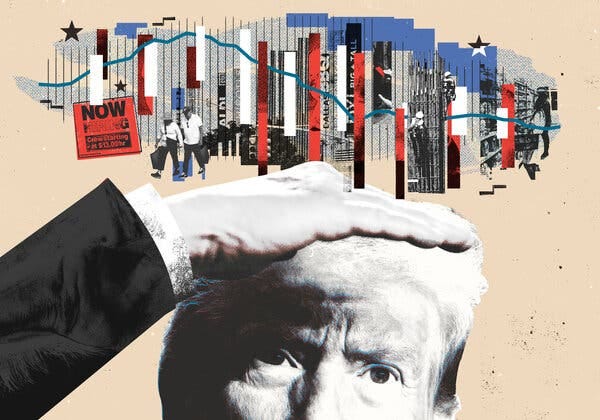
The result was not coordination, as Yarvin suggests might occur! It was volatility!
Incumbent firms with political access captured benefits (hello, tech bros)
Asset inflation accelerated as capital chased politically insulated sectors (hello, AI)
Small producers absorbed the shock costs of tariffs without protection (hello, all the SMEs that died)
This has meant that the system as a whole has become harder, not easier, to steer.
Trump demonstrated something crucial in real time. Namely, that once you control coordination, you also control distribution. As in, whoever sets the signals determines who wins and who loses.
But because those signals were improvised rather than institutionalized, the distributional outcome skewed upward (quelle surprise) toward asset holders, incumbents, and firms capable of navigating political uncertainty. The smaller, weaker firms and parts of society? Yeah, they’re fucked.
This matters because it exposes the flaw in Yarvin’s conclusion.
Yarvin looks at Trump’s failure and says: Trump didn’t go far enough.
I, on the other hand, look at the same failure and say: Trump went in the wrong direction entirely.
The problem was not insufficient concentration of power, it was the absence of architecture.
In fact, Trump proved that tearing away market primacy without replacing it with self-coordination produces dysfunction, avoids discipline, creates authority without capacity, and reduces system-wide learning.
That distinction cleanly separates Yarvin’s diagnosis from his proposed solution.
Yes, he correctly sees that the old coordination regime no longer works. Where he goes wrong is in assuming that the answer lies in more force, rather than in the far harder work of building institutions capable of coordinating a complex economy through transition.
Because unlike Yarvin, I would argue that Trump has not failed as a “system” that is seeking sovereignty, but as a coordination mechanism.
The Venture-State and Imagination Capture
I want to talk quickly about how Yarvin came to believe his nonsensical solution in the first place, and why others are seemingly convinced that he is making any sense at all.
At this point, it becomes possible to see Yarvin not just as a theorist of power, as he assumes he is, but as a product of a particular unimaginative world that exerts outsized influence over American political and economic life.
Consider that like any ideas, political solutions are never generated in a vacuum. They are constrained by what the people proposing them are able to imagine as plausible, legitimate, or even real. Before arguments harden into programs, they pass through an imaginative filter that determines which futures can be pictured at all.
Over the past decade, Silicon Valley, Yarvin’s core audience, has become one of the most important such filters.
The Venture-State (by which I mean Big Venture Capital)’s governing imagination is narrow yet intensely patterned, as an upcoming piece of work I will publish will outline. It is adolescent, and heroic, and obsessed with total sovereignty. It is, importantly, filled with stories of chosen elites, strong interventions, frontier breakthroughs, and final resets. And what is markedly missing from the imagination of the Valley? Stories of care, maintenance, compromise, legitimacy, or slow institutional work.
This is not coincidental! Science fiction, fantasy, and libertarian parables offer these tech bros (and yes, they are nearly always men) a theory of power that does little more than flatter the tech elite while removing entirely any hint of social complexity.
In the Silicon Valley stories, you’ll see, “politics” appears as the malfunction of a universe in which there is only one winner and one loser. Similarly, “bureaucracy” is described as corruption and evil, evil “institutions” are obstacles to be eradicated.
Coordination or collective governance, therefore, are to be avoided at any and all costs! Meaning that the heroic ending of Great Men on Great Journeys is achieved by exceptional individuals who see the evil more clearly than everyone else and act decisively enough to restore order.
So. Sigh.
Once this frame becomes the entire imagination of the tech elite, certain conclusions follow almost automatically! And it becomes clear that the proposals of someone like Curtis Yarvin are not an outside to this worldview, but rather his “tech-led, app-enabled monarchy” become its clearest expression!
Similarly, his “hard party” is the political science-fiction in which a chosen elite replaces democratic messiness. App-based obedience takes over any need for civic participation and gamified compliance replaces things like, I dunno, voting. Politics itself becomes an erroneous condition that needs to be bypassed entirely rather than navigated with care.
(Again, I urge you to read just how bat shit crazy his proposals are…)
Yarvin’s politics, in other words, does not emerge from a careful study of how complex systems actually adapt under stress (because that is an inconvenient truth in a world of binary winners and losers), but from a world in which authority is always singular, and conflict is always pathological.
Yarvin’s proposals are, worryingly, nothing more than science fantasy projections that those in power consider seriously, because this is, rather unfortunately, the extent of what they have grown up knowing…
Why the Hard Party Fails on Its Own Terms
Ok. But even if we grant Yarvin his premises (that coordination has collapsed, that incremental reform is exhausted, that the existing order is brittle) his proposed solution still fails on its own terms.
A hard party does not solve the problem he identifies, it literally only reproduces it in a more dangerous form.
At a basic, mechanical level, a hard party cannot do the things a modern coordination system must do in order to govern a complex society.
It cannot process information at scale:
When authority is centralized and dissent becomes synonymous with disloyalty, information degrades as it moves upward. I mean, we’re already seeing in the Trump presidency that market signals have become curated, filtered, and politicized. Errors are hidden, and bad news arrives late, if at all. This is actually a well-documented property of tightly controlled systems.
It cannot maintain feedback under uncertainty.
Transitions generate noise and they require rapid error correction, local experimentation, and the ability to reverse course without loss of face. A hard party, organized around discipline and unity, interprets uncertainty as weakness and system-correction is then seen as betrayal. Feedback becomes threatening to the apparatus of power, which will eliminate it entirely!
It cannot preserve legitimacy during loss.
This is important! Every economic transition produces losers, an inescapable fact. Without mechanisms for compensation, explanation, and consent, these losses translate directly into societal resistance (which is what we’re seeing amidst today’s societal unrest). Hard parties substitute obedience for legitimacy, but that obedience is brittle. It holds until it doesn’t, and when it fails, it fails catastrophically. What comes after this failure is guaranteed revolution!
It cannot transition without coercion spirals.
Because dissent is not allowed, but nor can you exit this system, every system correction requires more force than the last. Coercion and corruption thus becomes an issue of structural dependency, escalating precisely as the system’s informational capacity deteriorates. This is catastrophically bad. I mean, look at Zimbabwe post-2000…
Put simply: a hard party creates the appearance of control while systematically destroying the conditions that create control.
This is why Yarvin’s proposal actually mirrors the failure he claims to oppose!
After 2008, we replaced a broken market-coordination system with permanent liquidity support. Instead of rebuilding price signals, we flooded the system with money. The result was stability without coordination, and a growing addiction to ever-larger interventions.
The hard party is the political equivalent of that move. It would replace a system addicted to liquidity with a system addicted to force.
In both cases, a temporary substitute becomes permanent. And in both cases, the underlying machinery remains unrepaired. Thus the cost of maintaining the illusion of control rises over time, until the system can no longer afford it.
Yarvin promises decisiveness, but what his proposed model delivers is nothing more but fragility.
And once you see that the hard party cannot do the work it claims to do, even on its own logic, the appeal of absolute power begins to look like a much harder problem that I’ve already outlined: how to build a coordination mechanism without destroying the society it is meant to govern.
Power Is Not the Solution, Duh!
If Yarvin is right about anything, it is that the old order is exhausted and that the coordination machinery that once translated strategic policy into outcomes no longer functions. I mean, pretending otherwise has become an increasingly elaborate form of denial(!).
But… recognizing decay is not the same thing as knowing what to build next.
What the current moment requires is not more intensity, more purity, or more force. It requires reconstruction of the very unglamorous machinery that makes complex societies governable in the first place.
A viable path forward would have to begin with rebuilt coordination mechanisms: institutions capable of processing information, aligning incentives, and acting coherently across sectors and time horizons.
It would need slack (not as waste, hello DOGE, but as shock absorption) so that transitions do not instantly propagate into crises.
It would require clear information flows, so that systems can see themselves accurately while they change.
Legitimacy would need to be actively maintained during uncertainty, because no system can transition if its population no longer believes the pain has meaningful outcomes or limits. And institutions would have to be designed to learn, and to update rules, correct errors, to adapt without requiring collapse as a precondition.
None of this fits neatly into a slogan, of course, just as none of it offers the catharsis of a reset. And none of it can be delivered by a single sovereign act.
Which is precisely why it is absent from Yarvin’s solution space.
Yarvin offers a fantasy of power. It’s the idea that if authority were finally total, coordination would reappear automatically. What we actually need is architecture, and the boring, slow, difficult work of building systems that can absorb pressure, process conflict, and move between equilibria without tearing themselves apart.
Power can compel compliance, temporarily, but it cannot create trust, information flow, or adaptive capacity. Those emerge only from institutions designed to survive disagreement, error, and change.
The tragedy of Yarvin’s argument, in the end, is not its authoritarianism. It is ultimately its laziness.
So I dunno. Maybe the real question is not whether Yarvin is a crank or a prophet, but rather why so many people would rather crown Trump than design systems that can actually govern.
the USA in fact once had "[institutions] that generated trust, information flow, [and] adaptive capacity... [and were] designed to survive disagreement, error, and change"
The United States once had genuinely democratic governance structures, however imperfect and limited, fundamentally based around decentralized and publicly accessible mass-member parties. The Democratic Party, as a small "d" democratic institution, and the Republican Party, as a small "r" republican institution, were honest in their naming and functioned within a politically, economically, governmentally, financially, and scientifically decentralized and pluralized system that had legal/regulatory variability, policy variability, and local fiscal dominance. These parties, while far from flawless, allowed for real representation, genuinely participatory governance structures even for very serious policy matters with real participation, and a level of public accountability in political, economic, governmental, financial, and scientific decision making.
However, after WW2 a long multi decadal transformation began due to the dirty deeds of a convergence of several interests and an assortment of powerful special interest groups, and then our parties were transformed into centralized, exclusionary membership organizations. The so called Democratic Party has become a technocracy party, and the so called Republican Party became a conservative party. Neither really represents their original principles of democracy or republicanism, and they dont offer meaningful access or representation to the public. This transformation of the parties has been accompanied by a broader centralization of political, economic, and scientific decision making, which has caused the effective loss of most democratic governance structures.
Networked governance would be transformative. It is the secret sauce underpinning western military doctrine. Even the Catholic Church is beavering away at a new organizational model within a social-ecological context. Yet for mainstream governments there isn't a nicotine patch big enough to break their addiction to hierarchies.