

Mind the Gap
Ireland is the second richest country in Europe, and this week a single protest shut it down. Here's why.

Yesterday, on Sunday morning, I posted a graph on Twitter. And by Sunday evening I was watching Steve Bannon’s WarRoom podcast discuss the data after it had gone viral. A very strange day, indeed.
My inbox has been full of people arguing about the methodology, the axis labels, whether I should have used GDP or GNI*, and whether the composite index is “makey upey.” Good, I suppose! It’s hard to get people to care about data!
But instead of individually messaging and emailing all the people who have asked (there are too many), I am writing this post which gives everything (data, sources, the construction). But more importantly, I want to dig a little deeper into what this graph actually shows: that Ireland is not an entirely functioning state… Just a rich one!
But first. Why did a graph go viral? I’ve been hanging around data for a while and chart plots don’t normally do that.
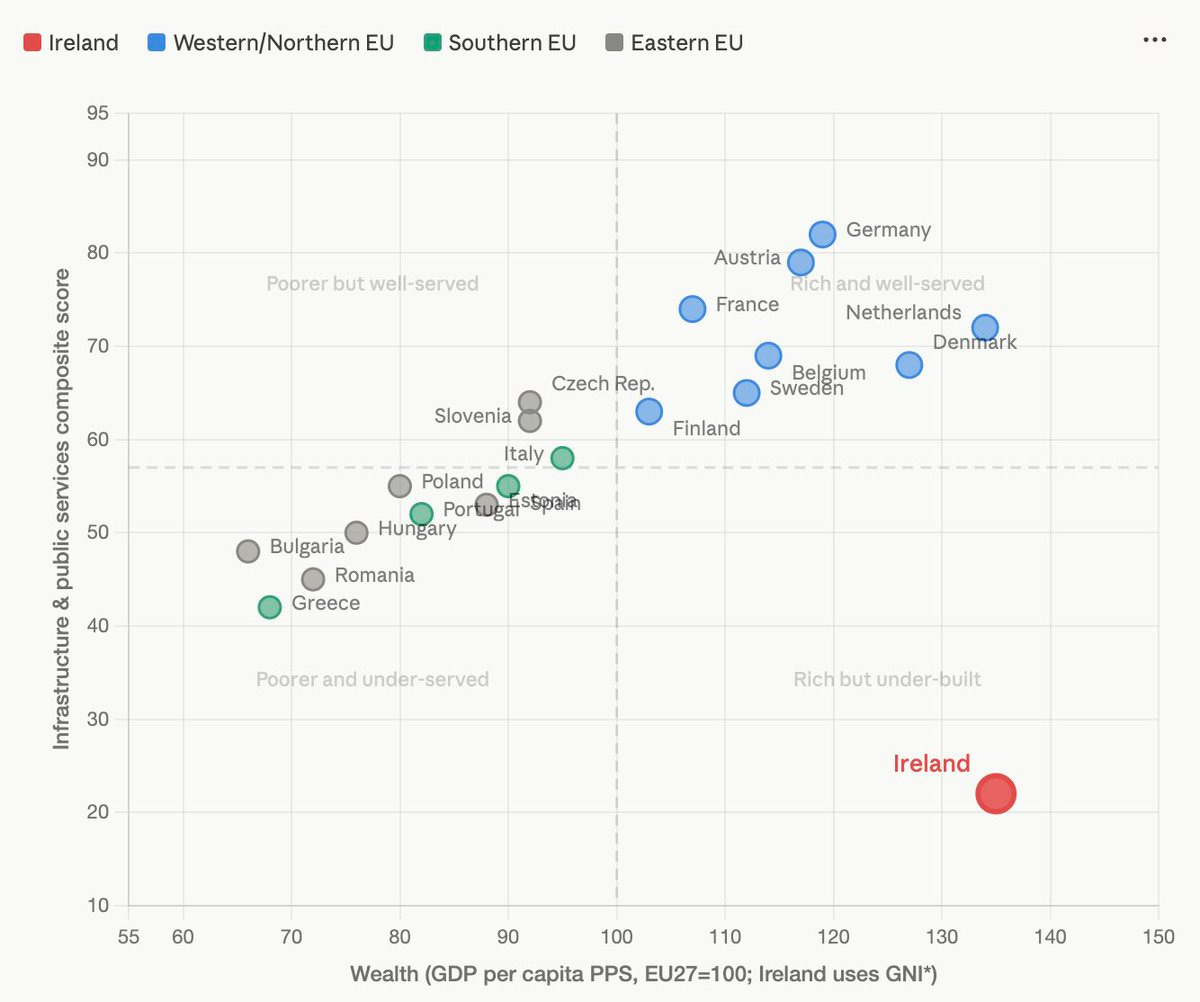
I suspect this one did though because it showed people something they feel every day and placed it next to something they keep being told.
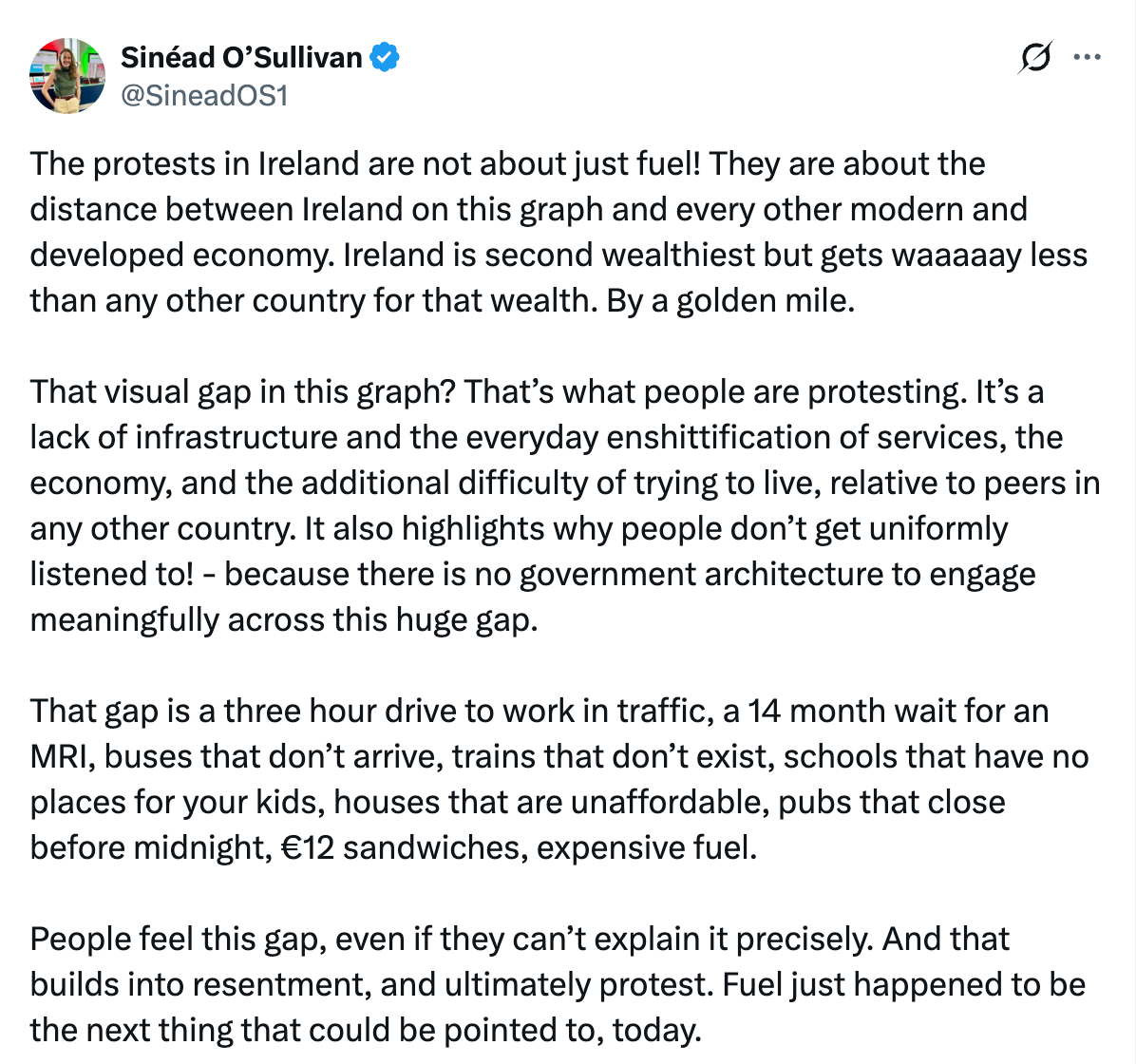
They feel: the three-hour commute in traffic, the closed GP list, the €2,200 rent, the fourteen-month wait for an MRI, the buses that don’t come, the trains that don’t exist, the schools with no places, the pubs that close before midnight, the €12 sandwiches.
And they keep being told: Ireland is the second richest country in Europe with a €23 billion surplus, record employment, and even if you’re not happy with this, just shut up and put up.
The distance between those two experiences is the distance between Ireland and every other dot on that graph! People looked at it and recognized that their own lives exist exactly in the gap. Fuel just happened to be the thing that broke the surface this week, but that gap has been there for a decade, and is indeed growing.
What kind of rich is Ireland?
A lot of why the gap in my graph exists has to do with the nature of the wealth itself. Ireland’s prosperity is not generated, it is extracted. But the extraction runs in an unusual direction.
The classical colonial model was geographic, in that a colonial power occupied a territory, extracted its resources, and shipped the value home. Britain did this to Ireland for centuries as we’re well aware with land, labour, food, leaving behind famine and underdevelopment.
Then the next post-colonial model got rid of the occupation (no boots on the ground in the colony) but kept the structure. In this model, the power outsourced the extraction to corporations. And in this way, the British Empire became British Petroleum, just as the Dutch East India Company became Royal Dutch Shell; the value still flowed back to the colonizer but it was through contracts, concessions, and transfer pricing rather than garrisons. The colonized country gave away its resources while wearing the environmental and social costs of this program.
Each colonial iteration has required less of the colonizer. The first model required armies, occupation, and physical control of territory. The second required corporations and contracts, as well as physical oil pipelines and ships carrying physical commodities.
Today, Ireland represents the third and latest model: extraction without even leaving the country! No armies, no pipelines, no ships, and nothing physical crossing a border at all. In fact, hilariously, Ireland does not go to the wealth; the wealth comes to Ireland!
Why? Because Ireland offers the one thing a globalized digital economy values above all else: a favorable tax jurisdiction. The resource being extracted is not copper or oil, it is a tax base. And the extraction is so clean and frictionless that the countries being extracted from (the US, France, Germany, every country where the products are actually designed, built, and sold) barely notice it happening at all. Or, as we are seeing… they are starting to realize it, but simply cannot stop it.
But there’s another big difference in Ireland’s model that’s fascinating.
In the classical model, the colony was exploited and the colonizer enriched. In the Irish model, everyone is exploited except the corporation that is giving up its resources (tax money). Today, the US and the countries where products are sold lose tax revenue. And Ireland itself also loses out, because despite collecting €28 billion in corporation tax, it has not converted the proceeds into functioning public infrastructure.
This is largely because the money was never connected to domestic economic activity in the first place. It was just handed to the state without requiring anything of the Irish economy: no workforce development, no supply chain construction, no infrastructure investment, no institutional capacity. Once it arrived, it was immediately distributed to Irish citizens as wealth transfers (e.g. heating subsidies! the HAP!), and the gap between what Ireland could afford and what it could actually do grew wider every year.
Ireland is not a colonizer, of course. But it is a node in an extraction system that siphons tax base from every country where real economic activity occurs.
A country might justify that position if it used the proceeds to build something (anything!) like world-class public services, extraordinary infrastructure, or a society so well-functioning that the trade-off had a visible return. Ireland did… None of this. It extracted from others and failed to build anything for itself. That is the uniquely disgraceful aspect of the Irish model; not the extraction alone, but the total nothingness that followed it. The nothingness we live in.
In short, Ireland found a way to be rich without ever needing to develop itself, believing that “tax revenue” meant “prosperity”. The farmers on O’Connell Bridge and the nurse emigrating to Melbourne are both living inside the consequences.
What do you actually get?
Let’s go back to the chart quickly.
The y-axis is a composite of five metrics that measure, in different ways, what a state actually delivers to its citizens in physical infrastructure and public services. I chose these five simply because they are available across all EU member states from the same credible sources, making the comparison consistent. They span health, transport, and public investment.
The data is publicly available here. Go knock yourself out playing with it!
A note on methodology: nobody is funding this research. This is not the output of a multi-year PhD program or a commissioned report. I built this graph because I was curious, and I used these five metrics because their data was publicly available, easily comparable, and could be collected in a reasonable amount of time by one person with far too many other things to do. If I were doing this with a team and a budget, I would use more metrics, weight them with greater sophistication, and subject the composite to formal sensitivity analysis. All I had was a question and a few hours on a late evening after work.
This graph is an honest first approximation, not a definitive index. But as the response has shown, the pattern it reveals (that Ireland is an extreme outlier among wealthy European states) is one that people recognize immediately from their own experience. A more sophisticated construction would not move Ireland out of the bottom-right quadrant, it would just measure more precisely how far into it Ireland sits!
I’ve got a summary of the data I used at the end of this post, so as not to bore those who don’t care!
Does the weighting matter?
No. And here is why: Ireland scores badly on every single component, not on one metric. And not on two. On all four. You could weight hospital beds at 50% and everything else at 12.5% each and Ireland is still in the bottom-right quadrant. You could drop rail electrification entirely and Ireland is still in the bottom-right. You could substitute entirely different metrics (housing completions per capita, broadband speeds, emergency response times) and Ireland would still be in the bottom-right quadrant, because Ireland is not marginally behind its peers on one or two dimensions. It is dramatically behind on all of them simultaneously. That is the finding. The composite construction is secondary to the pattern, and the pattern is robust to any reasonable specification.
I have not used some magical, PhD-level maths (although I could if I wanted to get fancy). I am not trying to trick anybody to prove a point. The fact of the matter is that whatever statistical treatment you give this, Ireland is still… considerably shitter at most things than our EU peers.
What people got right and what they got wrong
Several people pointed out that some countries with few hospital beds (e.g. Sweden, Denmark, the Netherlands) have strong primary care systems that reduce hospital dependency. This is correct, and these countries made a deliberate policy choice to invest in GPs, community care, and preventive medicine so that fewer people need hospital admission. Ireland has not made this choice. Ireland has both few hospital beds and weak primary care. 75% of GP lists are closed, while hospital bed occupancy is at 95%... the highest in the OECD. Ireland has the worst of both models.
Others argued, correctly, that Ireland does not tax its own citizens at Nordic levels. Brigid Laffan noted that 38% of Irish workers pay no income tax, that employer PRSI is among the lowest in Europe, and that the domestic tax base is narrow. This is all true, and it is central to my argument rather than a rebuttal of it. Ireland’s total tax revenue was €126 billion in 2024. (it doubled in a decade!). But the revenue comes disproportionately from multinational corporation tax, not from broad domestic taxation. This is the rentier structure: the state has Nordic-level money without a Nordic-level social contract. The Nordics tax everyone and everyone expects services in return. Ireland taxes almost nobody domestically and funds the gap with corporation tax from three American companies.
But… here’s the kicker. Irish middle-income workers are not lightly taxed. Marginal rates above €40,000 are among the highest in Europe when you combine income tax, USC, and PRSI! These workers pay high taxes and receive poor services. And the gap between what they contribute and what they experience is filled by revenue from Apple, Microsoft, and Eli Lilly.
That is the worst of all worlds; having heavily taxed workers receiving poor services in a country running a €23 billion surplus funded by companies it doesn’t control. That is the graph that you’re looking at.
The hierarchy of coping
Now to get onto what that graph represents.
A large section of the Irish public watched the fuel protests with distaste, calling the protestors selfish and only out for themselves; holding the country hostage for their own interests. This reaction was genuine and widely shared. But also, it deserves serious examination!
Ireland has a long tradition of protest, yes, but a very specific kind. We march for Gaza, we march for Repeal, we march for marriage equality, we hold vigils for asylum seekers, etc etc. These are protests on behalf of others, or for abstract principles, or against injustices happening somewhere else. They are deemed acceptable because they are selfless, and occur in a way such that nobody’s daily life is disrupted while nobody loses out. In effect: these protests require no skin in the game. The traditional Irish protest is a demonstration of values, not an exercise of power.
A normal Irish protest is not felt as threatening to the state because a typical Irish protest does not usually ask the state to do anything it doesn’t want to do!
The fuel protests were different. They were disruptive, self-interested, and they were farmers and hauliers and contractors fighting for their own livelihoods, not for a cause that could be applauded from a distance. These protestors had real skin in the game. And the public reaction (“they’re selfish, thuggish, not like a real protest!”) tells you everything about how Ireland distinguishes between acceptable and unacceptable dissent.
Acceptable dissent = symbolic.
Unacceptable dissent = effective.
But here is the thing no politician wants to say, so I’ll go right ahead and say it for them. In a state where access to services, infrastructure, and basic economic viability is shrinking, everybody is acting in self-interest, whether they admit it or not! The Irish economy, despite the massive wealth, has become zero-sum for most. So out of necessity, everybody must be selfish. The only question is the form of selfishness that people take:
The haulier who blockades a fuel depot is protecting his livelihood in the cheapest way available to him. It is disruptive, visible, and widely condemned.
The middle-class professional who buys private health insurance, drives because there is no public transport, and says nothing about any of it is protecting herself in the cheapest way available to her. It is invisible, silent, and highly respectable.
The young graduate who emigrates to Melbourne is protecting his future in the cheapest way available to him. It is culturally sanctioned and even celebrated as “personal growth”.
The elite insider who secures a planning favor, a board appointment, or a contract through connections is protecting his position in the cheapest way available to him. It is invisible and deniable.
Each of these is a rational response to the same collective failure: a state that does not provide anything that its people needs, so get those provisions elsewhere! The only difference is that some forms of self-preservation are socially acceptable while others are not.
For example: The middle-class family paying €3,000 a year for health insurance they shouldn’t need is engaged in exactly the same act as the farmer blocking a fuel depot. Both are trying to secure for themselves what the state should provide for everyone. One does it quietly and the other does it with a tractor. The quiet version has simply been assigned a higher social value.
And here is the part I struggle with enormously in this conversation, and that nobody wants to hear; that the quiet opt-out of the middle class and the young emigrants is arguably more damaging than the tractor protests!
Why?
Well, when half the population buys private health insurance, it removes the political pressure to fix the public system, because the people with the loudest voices have already exited. It creates a two-tier system in which public patients wait 22 weeks for an MRI while private patients wait five days; meaning the public system is actively deprioritized because the people who would demand better have bought their way out. And it redirects medical resources (consultants, beds, theaters, equipment) toward paying patients, which directly degrades the service available to everyone else.
The farmer who blockades Whitegate causes three days of disruption and it is front-page news. But the middle-class exodus to private healthcare has been degrading the public system for 30 years and nobody writes a headline about it, because it happens silently, one VHI renewal at a time.
The protesters were blamed this week for cancer patients missing appointments, for carers unable to reach vulnerable people, and for children with disabilities losing home care services. These are real and serious consequences. But they are consequences that the health system produces on its own, every single day, without anyone blockading anything!
The hospital waiting list is over 900,000 people. Emergency departments had 14,000 patients on trolleys in January alone. Cancer patients miss appointments in Ireland every week which have nothing to do with tractors on O’Connell Bridge, as there aren’t enough consultants or beds! The fuel protests made the failures visible and immediate; while the health system makes them invisible and chronic. Only one of these gets blamed.
The same logic applies everywhere. Every parent who pays for private education reduces the pressure on the state to fund public schools properly. Every commuter who buys a second car reduces the demand for public transport. Every young professional who emigrates removes one more voice that might have demanded affordable housing. Each decision is rational, obviously. But collectively they are catastrophic, because they hollow out the constituency for public provision.
The disgust directed at the fuel protesters is not really about their methods, it is about the discomfort of watching people do loudly and disruptively what the rest of the country does quietly and continuously: opt out of a system that doesn’t work and try to protect themselves by whatever means are cheapest.
Amazingly, despite the long-held feelings of discontent with Irish life, the fuel protesters are the only people this week who actually demanded something from the state. Everyone else has already accepted that the state won’t provide anything and made private arrangements; arrangements which hauliers cannot afford. The protesters are condemned for being disruptive, while the rest are rewarded for being compliant. However the compliant ones are the ones who ensure nothing ever changes, because their silence is the permission the Irish state needs to continue.
And continue it does, one FF and one FG vote at a time.
The gap in real time
The week itself was the gap in the graph playing out live. Ireland did not just lack the infrastructure to manage a fuel crisis; Ireland is lacking so fucking much that it lacked the infrastructure to have a conversation about the fuel crisis.
Every question the country argued about this week is a question that France, the Netherlands, and Spain answered years ago by building institutions and protocols and mechanisms:
Are the protesters legitimate?
Should the government talk to them?
Can we send the army?
Is this far right?
These are procedural questions, and in a state with functioning institutional architecture they are already settled. There’s no need for debate at all.
A persistent claim this week has been that the protests are illegal and therefore the state’s response was justified. This deserves scrutiny, because it reveals how poorly the government in Ireland understands its own legal obligations.
Article 11 of the European Convention on Human Rights and Article 12 of the EU Charter of Fundamental Rights protect the right to peaceful assembly. This is not a concession from the state, it is a fundamental right the state is obligated to protect and facilitate. The European Parliament’s 2019 Resolution on the Right to Peaceful Protest goes further: it explicitly recognizes that peaceful civil disobedience (the deliberate, nonviolent breaking of the law for reasons of conscience) is… protected! Amnesty International’s 2024 report on 21 European countries confirms that disruption should generally be tolerated as inherent to protest.
Disruption is not an illegal outcome of a protest, as the state itself suggested this week; according to international law, it IS the protest!
And yes, before you get angry with me, I don’t disagree: road blockades, sit-ins, and slow-moving convoys are disruptive and annoying, especially when the M50 on a good day is just attrocious. But they are not violent, and therefore protected.
Infrastructure obstruction (e.g. blocking a refinery or fuel depot) is more serious, and the state has legitimate grounds to act. But under European Court of Human Rights case law, any restriction on protest must satisfy three tests: legality, necessity, and proportionality. Is there a clear legal basis? Is the restriction necessary in a democratic society? And critically: is the response the least restrictive means available? Deploying the military is not the least restrictive means when negotiation, court injunctions, and specialist police units have not been tried. And as we saw, the state refused to negotiate.
And here a remarkable procedural failure emerged that went almost entirely unremarked…
It was the Minister for Justice who invoked military deployment. In every comparable European democracy, the line between justice and defence is a constitutional red line. The justice ministry controls policing, and the defence ministry controls the military. The two are kept separate precisely because the circumstances under which you deploy police against citizens and the circumstances under which you deploy soldiers against citizens are fundamentally different and require different authorizing authorities, different legal frameworks, and different accountability mechanisms.
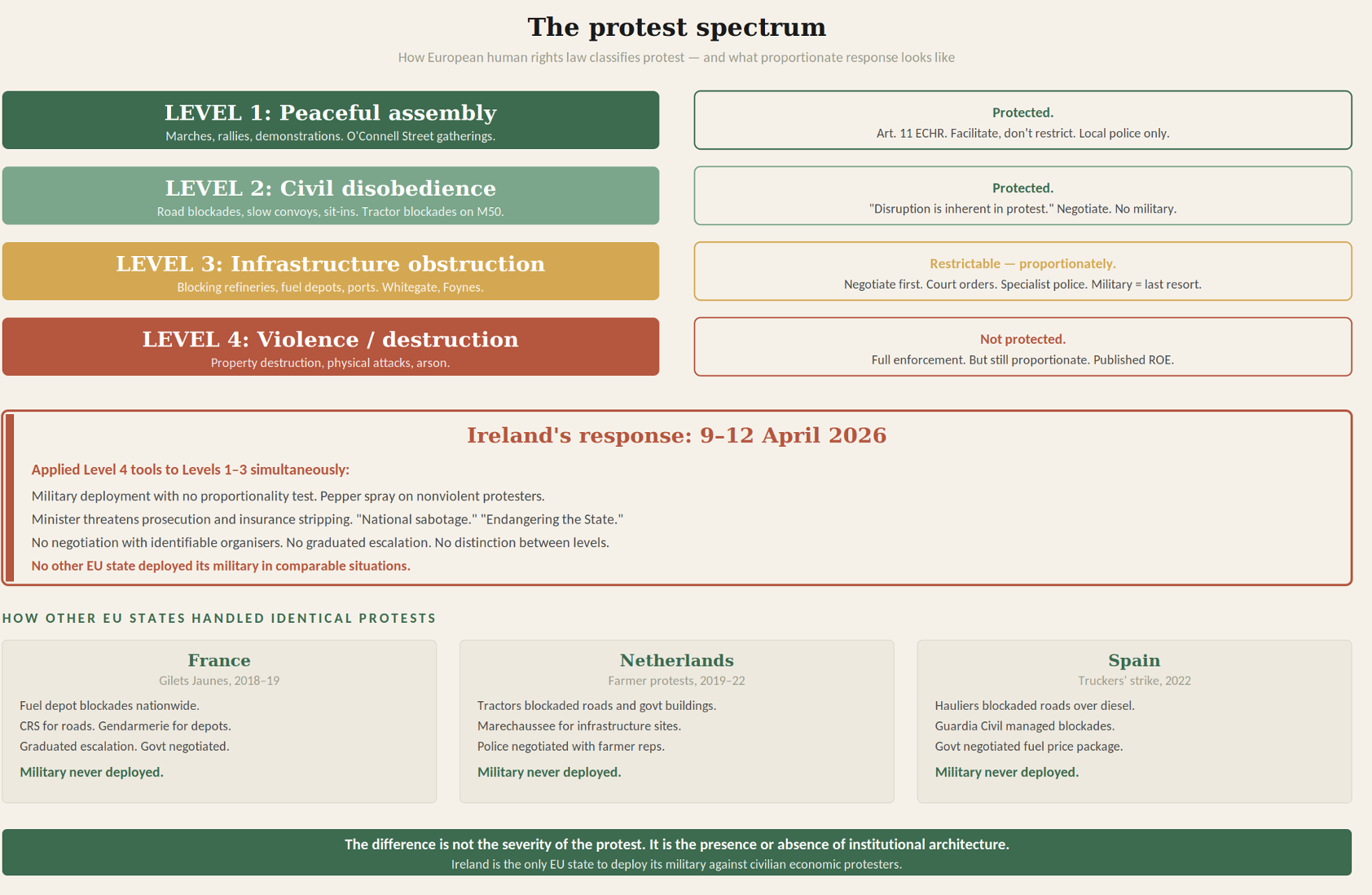
As I’ve written about here via Security Ireland, in Germany, the Basic Law constitutionally prohibits the use of military forces for police duties. In France, military deployment requires a formal legal requisition through the defence chain, decided by the President via the National Security Council. In Ireland this week, a justice minister activated the military as though it were an extension of the Gardaí — because in the absence of any framework distinguishing the two, it effectively is.
Not even anybody in government appeared to recognize that this line even existed, let alone that they had crossed it.
This is totally fucking bewildering.
What Ireland needed this week was not the army, it was proportional policing; a concept so basic that every EU member state except Ireland has institutionalized it.
Proportional policing means matching the response to the activity: facilitate peaceful assembly, manage civil disobedience through dialogue and agreed timeframes, address infrastructure obstruction through negotiation, court orders, and specialist units, and reserve enforcement powers for actual violence. Each level of protest gets a different response because each level presents a different challenge.
Yet Ireland treated a farmer on O’Connell Street, a tractor convoy on the M50, and a blockade at Whitegate as the same thing requiring the same response. They are not the same thing. The failure to distinguish between them is not a policy choice, it is an institutional absence. Yet another gap. The tools for proportional response do not exist, so disproportionate response (which is illegal in many countries) is the only option available.
Ireland had no graduated response available because no gradations exist. No gendarmerie. No specialist public order units. No civil protection agency. No crisis management authority. No negotiation mechanism for engaging with protest movements outside the licensed social partnership structures.
The government could not identify who to talk to and decided the problem was that the protesters lacked legitimacy, when the person in charge wasn’t to their liking or from a pre-approved lobby group.
But here’s the thing… The opinions we all held this week are almost… irrelevant?
And in fact, the real issue is that we were forced to have these arguments at all!
In every comparable European state, the institutional architecture settles the procedural questions in advance so that the political conversation can focus on the substance of:
Should the fuel tax be reduced?
What concessions are appropriate?
How do you balance fiscal policy against popular anger?
Instead, Ireland spent the entire week on the procedural questions and never reached the substance, because it has no procedures or protocols.
And here is perhaps the most absurd dimension of all: the Irish public just did the government’s job for it. For a week, us lowly citizens (unpaid, untrained, between school runs and commutes) conducted the institutional analysis that the state should have had on file. We debated legal thresholds, European precedent, the distinction between civil disobedience and criminal conduct, the appropriateness of military deployment. We did this on our lunch breaks, in group chats, on radio phone-ins.
The government, lacking its own understanding of the situation, then took its cues from that debate (Who is angry? What is the popular opinion?), reacting to public mood rather than leading from an existing institutional framework. This is governance by Liveline. The blind leading the blind; a population with no framework for assessing proportionality feeding its conclusions to a government with no framework for delivering it.
The entire discourse of the last week? Wow, it’s the damn gap again!
That this emotional labor was necessary at all is itself a tax on us; an invisible, unacknowledged tax on the time, energy, and goodwill of a population that is already paying some of the highest marginal income tax rates in Europe for services that don’t function.
The state collects €126 billion a year in revenue and it employs tens of thousands of civil servants; but when the first serious domestic crisis in a generation arrived, the institutional thinking was outsourced to people on their phones.
Legitimacy
The question that circulated all week: are these protesters using the Trump playbook? As in, are they copying the tactics, borrowing the strategy, playing us? The question sounds sophisticated but it misunderstands what happened entirely. They are not using the Trump playbook. They are the Trump playbook. And sadly, weather we like it or not, so are we.
The “Trump” or “Brexit” playbook is not a set of tactics that someone imports from abroad. It is what happens automatically, organically, inevitably, when a state fails to engage with legitimate grievance and an institutional vacuum opens up.
(Again, the pesky gap….)
Trump didn’t invent a strategy and export it. He stepped into a vacuum that American institutions created by failing to address deindustrialization, the opioid crisis, the hollowing out of rural communities. Similarly, Brexit wasn’t a Russian plot, it was simply what happened when Westminster ignored the north of England for 40 years. The Gilets Jaunes weren’t astroturfed, they were what happened when Parisian technocrats imposed a fuel tax on people who had no alternative to driving.
The pattern is always the same:
institutional failure to recognize legitimate grievance → vacuum is created → someone fills it. The person who fills it is never the one we would have wanted to fill it. But they are not the cause, they are the symptom.
Which brings us to the question underneath all of this: what is legitimacy, and who gets to grant it?

The liberal democratic assumption is that legitimacy flows downward: from elections, constitutions, institutions. And that if the system hasn’t recognized your demand, then your demand has no standing. This is why middle-class Ireland felt entitled to judge the protesters this week- because the middle class has proximity to those institutions. They work in the civil service, in the professions, in the organizations that interact with the government daily. Their legitimacy is pre-approved. And importantly, their complaints travel through recognized channels: union negotiations, professional bodies, well written letters to TDs, the pages of the Irish Times. When they suffer, it is understandable to the establishment.
But when a haulier in Kildare suffers, it is not understandable. That is, until he parks a tractor on a bridge, and translates the grievance into the language we all understand: traffic times, fuel prices, appointments. At which point he is condemned for using the only channel the system left him.
Dan Mulhall, Ireland’s former ambassador to the US, tweeted this week that there is a need for calm discussion but that it ‘cannot happen while the country is being brought to a halt and the law being broken.’ This is the precise formulation Ireland told Britain was wrong for thirty years. The Good Friday Agreement did not happen because the IRA stopped first. It happened because enough people recognized that the legitimacy of the grievance did not depend on the respectability of its expression!
The IRA were taken seriously because of their actions; not because of their inactions.
A country whose diplomats once brokered that insight on behalf of the IRA yet cannot apply it to a dispute over diesel has not learned from its own history. And I’ll use the word for a second time: this is bewildering.
Because there is more than one way to gain legitimacy. It can also be earned laterally, and not in the presence of a Minister or institution, but by the tens of thousands of people who share your grievance, who join the same WhatsApp groups, who drive their tractors to the same bridge, who recognize their own experience in yours. When that happens, it doesn’t matter whether the system recognizes it or not, it is real. The legitimacy is already established by the people who conferred it.
The idea that a government official would not speak to these people in an attempt to avoid legitimizing them fails to understand the mechanics of power or strategy. To which I would say to the Ministers: they are already legitimate. Just not by you.
These protesters were granted legitimacy by their size and the leverage they created, just as Trump voters’ grievances were legitimate, just as the Brexiteers’ were, just as the Gilets Jaunes’ were. In every case, ignoring that legitimacy did not make it disappear. It simply meant the people holding it went looking for someone who would recognize it. That is how you get Trump. That is how you get Farage. That is why Tommy Robinson was in Dublin this week… because the government created a vacuum by refusing to engage, and someone else filled it.
Pointing to the person who filled the vacuum as proof that the movement was illegitimate is not an analysis, it is the final stage of the cycle that produced the crisis in the first place.
The premature state
Ireland is what I have come to call a premature state: a country where wealth, sovereignty, and EU membership arrived before the institutional architecture required to make use of them was built.
Corporation tax grew from €4.6 billion to €28.1 billion in a decade, and 46% of it comes from three American companies. The revenue flooded in, but none of it was used to build the institutional capacity that every comparable European state maintains as standard. It was distributed to all of us: energy credits, landlord subsidies, double child benefit, Christmas bonuses, one-off payments calibrated to electoral cycles. 85% of government spending goes to current transfers. 15% goes to building things.
Think of it this way: every other wealthy European country treats its budget like a household that earns well and invests: it puts money into the house, the pension, the kids’ education, and the things that compound over time. Ireland treats its budget like a household that earns well and spends it all at the pub, every month until it’s gone, with nothing put aside and nothing being built. And then when the boiler breaks, there’s no savings and no plumber, so you hand everyone in the family €450 and tell them to buy a space heater.
The gap on the graph, this distance between Ireland and every other wealthy European country, is what I call the architecture gap: the distance between what this country can fiscally afford and what its institutions can actually deliver.
It is the widest in Western Europe, and it is not closing. In fact, it is widening. And this week showed what happens when it is tested: no gas storage, no energy strategy, no crisis agency, no graduated response, no negotiation capacity, and a government whose only tools were a €250 million cheque and calling in the army loaders.
And at a certain point, even the cash stops helping. You can give every household a €450 energy credit but you cannot write a cheque that fixes a three-hour commute; you cannot direct-debit someone a GP appointment that doesn’t exist; you cannot transfer a hospital bed into a system running at 95% occupancy; you cannot deposit a train line. The machinery upon which the Irish government was built from which to distribute tax from revenues earned elsewhere, was also built for problems that only money solves.
Increasingly, Ireland’s problems are ones that only institutions, not money, can solve; and the institutions were never built.
This crisis will pass and the fuel will eventually flow. The tractors will leave O’Connell Bridge and the government will announce more packages. But the gap will still be there; between what Ireland can afford and what it can do, between the state it pays for and the state it has. And until the architecture for a real state is built, every future crisis will arrive in the same vacuum and produce the same response: cheques, soldiers, blame, and nothing learned.
Hospital beds per 100,000 population.
Source: Eurostat, 2022. Ireland has 291 beds per 100,000 people. The EU average is 516. That places Ireland 43% below the average and fifth lowest in the EU. Germany has 766. Austria has 690. France has 571.
Rail network density.
Source: European Commission and UNECE transport statistics. Ireland has approximately 1,950 kilometres of rail for 5.4 million people. The network has halved since its 1920 peak of 5,600 kilometres. Rail accounts for 3.1% of journeys in Ireland, compared to the EU average of 7.9%. Meanwhile Ireland’s motorway network per capita is three times the UK’s.
Rail electrification.
Source: European Commission. Ireland has approximately 38 kilometres of electrified rail — the DART line. That is effectively 2% of the network. The Netherlands has 76% electrification. Germany has 62%. France has 55%.
GP density and access.
Source: OECD Health at a Glance. Ireland is significantly below the OECD average for practising GPs per capita. Over 75% of GP practices have closed their lists to new patients. Nearly 30% of GPs are due to retire within five years. Public patients wait 22 weeks for an MRI and 55 weeks for a CT scan. Private patients wait five days and six days respectively.
Public capital investment as a share of national income.
Infrastructure outcomes relative to fiscal capacity. Source: IMF 2025. The IMF found that Ireland faces a physical infrastructure gap of 32% relative to competitor economies, with a quality gap of 27%. Despite record government revenues, spending is not translating into comparable infrastructure outcomes.
Repeating from Twitter:
"Sinead, you have just produced more insight than our elected officials, entire civil service, academia and journalists combined.
Don't let efforts to pick minor holes in this detract. This is the analysis and debate that is entirely missing right now.
Bravo."
Some additional thoughts:
1. I am from a rural community but spent 2 decades in "the city" post MBA. There is an ability in rural Ireland to spot bullshit from miles off that is entirely absent in D2/D4/D6. Spin only takes you so far.
The policy of "ever greater State (where is Stephen Kinsella these days?)" is deeply challenged when you collect the taxes to fund the policy but fail to deliver the results.
2. People see a huge split between those in Government / Gov funded NGOs / Semi States etc. with flexitime and Defined Benefit pensions and their lives. It is the single constant and substantial bone of contention in pubs and around dinner tables across rural Ireland. There is zero attempt to deliver meaningful productivity in many of these organisations and their neighbours absolutely see it on a daily basis.
3. Ideological measures at huge cost such as retrofitting (often adequate) housing to save the planet doesn't pass the bullshit test. The ESRI report says it doesn't result in much of an energy saving either, so now its so that people can eat their breakfast in their pyjamas (per Eamon Ryan). This sort of nonsense has people paying 52% tax to fund pulling double glazing out of council houses to replace it with triple glazing ... well, pulling their hair out.
4. The scariest thing I have heard (repeatedly) from Michael Martin is that it is undemocratic to give in to a minority. This is exactly the sort of thing that someone who has never been oppressed by a majority would say. A head count does not legitimise oppression, physical or economic, of a minority. Would you consider writing a piece about the "tyranny of the majority?" for him?
5. I've seen what happens when a group of individuals try and use what Michael Martin would describe as "legitimate processes" to pursue a commercial grievance against the State. A close contact has spent 20 years trying to undo the harm caused by the State to a successful aquaculture business. They have been to the Supreme Court twice and won twice (Barlow v Min). Meanwhile there is no consequence for the behaviour of the civil servants involved and the financial consequences are still uncertain. That is what a "win" looks like when you play by the rules. 20 years of their lives gone.
The farmers / hauliers etc. are right. Blockade is the option that will deliver results. The courts and the ballot box are an utter charade. I've seen that first hand.
Great article. You should enable paid subscriptions. I was going to pay but could not :-)
I loved this line
governance by Liveline