

On Irish Sovereignty
A discussion of the Irish Triple Lock, power, and the freedom to choose

In my last substack, I dug quite deeply into the philosophical elements of defense and neutrality. If you haven’t already read it, I urge you to do so before embarking on this essay, as this is going to try to build on some of those elements.
But even for the sake of readers who have already finished it, let me begin where I left off: that for all its fury, the passionate argument over neutrality is not actually an argument about neutrality, but a nation hurling the same handful of words at one another with total certainty, albeit with no shared meaning. And doing it so loudly and so righteously, and for so long, that none of us have been able to notice the noise is little more than a hiding place, and a way to debate forever about what we should do, so that we never have to debate who we should be.
Part of this endless debate is centered on the Triple Lock, which is what I said I would discuss in this essay. For the benefit of non-Irish readers, this is a hard rule that Irish soldiers cannot be deployed abroad without three keys permitting it to do so, simultaneously: (1) the Irish Cabinet, (2) the Dáil (Irish parliament), and (3) the UN Security Council.
The parties leading the Irish Government want the third key (of the UN Security Council) gone, on the grounds that it is intolerable for Moscow, or Beijing, or Washington to hold a veto over Irish peacekeepers. The Opposition within the government, however, call this the dismantling of neutrality, as it could give way to Irish military being deployed more readily — the slippery slope argument. And wedged between them sits a third camp, led with great irony by a former Fianna Fáil Defence Minister inside the Taoiseach’s own party, who wants to reform the triple lock, but not scrap it.
As of writing this, the revolt has won its next round and the whole thing has been shoved back to be debated endlessly again in the autumn.
So: One side of this debate argues about what we may do, another about who we are, a third about how we’re allowed to decide it. And almost everyone has agreed on something: the Triple Lock debate has become a useful proxy for the ten million aspects of neutrality we’ve never defined, which I suppose is exactly the appeal of this debate. Which is that this single mechanism fits on a ballot card, whereas the entire question around state identity is too big to argue about.
So unlike neutrality, the debate around the Triple Lock gives us something slightly more tangible to grasp onto as we try to figure out the shape of the question we’re actually trying to answer.
A video was recently posted by political party Aontú, stating that a serious public discussion on the Triple Lock is long overdue. Yes, this is correct! However, in the video, the presenter says:
Neutrality wasn’t cowardice; it was a statement. A statement that we are a sovereign nation. And that policy of neutrality has defined Ireland ever since.
In one breath, and less than a minute into the video, there is a sentence that manages to weld together the two issues this whole argument keeps entangling. Neutrality (who we are), and sovereignty (what we do). And it is the Triple Lock at the center of these two huge issues, that supposedly proves that Ireland has both.
My last essay teased apart the first knot of who we are, and found neutrality to be a word we’ve never defined, sitting on top of a version of “self” we’ve never really considered.
But the Triple Lock asks a different and fundamentally more practical question about what we do. Whether we send soldiers out, and on whose permission, and by what right. However, the unspoken assumption through the entire neutrality and Triple Lock debate, and that Aontú makes in an opening sentence, is that these two questions are the same question. That who we are feeds into what we do.
But it doesn’t; and these are not the same questions. You can know exactly who you are and be unable to do anything about it; while you can act on your own accord and have no idea who you are. The debate about Ireland’s neutrality and the Triple Lock lives in the gap between these terms, of neutrality and sovereignty.
So if the last essay was about who we are, this one is about what we do. The nuts and bolts of sovereignty.
Sovereignty
What even is sovereignty? When I first started working on defense and security policy in Europe nearly three years ago, I got used to hearing the following, exclaimed passionately with fists slamming into tables, accenting the last word:
“... but we are Europe! We are sovereign!”
The problem with this statement is that sovereignty is not something that you choose to be, it’s something that you choose to do.
Sovereignty: is the capacity to make binding choices over your own domain and enforce them yourself.
Looking at this definition again, with its two elements.
The first is the authority to choose. It is the recognized right to make your own decisions, such as to sign your own treaties, set your own laws, declare your own neutrality. This is the part that gets the fists slamming into tables. It is also the part you are simply handed by virtue of the fact that you are a country. You have a flag, the ability to write laws, and the right to be left alone. You have these simply because you have borders.
The second element is the power to back that choice, which is to say having the actual capacity to make the decision lasting even if somebody pushes against it. This is the part nobody just gives you, meaning that you either build it, or you do not; but you cannot accidentally obtain it. It roughly covers (in a military aspect) the ability to defend your own territory, to see and control what moves through your seas and skies, and to make a choice and enforce it without a higher power controlling you. All of this is earned at a huge cost, over many years.
The second element is why sovereignty is not something you declare, it is something you build. The man at the table shouting we are sovereign has confused having the ability to write your own laws from having the ability to uphold them. In order words, he has mistaken the right to choose for the ability to enforce that choice.
So let’s look at the individual constituent parts of sovereignty:
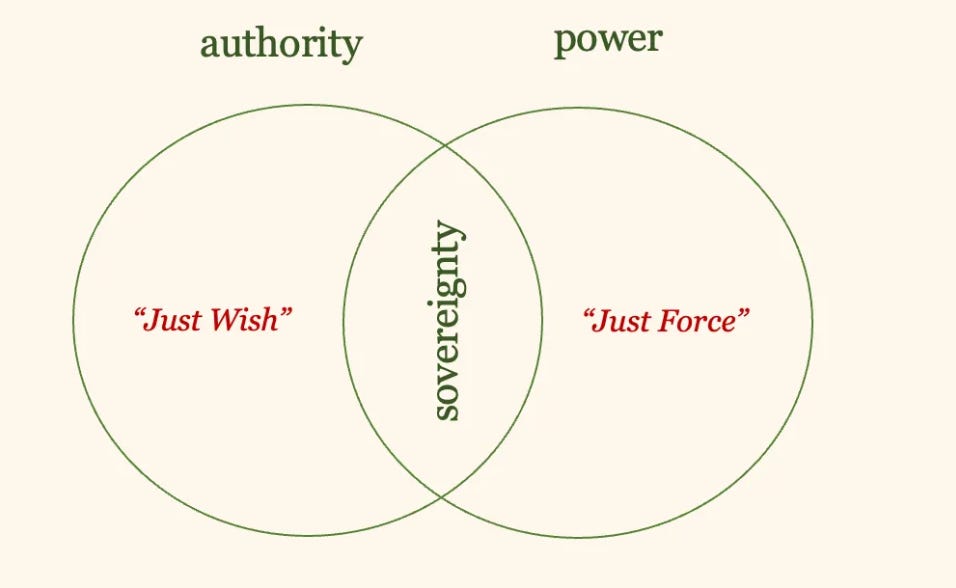
Start with the left circle. Authority without power is a wish. You may hold the recognized right to decide, but without any way of enforcing it, your decisions only matter for as long as nobody more important objects to them.
Real-world examples of these “just wish” countries are the micro-states that are fully sovereign on paper and entirely dependent on a larger neighbor for their defense; in other words client states whose foreign policy mirrors their patron’s. In the starkest cases, they are states that hold a UN seat while unable to enforce a single decision inside their own borders. The former US constitutional lawyer Robert Jackson gave this condition a name: the quasi-state.
Now look at the right. Power without authority is just force. This is the capacity to impose your will with no legitimate claim to do so. For example, imagine a warlord in a collapsed state that is holding territory with nothing but weapons; or the revisionist power that holds military strength and uses it beyond the bounds of any rule it recognizes (which is what Russia is doing in Ukraine right now); with the capacity but not the right to seize territory, and which does so anyway. So you can see, force that is decoupled from authority is not sovereignty either. It is simply domination, and “history” is essentially just a recounting of the ways in which the world has tried to build rules to contain it.
Sovereignty is that very narrow place in the middle where both authority and power overlap — it is having the right to choose, and the strength to make the choice tangible. It is a much harder and rarer thing than either other side of the Venn diagram, because it is the only part that you have to make. You cannot be given sovereignty.
So where does this leave a country like Ireland? Because we clearly do not land in the middle, and this is by no accident. For eight hundred years we were actually on the receiving end of the thing on the right of that picture, the just force. We experienced the empire, with its raw power with no authority; the proverbial boot on our necks. And when we finally got rid of this boot, we were so determined never to be that coercer throwing its weight around that we fled all the way past the middle and into the circle on the left; taking with us the recognition of our new statehood and our new flag, while never building the power to make any of it endure.
In fact, we ran so far away from just force on the right hand side, and with such speed, that we landed in the furthest distance of just wish on the left hand side.
C.S. Lewis made a point that may seem unrelated, but that cuts to the core of the morality of sovereignty — a topic which we have convinced ourselves we lead, but that we don’t even truly understand never mind possess. Lewis wrote that you only ever learn the strength of a temptation by resisting it. That you find out how strong a wind is by trying to walk against it, not by lying down.
Another way of framing this is that the person who always gives in never discovers how powerful the thing he surrendered to actually was, because he never once held out against it. And so Lewis discussed, in a seeming contradiction, that bad people in a strange way know very little about badness, because they have lived a sheltered life by always saying yes to their temptations. This claim suggests that virtue is not the absence of struggling, but what is left after the struggle.
The implication of this for Ireland is that it is possible to conflate “innocence” with mere “untestedness”. In other words, it is possible to think that our neutral “goodness” is defined by being as far away as possible from “badness”. But this is not true. The person who has never been in a position to do harm is not therefore automatically good; they are just unproven!
In fact, it is more coherent to praise a soldier who could kill and yet still chooses restraint; than praise the soldier who has never lifted a rifle, because there is no moral high ground in having no capacity. If goodness lives in the gap between what you could do and what you choose to do — and if you have closed that gap by making yourself unable to do anything – then you have not become good. You have only removed yourself from the arena in which goodness is decided.
This is precisely what Ireland has done, and it is why our neutrality has always carried the air of a higher morality, sitting far above the squalid business of force. But what if it is in fact something closer to the opposite?
We did not hold power and then refuse to abuse it, which is arguably the much harder and more noble thing. We simply never built the power that sovereignty requires, and yet somehow still interpreted our incapacity as a moral principle.
So why am I going down yet another path of philosophical questioning, if I told you I was going to discuss the Triple Lock? Because the cost of this arrangement we have with sovereignty is ultimately philosophical! This Venn diagram I’ve outlined is the reason our principles seem to collapse the moment they meet resistance.
In short: a principle you have never had to enforce is a principle you have never actually held. And it is the reason the two great rows of current Irish foreign policy, which look like separate arguments about separate things, are in fact the same argument
First, the Occupied Territories Bill (OTB). Here we had the will to do something! A clear, popular, democratically arrived-at decision to ban trade with illegal settlements. We had the authority to choose; and we chose. And then the choice simply… evaporated. It was hollowed out to cover goods but not services; then stalled for eight years, and finally explained away by the Taoiseach himself:
We don’t have the power, if we wanted to even, to stop trade.
Read. That. Sentence. Again.
It is not saying we don’t want to. It is saying we cannot. That some higher power (the United States) overrides our will, and that there is nothing we can do about it. The OTB was the left hand of the Venn diagram (a just wish) without the right hand (just power). We knew exactly what we wanted, and then we were alarmed by our discovery that we are not sovereign enough to have it!
Now take the Triple Lock. On the surface, this is a completely different debate; some sort of technical fight about whether to keep a rule that requires UN Security Council approval before Irish troops deploy abroad. And sure, from the outside it looks like a question about whether or not we want to be neutral: (1) keep the Triple Lock and you keep the neutrality; (2) remove it and you start walking down the road away from neutrality. And while one side says it is intolerable that a permanent member of the Security Council (Russia) holds a veto over where Irish soldiers can go; the other side says removing that veto is the first step out of neutrality. The whole thing is conducted as a false choice of in or out, neutral or not.
But tear back the outermost layer and look at what the OTB just taught us! The Occupied Territories Bill showed us that with or without the Triple Lock, we still do not have the ability to be sovereign on the moral questions of war.
The OTB had nothing to do with the Triple Lock. There was no Russian veto involved, no UN mechanism, no rule to keep or scrap our posturing. It was a litmus test of whether Ireland could take a clear moral position on a war and make it stick… and we could not. A higher power overrode us anyway, through nothing more formal than economic dependence and American displeasure at our desire for autonomy (how dare we!).
Again: We don’t have the power, if we wanted to even.
So the Triple Lock debate is, in a sense, a fight about the wrong thing. Both sides believe that the question on the table is whether a foreign power gets to override our will: if we keep the lock and Russia overrides it, but if we scrap the lock we get to take decisions back into our own hands. But the OTB has already shown us that this is an illusion. We do not take the decision back into our own hands by scrapping the Triple Lock, because the thing that overrode us on Gaza was never the Triple Lock to begin with. It was our lack of power to be able to enforce our own wishes!
In fact, if we remove the Russian veto, the next moral question of war that we will run into is exactly the same wall the OTB ran into – which is that our problem is not a rule we can repeal, but a dependence on others for security that we never addressed, let alone acknowledged.
This is the thing the whole country is arguing around, but never about. The Triple Lock looks like a referendum on neutrality, but the OTB has already shown that neutrality is not the variable that matters. Sovereignty is.
And whether we keep the Triple Lock or not, while declaring ourselves neutral or abandoning the policy entirely, we will still be a country that cannot enforce our own moral choices about war. Why? Because we built the authority to make those choices and never built the power to back them, which is the definition of sovereignty. The OTB is not a separate scandal from the Triple Lock; it is the answer to the debate on the Triple Lock.
So if sovereignty is the thing we are actually missing, then the obvious question is how we came to be missing it. And the answer is surprisingly simple, and one which doesn’t include bad luck or a failure that we back into without knowing. Actually, it was a choice. A specific one, made very early, even if we have never consciously discussed it.
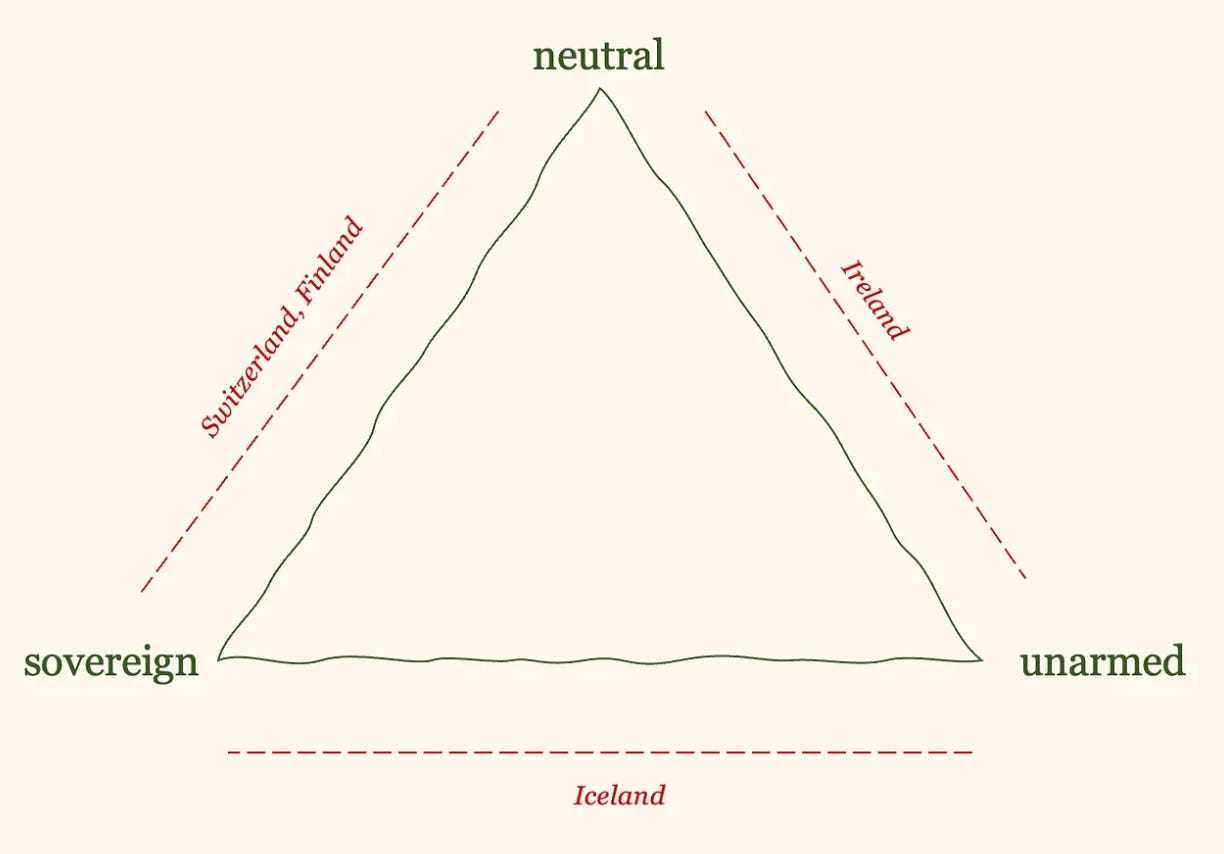
A small country gets to pick two of the following three things: sovereignty, neutrality, or being unarmed. A country can be neutral, and it can be without a serious military, and it can be sovereign… but not all three at once.
Switzerland chooses neutral and armed, and it keeps its sovereignty
Iceland chooses unarmed and allied, in that it doesn’t have an army, but inside NATO; and thus kept a version of sovereignty by pooling it (trading some autonomy for a security guarantee).
Ireland? Well, we obviously chose neutral and unarmed.
Which means… drumroll… that we chose the corner that gives up sovereignty. We are the country that kept the unarmed posture with empty barracks, subtly letting the sovereignty go; while simultaneously spending one hundred years telling ourselves this combination was the sovereignty.
Simply put, when you do not defend yourself, someone else does. And that “someone else” is never neutral.
Irish airspace is policed by the Royal Air Force. Irish sea lanes and cables run through a security order underwritten by the United States and the United Kingdom. We are not, somehow magically, floating free above the world’s political and military blocs; we are under the umbrella of two very specific powers. And no, you do not get to choose the politics of the umbrella you stand under. A protector’s protection comes bundled with a protector’s posture. Our security guarantee is paid for, whether we openly discuss it or not, in alignment.
And sadly, the two powers whose umbrella we shelter under are the very two whose foreign policy we find most repellent. We march against American wars while American troops transit through Shannon to fight them! Indeed, we condemn the conduct we deplore while we depend, for our own safety, on the power conducting it. Our neutrality does not hold us apart from great-power politics even if we endlessly tell ourselves this falsity. It actually binds us to it, on the worst terms, with all of its ugly dependence and none of the leverage to object effectively.
The Occupied Territories Bill finally exposes this incoherence. We are a former colony; a people who understand the trauma of dispossession all too well, and yet, on Israel and Palestine, the Irish state is pulled again and again, over and over, toward the position our protectors hold rather than the one our history should dictate. So while we wanted to be the country that stood with the colonized, we built ourselves, instead, into a country that cannot afford to.
You see, our security (as well as the economic order that sits atop it) depends on the two most steadfastly pro-Israel countries on earth. This contradiction is structural, in that we have built both our economic prosperity and our protection on patrons whose ideology we do not share, and yet are somehow surprised that we cannot freely go against our patron on the question it cares about most — Israel.
What economic sovereignty might look like is a question for another day that I’ll come back to. For now, I want to discuss how we might achieve Irish sovereignty: by either forfeiting neutrality or by becoming armed.
And since my last essay was on the question of neutrality, now I want to look in more depth at what it means to become armed. At defense.
The anatomy of power
While the “power” part of the sovereignty Venn diagram can refer to many things, the most foundational aspect of this is defense. But what even is “defense”? It’s important to define, because it can mean many things to many people, and is yet another source of people shouting past each other endlessly.
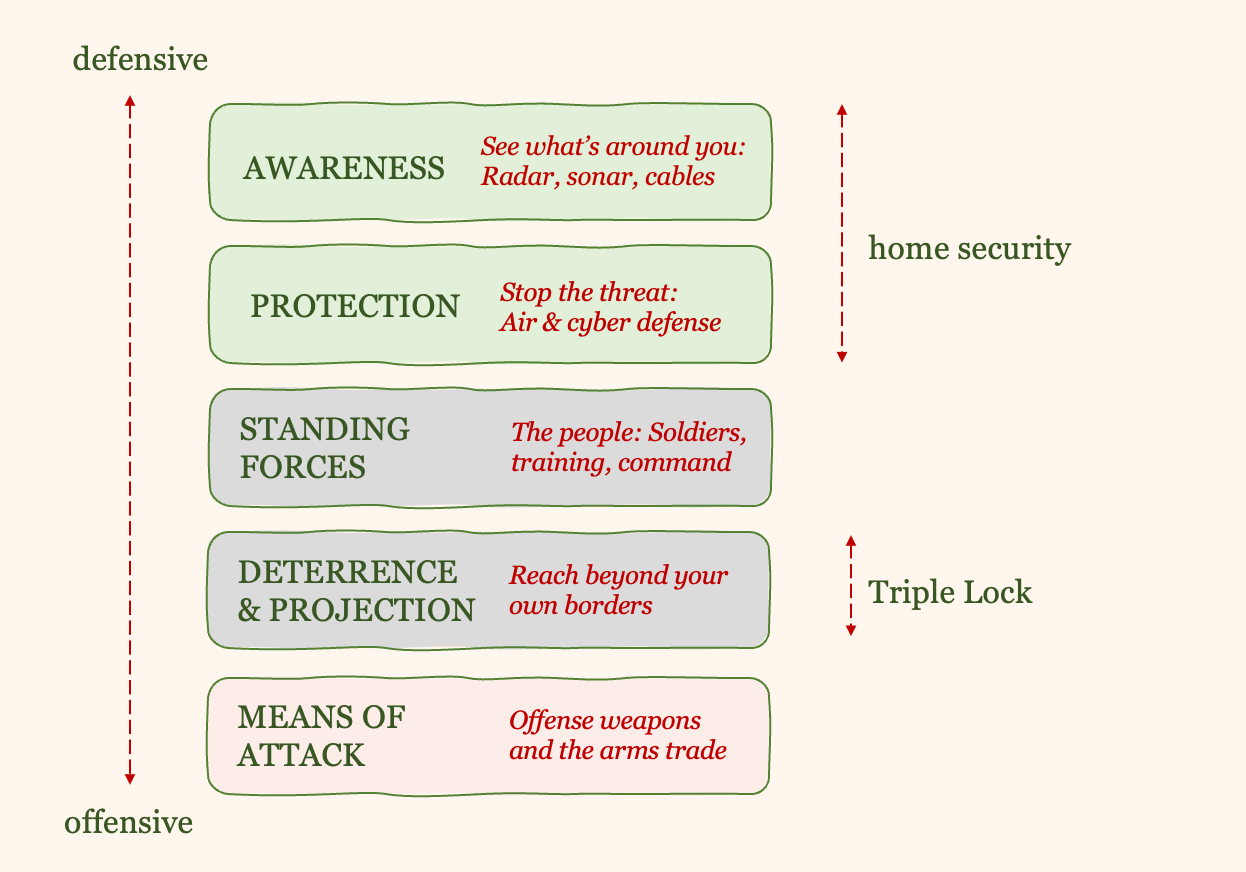
Think of defence as a chain with five links, running from the most defensive at the top to the most offensive at the bottom.
At the top is awareness, which is simply knowing what is happening in and around your own territory. Radar, sonar, maritime patrol, watching the seabed and the cables, and the cyber equivalent of these same things. This is the most “harmless” end in that it threatens no one.
Then there is protection, which entails stopping a threat once you have seen it. For Ireland this would include air and coastal defense, defending the power grid and the hospitals from attack, search and rescue, etc. Still wholly defensive, as it acts only when something is already coming at you. These first two links are what we might call “home security”, and together they are the entire substance of sovereignty; the part that you build for yourself, and yet that we rely on others for.
The third link is the standing force itself. The people, the training, and the institution of armed forces. Think of it as a body of knowledge. I have separated it out here simply because a lot of what people feel about “defense” is really feeling about armies and soldiers, and in the Irish context, it is where we have a deep reflex that says “armies” are what was done to us.
The fourth link is deterrence and projection, which is the capacity to reach beyond your own borders, or to hold a threat credible enough to change someone’s behaviour without even using it. Here is where you cross from defending your own territory to shaping events elsewhere, and it is the place where neutrality kicks in. This is the place where a country can reasonably say not us. This, in fact, is the link the Triple Lock actually oversees.
Importantly, up until this fourth layer, is everything that is included in neutrality.
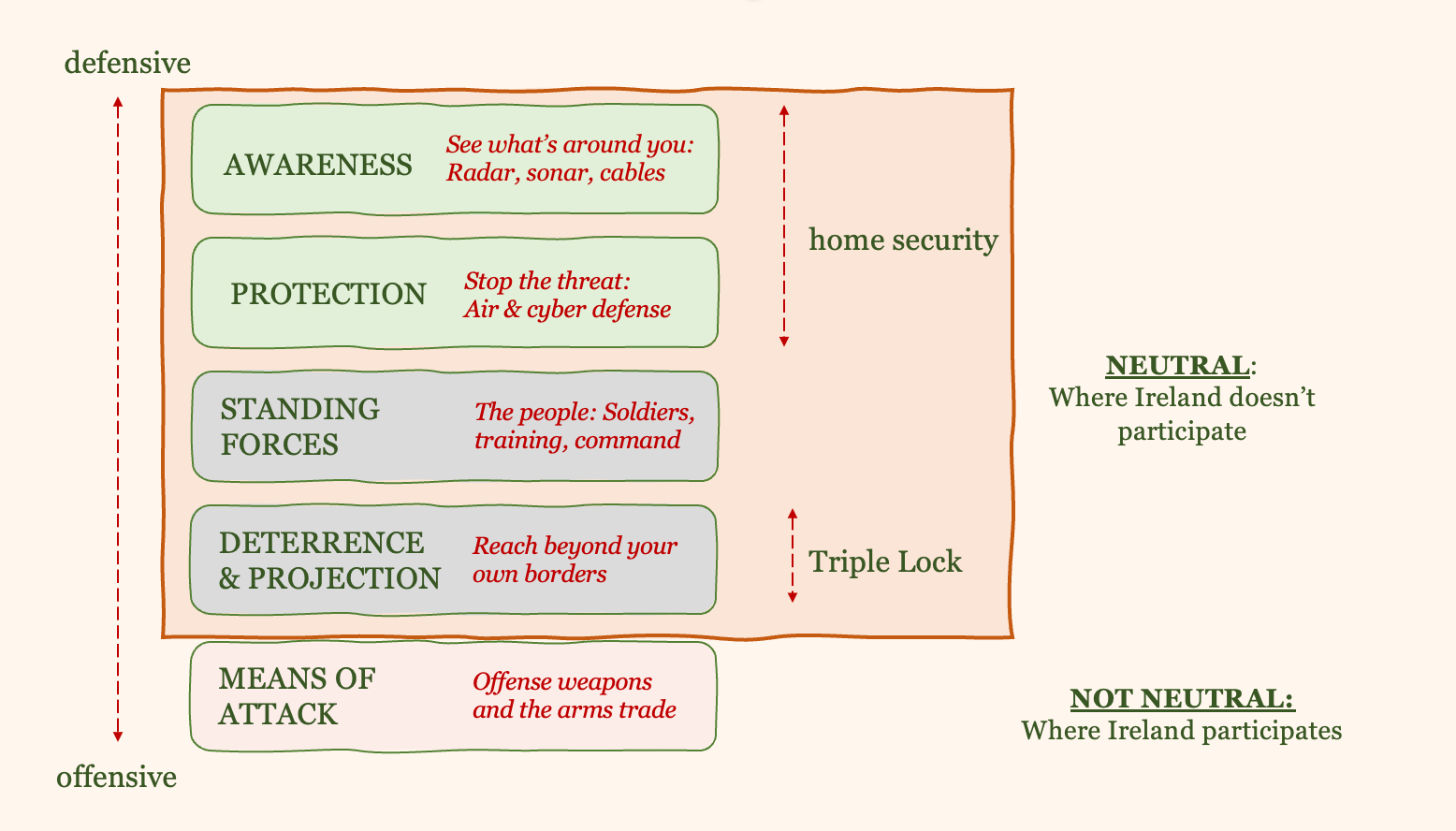
Finally, the fifth link is the means of attack. It is the offensive weapons themselves and the business of manufacturing and selling them. Think about missiles, strike aircraft, the arms-export business, and the dual-use technology that ends up in someone else’s war. This is the part of the value chain whereby someone starts to think: “warmonger”.
Now here is what a coherent neutral does with that chain:
It builds the top link by watching its own waters and defending its own ground, because that is what keeps it independent (read: sovereign)
It declines the “projection” link, as it does not project force or join others’ wars.
It polices the “means of attack” link hardest of all; it refuses to be a supplier into anyone else’s war, because feeding a war is the most direct possible breach of taking no side.
A serious neutral may keep an army and still never touch the “means of attack” within that chain, as the top end is what neutral countries build, and the bottom end is what it refuses.
But look at what Ireland does, which is not even a milder version of that, but its exact opposite!
We are absent from the top. We do not watch our own seas in any serious way, and we cannot defend our own sky. So the awareness and protection a neutral builds first, we have simply never built. We have withered away at the “standing forces” link, as we have a defense force that is shrinking below the size needed to run even what little it has. And we decline the “projection” link, loudly and constantly. We would never project a war; we would never join. (And this is the one place we and the coherent neutral actually agree).
And then, at the very bottom, we find the one link that a neutral refuses most strictly, but in that Ireland is actually a supplier!
Aughinish Alumina, on the Shannon estuary, is Russian-owned, one of the largest alumina refineries in Europe, and it feeds the aluminium that feeds the Russian war machine even now. Indeed, Ireland licensed some €20 million of dual-use technology for export to the Israeli military in 2024. And as I wrote about in the Irish Times, it was literally the same week that Anthropic’s technology was pivotal to a US strike on an Iran school, that we welcomed the corporation as Dublin’s latest American tech company.
So, Ireland refuses to build the parts of the defense chain that a neutral is permitted to build – and indeed must build to gain sovereignty – while we participate in the part of the defense chain that a neutral must never touch.
Despairingly, the defense chain, for Ireland, runs exactly backwards.
This is a very bitter thing to understand about our own country, and I understand that it’s hard to hear while even harder to comprehend. Some people have been confused by my public demands for an increase in the Irish defense budget while also stating that we should not allow US defense-mandated companies to operate in Ireland. Some people have gone further still and suggested that I am talking from both sides of my mouth in this debate. She want neutrality! But she also wants defense spending! Make it make sense!
This is confusing only if you conflate “increased defense budget” with “reduced neutrality”. In fact, it is the opposite. An increased defense budget is exactly what will enable our sovereignty, such that we are able to make the decisions around our own moral positions so that we can, without contradiction, be neutral.
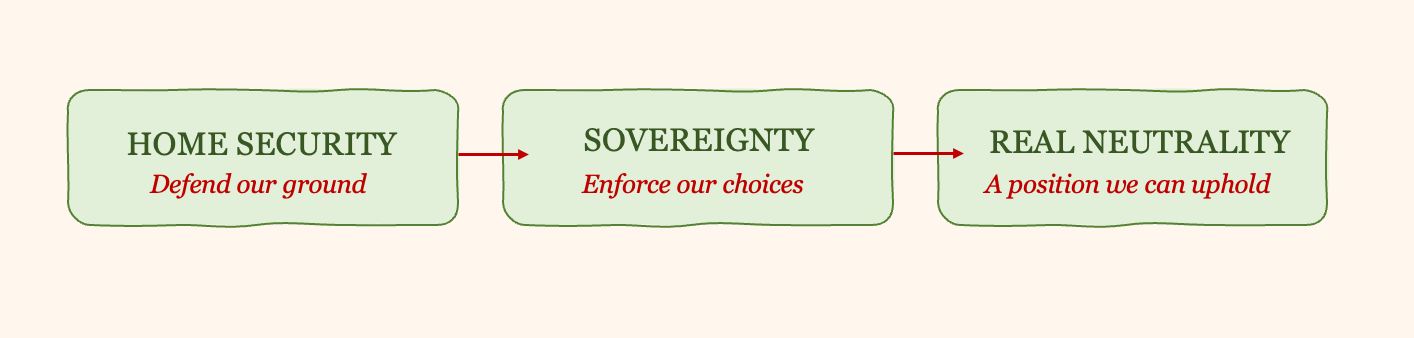
What I am asking us to build is awareness and protection, and the capacity to see our own seas. That is home security, and home security is not the opposite of neutrality; it is the precondition for it.
So the two halves of my position are not in tension; they are the same position. I believe to be morally consistent, Ireland should build the part that defends ourself, while refusing the part that implicates us. Why? Because people in Ireland seem to want neutrality, and it is the only coherent version of neutrality that there is.
Similarly, a larger defense budget is not a step away from our moral independence but the only thing that can give us moral independence. The reason we could not hold our position on Gaza was not a shortage of conviction; it was a shortage of power. That we depend on others for our security — economic and otherwise. But if we build the capacity to defend ourselves? Well then we build the capacity to mean what we say, and to take a moral position on a war and to make it endure.
Yet we do not do this. It is sobering to realize that the one part of the defense chain we actually engage in is the means of attack. We have somehow talked ourselves out of the cable-watching while doubling-down on the alumina.
The company we keep
It is also worth discussing the most sordid part of the defense chain — the means of attack — because unlike any other neutral country, it is the only part of the chain that we are, with both feet, very firmly and shamefully standing in.
I can tell you from experience, as I teach this topic, that the global arms industry is extremely dysfunctional. By which I mean a structural dysfunction that has two distinct features which, when considered together, make the industry dynamics highly corruptible.
The first is a single buyer. A defense company ultimately sells to governments and mostly only to governments, which means it avoids the normal discipline of a market. So in this industry, prices are negotiated rather than competed, and the state cannot let its “national champion” (aka Boeing or SpaceX or Thales) fail, so bailouts of such companies are always implicit. These companies are “too important to fail” and thus can do whatever they want.
The second is that there are only a handful of sellers. A wave of mergers a couple of decades ago collapsed dozens of firms into a few giant defense “primes”, so that a few sellers now face one buyer in a closed loop.
On top of this, there is also a revolving door of:
Government officials → Company boards → Think tanks that write the threat assessments that justify the budgets → Weapons deliberately built across as many districts as possible so that no program can ever be canceled.
Voila, now you have a machine that manufactures its own demand, ready to be applied at will to any enemy (or friend) of Presidential choice. Eisenhower, who built the largest war machine in history, is the one who dubbed it the Military Industrial Complex while warning us about it. And no, he was not a crank. He was right about his judgement of this industry!
And yet this machine, which works hand in glove with the governments of America, the UK and others, has helped produce a run of catastrophes that the people who oppose Irish defense have every right to point at. I use the word catastrophe in this instance because no single other word can encapsulate the scale of horror about which I am discussing.
Iraq, invaded in 2003 on intelligence that everyone now admits was false, left hundreds of thousands dead, a region destabilized and the preliminary conditions for the creation of the Islamic State. Similarly Afghanistan endured twenty years of warfare and trillions of dollars of US spending, only to have the same regime back in power at the end of it but without the men, women and children who made up its population. Oh, and in Libya – an intervention that collapsed the state, opened slave markets, and created a migration nightmare that is of an overwhelming proportion.
These were not defensive wars. They were force projected across the world by powerful states — aided by the bottom of the chain I just outlined — and they were completely avoidable disasters.
Now. There is no committee, or cabal, or single hand on the wheel of these wars, as some conspiratorialists like to believe. However, it is probably even worse than that, and yet somehow even more boring. These wars are the natural outcomes of what a system produces when groupthink, careerism, the budget-maximizing instinct, neoliberalism and (as always) a total absence of consequences are allowed to run unchecked.
I, more than most given the time I’ve spent with Congressional policy-makers in the defense world, can confirm that threat-inflation is the safest career move in Washington DC; no one was ever sacked for over-warning (or over-warring). Can you name a person who lost their job, or a pension, or a seat in the Situation Room because of Iraq? No. The industry, and in turn the government, get positively giddy at the thought of increased military spending. If for no other reason that it is always a useful tool for propping up the industrial parts of any economy that is starting to slow.
And even worse, is that the people who presided over these catastrophes do not, ever, end up disgraced. Rather, they end up rehabilitated! They are given chairs at the great universities, and fellowships at the institutes, with endless slots on endless panels, in which they reprocess their decisions into the bloodless language of tradeoffs and of “hard lessons learned” while they sound like a CEO discussing a bad quarterly earnings report. Don’t believe me? Listen to Anthony Blinken’s recent (and shocking) remarks at Harvard Kennedy School in which he discusses the “ooops” of Gaza.
The laundering does actually happen, and it is done in some of the most prestigious institutions in the world, which is exactly why it is so effective and so fucking hard to tolerate, because these are the same institutions upon which I built my own career, in this very industry.
So because of recent hostility to my writing about security, let me be clear about what this does and does not make me. I am not standing outside this world pointing at it, like a lot of Irish commentators on defense. I am from Harvard, a globalist university that has a questionable moral track record, and for most of my career I have, in some capacity, worked along the defense chain. I am, on paper, precisely the kind of person you should be suspicious of when they start telling you the country needs to spend more on its military. For god’s sake, I am credentialed by the same institutions that do the laundering, and involved in the industry that profits from the spending on the killing! If you distrust people like me… well, you are right to.
But… for every person in the defense industry that has later converted their hand-in-wallet decisions into respectability, there is at least one more who, like myself, will turn this into a devastating argument against unaccountable projection. And if you have read anything else I have written, you will have noticed that almost all of it, in the end, is about accountability. Why? Because the world’s evil trades on power that is left unchecked. Just last night, I had a few drinks with some American friends in the military domain, and we talked endlessly about military and governmental ethics; or the current lack thereof. It is not a coincidence that I care so passionately about accountability and sovereignty; it is a product of being in an industry that relies on countries like Ireland not having the latter (sovereignty) so that it can avoid the former (accountability).
Again, people have often misread my desire for our neutrality to be defined and labeled with a desire for it to be reduced; and yet this too is the wrong way around. I want definitional neutrality such that its current opacity cannot be further used, without accountability, by those in power, in exchange for economic benefits such as jobs and economic gain that reduce our sovereignty.
Keys to locks
So, let’s go back to the Triple Lock, and remind ourselves of what the debate looks like from the outside: a technical fight about a rule, and some sort of a referendum on whether we wished to remain neutral.
And now look at what is really underneath that. A ferocious argument about sovereignty, not neutrality, being argued by a country that can not tell the difference. Both sides are indeed fighting over whose veto we would live under, with neither side noticing that the veto was never the problem; the missing power behind it was.
But here’s another question that’s rarely asked: why is this coming up now?
The Triple Lock has been there, mostly unexamined, for the better part of two decades. We were content to leave it alone, unnoticed, because that deferral worked perfectly fine while nothing forced our hand. And now, suddenly, it is the live wire of the worst type of Irish politics because the ground underneath the question has started to move under us, and from the outside.
Ireland’s entire strategy, for a century, for both neutrality and sovereignty, has been the deferral of choice. In such a way that we never, ever answer the questions that matter.
That permission to defer the debate however is being withdrawn. Whether we like it or not, Europe is rearming, and the scale and speed of it is hard to overstate. Poland is building the largest army on the continent and positioning defense as the engine of its economy; Germany has abandoned eighty years of restraint and is building a whole security architecture being rebuilt around the exact question we have spent a hundred years refusing to answer. Zelenskyy is insisting that Ukraine be ushered into the EU at lightning pace, bringing with it an oversized and heavily militarized economy. The EU diplomatic service has announced new top roles with a defense focus. Canada is positioning itself as the replacement for the United States, and as the de-facto leader of Europe’s military re-industrialization. And as this new structure takes shape, the space to stand inside it economically while standing outside it on defense starts to shrinks rapidly.
Just to be clear, I am not celebrating Europe’s re-arming, which is a response to a genuine threat. Anything but! I mean, this is a vast diversion of resources and attention toward the tools of force, and nobody who has spent time near such tools mistakes their proliferation for good news. If I had a vote on whether the world should be moving this way, I certainly would not vote for it.
But I suppose that is precisely my point. I do not have that vote, and neither does Ireland. This is not happening because we want it to, and it will not stop because we wish it would. As I move through my career, it is becoming more obvious to me that good policy-making is, uncomfortably, dealing with the realities that others find too ugly to look at.
The Triple Lock may be the first place this is surfacing in our politics, but it will not be the last. It is the leading edge of a much larger reckoning, arriving from Berlin and Warsaw and Brussels. Not from Dublin. So the choice Ireland faces is not the one the Triple Lock debate thinks it is. It is not “keep the rule or scrap it.” Actually, it is not even “rearm Ireland or stay neutral”, although this also sucks enormous oxygen out of the air. It is more brutal than that: decide deliberately about what and who we are, or have the decision made for us by a structure we did not shape.
So let me leave you where we began, with the fights about the Occupied Territories Bill and the Triple Lock. While one is about controlling trade, and the other is about controlling our troops; both are actually about whether Ireland can take a moral position in the world and be able to enforce it. Whether we have sovereignty or not.
The OTB already gave us the answer, even if we still haven’t allowed ourselves to comprehend it: no, we don’t. Because conviction without power is a “just wish”, and we have spent a century praising ourselves for never having that power. There is a difference between having conviction in a decision and having the tools to be able to reach for that same decision.
Both sides in the Triple Lock debate believe they are arguing about whether to be overridden by Russia. But we can’t take military decisions into our own hands just by removing the Russian veto, because it is sovereignty that we seem to actually desire. So if we lack the sovereignty to control our own military posture, then who controls it?
The Triple Lock is arguing that it is the Russians, while the Occupied Territories Bill is an implicit acknowledgement that it is the Americans.
There is an obvious asymmetry between those two vetoes. The Russian one that we are tearing ourselves apart to get rid of is the only one we ever chose, and the only one we can see, and therefore the only one we could ever actually repeal. Yet the American one is unchosen, mostly invisible, and unrepealable until we do the much harder task of fighting our way out of an economic and security dependence you cannot eradicate with a single vote in the Dáil. And of course it is the Russian veto we jump towards, because saying no to Moscow is the most natural path for us — the “reactive self” yet again doing the only thing it can, in our refusal and rejection. And it is… free. It costs nothing, risks nothing, and hands us the superior feeling of saying No to a great power without our having to build a single thing.
But we are overruled from outside either way, which is our seemingly permanent condition, and the only thing the great debate is really deciding is whose name sits on that overriding mechanism. In the end, we are fighting amongst ourselves, and with everything we have, over a lock we don’t even hold a key to.
Which is to say that we would still, even now, so much rather say no to Russia than yes to ourselves.
As to the question of "Who we are", I thought Michael Collins said it nicely:- "'..I stand for an Irish civilisation based on the people and embodying and maintaining the things - their habits, ways of thought, customs - that make them different - the sort of life I was brought up in... Once, years ago, a crowd of us were going along the Shepherd's Bush Road when out of a lane came a chap with a donkey - just the sort of donkey and just the sort of cart that they have at home. He came out quite suddenly and abruptly and we all cheered him. Nobody who has not been an exile will understand me, but I stand for that...'. - Also Sinead, when you asked in your last article whether we would die to defend tax havens or low corporate rate, I think the key word in the question should be 'civilisation' as Collins uses it above - what type of civilisation would the majority of people in the country be ready to die for. That is at the nub of all this.
I would be interested in the facts behind why we couldn't pass the Occupied Territories Bill. Exactly why couldn't we? What are the consequences that are so dire that we must support genocide? Please explain.