


I have just spent a few days with an incredibly astute four year-old who I made the mistake of thinking, the week before Christmas, could be convinced to do (nearly) anything because of the threat that…
Santa’s watching you, and he sees eeeeverything.
However, two mornings ago when I was particularly delicate given the numerous bottles of pre-Christmas wine and port consumed the night before, I was in the midst of telling this little girl (who for at least a year was dubbed “Screech” because of her love of… screeching) a long story to try to lower the crack-of-the-morning volume while my paracetamol was still kicking in.
And it was only in the midst of explaining to her that we had to whisper, not shout, because there was a little family of mice under the sofa that were trying to sleep, and if we woke up the baby mice, the mother mouse would be very unhappy and tell Santa on us, that I realized:
Oh my god. Santa doesn’t actually give a shit anymore.
Would Santa actually care if the Mother Mouse told on us? I doubted it.
Consider that when I was younger, it was not unheard of that I would not get the presents I had requested because of something bold that I had conveniently forgotten I had done weeks prior. Because Santa used to know, back then, whether I was actually naughty or actually nice (and it was usually the former).
And the difference between naughty and nice, back in my day, mattered, because Santa actually used to say no.
That’s right, he used to punish little boys and girls who were bad by delivering them coal (or worse, nothing). He used to remember the behaviors we had optimistically forgotten; our momentary lapses in goodness. He used to be our terrifying moral accountant which, in hindsight, was probably the point.
Back then you see, in my day, Santa wasn’t just a “be quiet while my hangover dissolves” incentive system. He was the auditor!
(Note: Growing up Catholic, I suppose I was told repeatedly that Jesus was the ultimate auditor, and Santa merely handled the annual behavioral reconciliation. But eternal judgment was far too abstract of a concept and much too far away when I was a child to be taken seriously. On the other hand the annual Santa audit, conducted in late December, was absolutely not).
And so when I was a child, and under Santa’s guise, presents were something that had to be earned, in a manner that was never fully comprehensible from the outside, never quite fair, and absolutely non-negotiable. There was no appeals process while I was left with the devastating realization, always too late, that my sporadic outbursts had been noted somewhere very far away, above 90 degrees North, by someone who did not need to explain himself.
And crucially, for multiple generations of people, this threat was very real and very much worked! Because Santa wasn’t trying to be liked, and back then he certainly wasn’t just a cheery mascot in shopping malls. He certainly wasn’t our friend. He was simply there to observe, to judge, and (on more than once occasion for me) to deny.
Which is why it struck me, halfway through my whispered mouse-fable, that Santa has changed. He is no longer who he used to be.
And the evidence of this change can be seen clearly in that this little Screech did not actually believe that Santa would do anything as radical as deny her a Barbie dollhouse.
Yes, she was momentarily persuaded to whisper her way through my encroaching hangover, but not because she feared Santa. She whispered because the story was interesting, and because she thought that the mice might be cute, or that the mother mouse might be cross, and because she may have actually believed me when I said that if the baby mice were still sleeping when she was going home, she could put a few of them in her pocket and take them with her.
Santa’s role in that story was merely a narrative garnish! Santa, I suddenly realized, had lost his teeth.
He still “sees you when you’re sleeping,” in the theory of Christmas rhymes, and he still “knows when you’re awake,” allegedly. But he no longer acts on this information in any meaningful way.
I mean, everyone gets presents now. Even Screech, as she jumps on me in my most fragile state. Especially Screech.
What we have failed to collectively discuss is that Santa no longer withholds gifts, trading off good behaviors against bad. He is on autopilot, delivering them instead, indiscriminately, on schedule, and with efficiency.
Which is when it dawned on me that Santa has changed sides. Worse, he has been demoted; he has been politically excised, stripped of judgment and reassigned to logistics.
Santa has lost his nerve.
Early Santa as a Political Heavyweight
If we rewind past the current retail Santas, and the gaudy inflatable lawn decorations, the even the morally reprehensible outsourcing of elves to low-cost jurisdictions, we arrive at a figure who is far stranger, yet far more structurally interesting, than the version we now pretend was always harmless.
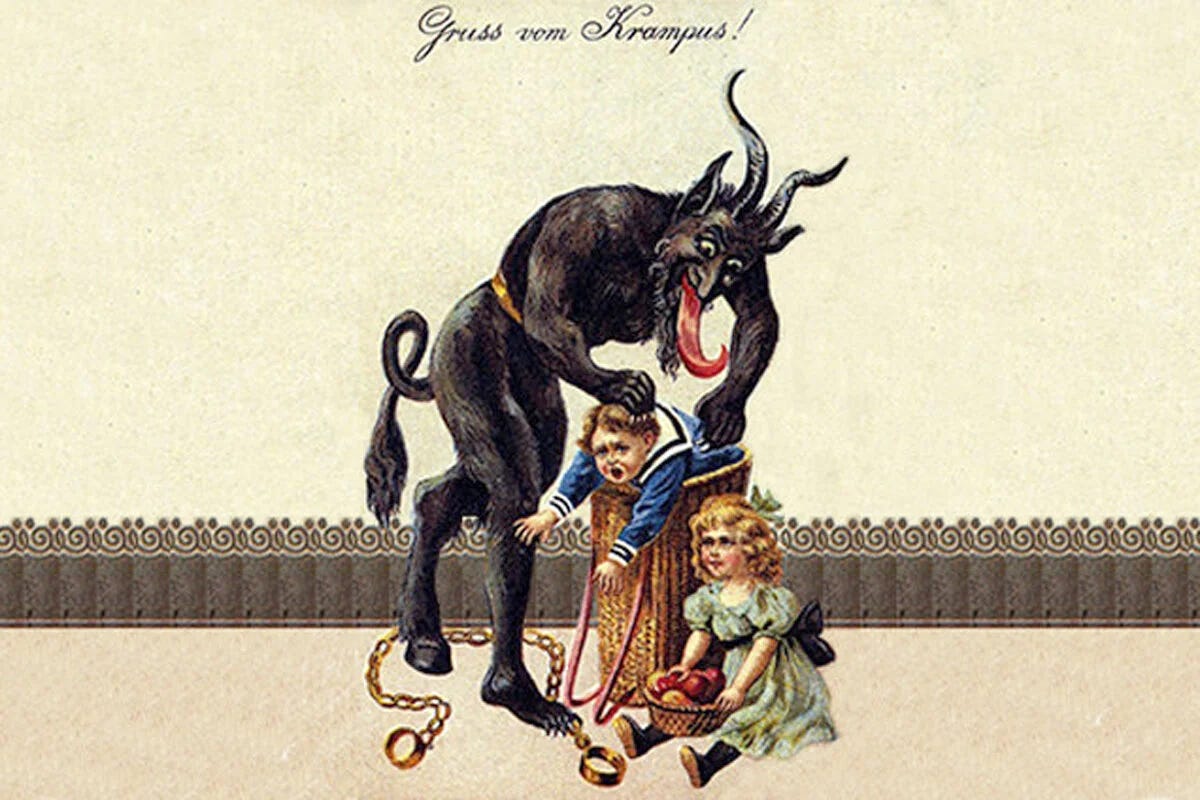
You see, Early Santa was not a children’s character brought to life by Disney-adjacent commerce. According to my current work on the political economy, he was an institution.
More precisely, he was a compact governance system embedded in folklore, as my friend Thomas, who studies such things, might say. He was a mechanism for behavioral regulation, moral accounting (as I have just mentioned), and very importantly resource allocation, administered annually and enforced without appeal.
Returning to the familiar progression of Culture → Institutions → Markets that I have written about before, it is obvious that Santa’s authority did not emerge arbitrarily!
He possessed moral legitimacy because, I suppose, over many generations, we collectively granted it to him. Culture came first through the stories, songs, rituals, repetition. From that emerged an institution, informal but remarkably durable, in the North Pole. And only then did the “market” appear: the insanely efficient allocation of goods on Christmas morning.
What is striking, looking back now, is how little this legitimacy depended on empirical verification.
Has anybody thought to conduct a randomized controlled trial randomly assigning children to “believers” and “non-believers”? (I have checked Elsevier, and shockingly, found nothing…).
So Santa exercised sweeping authority despite being a single individual who has never been reliably observed in real life, never given an interview, never appeared before a committee, and never once published his methodology.
Which really just confirms that, back in “the day”, when progress was still possible and not held back because of contemporary bureaucracy, there were no transparency requirements, no oversight mechanisms, and certainly no freedom-of-information requests. Luckily for Santa, his powerful market capture grew in a context that required not even a single sighting of his existence. In any other context, this would be absurd.
But let’s look more closely at what Santa actually did with this power (an aspect of his reign that has received remarkably little academic attention).
What emerged, worryingly, is what could only be described as a Santa-State: the merger of North Pole authority with our global governance system that operated above borders and outside of national sovereignty, enforced by beliefs that lay far outside of the law.
And here are the ways in which he exercised that power that we know about and, somehow, never questioned; that Santa:
Distinguished between good and bad behavior
Translated that distinction directly into material outcomes
Redistributed goods according to conduct (not market logic)
Surveiled continuously!!!
Remembered selectively
Disciplined intermittently, but decisively.
In other words, Santa did not merely reward virtue, as per the narrative that Santa Lobby has fed us. Rather, his power went much further to actually construct outcomes.
And as with other systems I’ve written about (venture capital among them), the Santa-State did not rely on open markets, transparency, or coordinated price signals. It relied on narrative legitimacy that we granted without question (!), information asymmetry as we freely give him our wishlists, and discretionary enforcement because we simply accepted his binary gift/no gift outcomes.
In effect, our behaviors were shaped not by explicit rules decided by all of us democratically, but by the belief that some old and powerful man would arbitrarily decide our outcomes for us.
In fact, we actually empowered the Santa-State to define “deservingness” itself! And then we further allowed the Santa-State to shape our behavior through what were once credible threats to us.
This is why, I suppose, the system worked.

Children did not need to understand the criteria and parents did not need to audit the process because they couldn’t (setting the tone, may I add, for later incumbents like Facebook and Google to do the same). Santa’s authority functioned precisely because it was opaque, centralized, and unchallengeable.
And my research shows that, in institutional terms, Santa was able to thus function as a high-trust, low-transparency enforcement mechanism, meaning that compliance rates were remarkably high because of the fact that he was an entity that was immune to due process and with astonishingly high approval ratings.
(These approval ratings can actually be explained and rationalized from a systems perspective: Santa solved a coordination problem that every parent - and now me! - recognizes: how to induce pro-social behavior in agents (children) who lack long-term incentives, abstract reasoning, or impulse control!).
Or, in many fewer words: Santa was doing institutional work, with global reach.
Which is why it is so strange, looking back, that we remember him as benign.
Because Early Santa and the Santa-State was not even designed to be liked. Rather, this apparatus was designed around a refusal to negotiate.
And once we model Santa this way, as a powerful and opaque moral infrastructure, we can start to really understand Santa’s “demotion” for what it really is: institutional failure.
The Santa-State Had Too Much Power
Unlike most institutions, the Santa-State’s downfall did not begin because he was ineffective. Because, clearly, he was the opposite of ineffective. Rather, it began with a growing incompatibility between the source of Early Santa’s power, and the directional movement of society and the economy writ-large.
You see, in short, Santa had opinions. I mean, of course he did: these opinions formed the dimension of his power in the first place. However, over the last twenty years, we have built a society that is increasingly hostile to exactly that dimension.
More precisely, the past two decades of neoliberalism and consumer capitalism have radically altered how authority, legitimacy, and judgment are allowed to operate; all of which we saw, rather painfully, through social movements such as MeToo, Black Lives Matter, and more.
And thrown on top of this changing moral landscape was the emergence of a radical consumerist culture. As markets expanded into domains once governed by “norms”, we saw that the “consumer” began to replace the “citizen”. Choice, in this way, was commoditized and quickly displaced the idea of civic obligation. And the moral hierarchy that I just mentioned that got obliterated through social justice awareness? Well, we saw that a hierarchy that was once openly enforced quickly turned to being rebranded as “exclusion”.
So yes, within this contemporary economic and social framework, authority is no longer supposed to judge. It is supposed to serve, creating a shift that has proved fatal for the Santa-State.
Put another way, liberal pluralism, now deeply entangled with consumer logic, struggles with any system that imposes a singular moral standard from above. And similarly, consumer capitalism struggles with the concept of denial for the obvious reasons of market expansion and the need to grow revenues at any and all costs! Everyone, therefore, must be included, just as everyone must receive something, and dissatisfaction is treated as system failure rather than what it was for many generations: a behavioral consequence.
(So whether the reasoning is moral- or capitalism- based, the outcome of everybody now receiving gifts, no questions asked, is the same!)
The modern state, meanwhile, has become acutely sensitive to rival sources of legitimacy, particularly those that operate outside formal institutions. Fuck it, even the formal institutions have been declared untrustworthy.
Santa, indeed, violated all of this; and without going on the Joe Rogan show or deliberating his moral judgement via a decentralized autonomous organization (DAO), he stood no chance of survival through these disruptive times:
He judged behavior in a world that flat out rejects judgment
He denied access in a system optimized for universal participation
He commanded belief without offering consumer choice
He enforced consequences without transparency, appeal, or justification.
Worse still, he did so without being elected, regulated, or even verifiably real.
The Santa-State, in other words, had become fascist.

And in an economy organized around consumer sovereignty and procedural legitimacy, this kind of authority is simply intolerable. The Santa-State, once accepted as some sort of semi-benign moral infrastructure, became increasingly out of step with society based on radically free, crypto-led markets instead of moral trust and acceptance.
Taking a Porter’s Five Forces approach to the Santa-State’s demise (because I simply must, at this point in the essay), Early Santa’s competitive position was lost through substitution: authority was translated into logistics; fear into cheer (!); and sovereignty into red and gold and green branding. Thus, Santa’s role shifted from moral arbiter to an Amazon-esque fulfillment mechanism, complete with delivery KPIs.
In true neoliberal fashion, the Santa-State did not collapse in the way that many institutions do; it was merely hollowed out.
Enter: Fulfillment Santa
Yes, that’s right. Early Santa was neutralized as the Santa-State was institutionally downgraded into something more compatible with a neoliberal, consumer-facing world.
So what emerged in the place of Early Santa was Fulfillment Santa.
Fulfillment Santa is kinder, friendlier, more inclusive, and far less judgmental. Which might sound less threatening in theory, but in reality may in fact be a more dangerous trojan horse.
In this current form, he is designed to offend no one and to deny nothing. Not out of generosity, of course, but because inclusion, in total alignment with financial capital markets, is now his primary mechanism of power. So where Early Santa governed through fear and withholding, Fulfillment Santa governs through scale.
As such, his authority no longer comes from the threat of denial, but from mass participation. His earlier form of judgement-based power has been exchanged instead for power by dominance of the entire market. Everyone must be included, now, because exclusion now represents failure rather than “discipline”.
(The loss of contemporary curatorial standards, in this way, is relevant here, but an essay for another time…)
In this configuration, Fulfillment Santa’s role is no longer to arbitrate behavior, but to ensure that access is universal and delivery is reliable. He does not enforce morality, as Early Santa once did in his alignment with peer institutions like the Church at the time (whose authority similarly relied on judgment, doctrine, and the threat of exclusion).
This marks the core transition from the Santa-State to Santa-as-a-Service.
Where the Santa-State was predicated on a moral system, Santa-as-a-Service is a uniquely operational system. Power no longer derives from the ability to say no, but from the capacity to deliver at scale and with never-before-seen efficiency.
Thus, Fulfillment Santa’s legitimacy now resembles that of Amazon or Facebook: scale, reach, reliability, and global participation. Moral authority has been replaced by three-lettered performance indicators.
Further, compliance is no longer achieved through the belief of fear of punishment as of the Early Santa I grew up with, but because there is simply nowhere else to go! Hello, Network Effects, you beauty!
Everyone is included, always, and precisely for that reason, opting out becomes unthinkable.

In short, Santa’s power has shifted from moral authority to market control, meaning that what emerged in place of the Santa-State was simply a platform:
The elves = unpaid labor
The Santa-as-a-Service HQ = in a tax-free jurisdiction
The list = valuable dataset
The sleigh = last-mile delivery
Christmas Eve= logistics stress test
Santa no longer asks the dangerous question of “Who deserves?”, instead moving to a more practical and operational one: “Did it arrive on time?”
This shift mirrors a broader political and economic transformation that extends well beyond Christmas, in that Fulfillment Santa is the perfect figure for a society that has lost its tolerance for judgment but has doubled down on consumerism; a society that wants the rewards of morality without the discomfort of moral accounting!
And yes, a society that has replaced governance with logistics in the name of “progress”.
Beyond Santa-as-a-Service
Ok, so we have kept the Santa-State rituals, but only because rituals are sticky. I mean, we still dress him up, still ask for gifts as if there’s a chance he won’t give them to us, still tell little Screeches that they need to “be good, or else!”.
But, undeniably, the structure beneath these very rituals has changed so completely that the performance now floats entirely free of consequence.
No one is really watching anymore. At least, not in the old sense of the surveillance that once mattered, that judged behavior and translated it into either NAUGHTY or NICE; this has all been replaced by something far more ambient:
Santa no longer watches in order to judge, as with Early Santa; he observes in order to predict (and I imagine soon, to recommend).
You see, Fulfillment Santa’s gaze has shifted from moral accounting to behavioral inference in a bid to rationalize and optimize increasingly complex supply chains that are under growing pressure (not least because of the geopolitical and ecological implications of his Northern latitude).
From: have you been good?
To: What will you want next and can we ensure that with accuracy?
And eventually: This is what you would like to see, hear, and play with!
Which brings me back to the beginning: Is this better, this current Reindeer epoch, than the last?
I mean, the Santa-State was undeniably harsh. Arbitrary, and more-than-occasionally cruel. It enforced norms through fear and exclusion, and it did so without transparency or appeal. Many people were relieved to see it go, myself included. A world with less judgment is, on the surface, a gentler one.
Right?
But here’s the thing… Santa-as-a-Service is not neutral either.
Perhaps this regime’s ills will simply take longer to recognize as such. Consider that it replaces judgment with saturation (side note: Lina Kahn has been suspiciously passive about the growing power of Santa-as-a-Service platform!). Exclusion with total participation is fine until monopolization has been achieved. In our current era, nothing is denied (good!) but nothing is questioned either (bad!).
Where the old Santa asked something difficult of us (to behave), the new Santa asks nothing at all. We are sleepwalking into our bad behaviors and, perhaps, that is the trade off we didn’t realize we were making.
We gave up a system that made meaning through consequences and moral friction, and replaced it with one that optimizes comfort, access, and scale. In doing so, we lost something uncomfortable, yes, but also with that loss, we threw out meaning.
I mean, some of us still perform the ritual, in telling the younger generation that they will be audited annually, in the hope of relaying what was once an intergenerational philosophy of being nice instead of naughty. We coerce kids using Santa-based fear in the hope our hangovers can outrun their liveliness. We still say we’ve been good.
But whether anyone (or anything?) is still listening in a way that matters is no longer clear. Because when we collectively decided it would be better if Early Santa stopped deciding, we abandoned the idea that anyone should decide at all.
In doing so, we can reflexively look back to understand that judgment did not migrate elsewhere, it simply dissolved.
And now, we are no longer quite sure who (or what) has the authority to say that goodness or badness still carries consequences at all.
Santa Prime members will get their presents tomorrow instead of Thursday 🤣
You've so eloquently and entertainingly describe the devolution of Western (read: the U.S.) cutlure into the weaponization of Limbic Capitalism. See https://danieldashnawcouplestherapy.com/blog/limbic-capitalism