


TL;DR: Taylor Swift, Inc. has scaled to become America’s Queen not by inheriting a crown, but by choosing the love story so ordinary it belonged to all of us 🫶❤️🔥
Thanks to Joe Haslam who thinks (and teaches) endlessly about business scaling laws for poking me about this topic, leading me to write this post!
Taylor Swift’s problem is not fame. It’s scale.
She isn’t a celebrity anymore; she’s a sovereign state with a stronger balance sheet than Argentina and a more reliable credit rating than Turkey. Her gross revenues rival the GDP of small countries. Her fan base is a voting bloc. Her back catalog is an asset class. The normal challenges of celebrity (wardrobe malfunctions, paparazzi, fickle critics) simply don’t apply at her level.
Swift, Inc. has long transcended the entertainment industry and now operates more like a multinational: relentless growth, global distribution, currency hedging, and quarterly product cycles disguised as surprise drops.
But there’s one challenge she cannot engineer her way out of:
How to remain human at planetary scale.
This is the paradox of Taylor Swift, Inc.:
She cannot down-market her art. Fans will buy the mug, the tote, the cardigan, but they do not want “All Too Well (10 Minute Extended Grocery Store Edit).” The lyrics have to be bigger, mythic. Romeo on the balcony, blood in the wine, the scarf at your sister’s house. She is allowed to be “drunk in the back of the car,” but never truly stuck in traffic. Even her heartbreaks are cinematic. The moment she sings about laundry, the spell breaks.
She cannot stop growing. A billion-dollar pop empire is a shark: it must keep swimming or die. Swift has already eaten the record industry whole, rewriting its rules with the re-recordings. She conquered cinema, sending her tour film into AMC theaters like a Trojan horse. She conquered the vinyl market, creating thirty different versions of the same record and convincing fans to collect them all. From Nashville to indie-folk exile to billion-dollar mogul, her business model is expansionary by necessity. There is no “settle down” stage for Taylor Swift. To stop would be to shrink, and shrinking is the one thing she cannot do.
She cannot be ordinary. No one pays $800 for Eras Tour tickets to watch someone normal. No one sobs through a 44-song setlist because the performer seems “just like us.” Normal is not what you get from the woman who built an entire arena show around the act of falling through a trapdoor into a digital ocean. Swift’s magic has always been scale: confessional lyrics sung with the intimacy of a diary, staged like a Marvel movie. She is “just a girl in a dress,” yes, but also the woman who sells out stadiums four nights straight. Even her attempts at ordinariness (remember her baking cookies with Karlie? And strolling Tribeca in high-waisted shorts) were instantly commodified. The only thing less believable than her stardom is the idea that she could ever be ordinary again.
And yet, paradoxically, ordinariness is exactly what she found a way to embody.
The Solution (Taylor’s Version)
She can live out the most ordinary love story possible: visibly, loudly, joyfully.
Marrying Travis Kelce is, first and foremost, a romance. What makes it extraordinary is how ordinary it feels. The world’s most famous pop star fell for a man who is not only unafraid of her scale but delighted by it; a man who looks at her as if she is not Taylor Swift™, but simply the girl in his passenger seat. In the box seats and post-game interviews, in the unembarrassed way he talks about her, the story is instantly legible: the boyfriend who won’t commit? Check. The fleeting artist who disappears? Check. And then, finally… The man who shows up. Loudly.
What resonates isn’t calculation but recognition. Swift didn’t have to perform relatability; she simply lived it. Her choice mapped onto a narrative so familiar it felt mythic: the ordinary love story women everywhere have either lived or longed for. It’s “You Belong With Me” rewritten fifteen years later, but this time the cheer captain actually gets the girl. And in that turn, Swift pulled off what no royal bloodline, no multinational, no strategist ever has. She became America’s queen not by inheritance or title, but by choosing the ending that belongs to everyone.
The Archetypal Arc
What makes Kelce so compelling isn’t just who he is, but where he arrives in the story. He is the final chapter in a sequence that feels almost scripted, though painfully familiar to most of her hundreds of millions of fans, and anyone who’s ever tried to love in the modern world.
Before the man who shows up, there is often the man who won’t commit. Before the partner who makes it easy, there is usually the one who vanishes. Swift didn’t design this arc (it simply happened to her) but in its unfolding, it mirrored the path so many of her listeners know by heart.
Long before Kelce, there was Joe Alwyn, an actor of such mild profile that even Google struggled to maintain his page traffic. For seven years, Swift dated him largely out of sight, constructing an era of privacy that, in hindsight, reads like the romantic equivalent of a defensive portfolio: steady returns, low volatility, no dividends.
It was an era of quiet townhouses in London, cardigans and countryside, long drives where the music was off. To fans, this felt familiar… Achingly familiar. Alwyn was the boyfriend who never IPO’d. The man who says he wants the same things you do, eventually, just not now. The one who makes you start to sound like a corporate strategist in your own kitchen: what’s our timeline? what are the milestones? when’s the exit? It was “You’re Not Sorry” set to a seven-year business cycle. Women everywhere recognized the posture: patient waiting, endless justifications, whispering that surely, next quarter, things will change.
Then came Matty Healy. He was volatility in human form, a human NFT bubble: clever, chaotic, brilliant until the crash. His presence in her life lasted only weeks, but the cultural fallout felt longer, mostly because he was the archetype of the bad bet. The quick high, the sparkling chaos, the person who makes you feel like the universe cracked open and then forgets your birthday.
He was “I Knew You Were Trouble” with a nicotine addiction. Healy wasn’t built for the long haul; he was designed to spike the graph and vanish, leaving everyone who bought in feeling foolish. Every woman has had a Healy, or at least a version of him. The ghoster. The artist who weaponizes mystery. The man whose genius makes you feel small, then makes himself disappear.
And then, finally, Kelce. Six-foot-five of Midwestern enthusiasm. The tight end who not only shows up, but shows up loudly. In post-game interviews. On podcasts. At Eras Tour dates.
If Alwyn was private equity and Healy was crypto, Kelce is the index fund: stable, obvious, not glamorous to the elite but absolutely essential to everyone else’s portfolio. Her catalog was already a diversified portfolio: heartbreak as high-risk, revenge as high-yield, resilience as long-term growth.
Kelce is the stable index fund that balances it all. He is not the man who “keeps up” with her; he’s the man who puts on a foam finger and cheers from the bleachers. He’s the boyfriend you don’t have to explain.
And this, really, is why the engagement froze traffic lights. Not because of celebrity spectacle, but because of archetypal recognition. Women around the world didn’t see stardom, they saw themselves. They saw the seven-year almost. They saw the ghost. And they saw the man who finally made it easy.
Swift’s arc has always been mythic. But this particular myth was written for every woman who’s ever stood in a kitchen waiting for someone else to be ready. For every woman who’s ever justified the chaos of a man who cannot hold her. And for every woman who, finally, found the one who does.
It was the most ordinary story she could possibly live. Which, for Taylor Swift, makes it the most extraordinary move of all.
Relatability at Scale
What makes Swift’s relationship powerful is not exclusivity but resonance.
She doesn’t make herself small by choosing Kelce; she makes herself legible. He is the kind of man who is recognizable in every family tree, every Sunday gathering. And by being loved this way, Swift becomes not distant but familiar, not rarefied but relatable. She is the sister who waited too long, the best friend who cried on your couch at midnight, the mom singing along in the carpool line, the daughter blasting “Shake It Off” upstairs, the aunt who slips you concert tickets, the teacher who quotes her in homeroom. She is with us at every life stage, threaded through our breakups and weddings, our car rides and graduations. We love Taylor because, impossibly, she has always been ours. That’s the trick: she is both kin and queen. Your sister in the kitchen, and the bride in the balcony scene.
From a business lens, this is the holy grail: ubiquity without commodification. Most global brands fail at this balance. Coca-Cola is everywhere, but emotionally thin. Hermès is aspirational, but closed-off. Even Disney, once the master of generational loyalty, has started to feel like a corporation first and a dream factory second.
Swift has managed what no multinational has: she scales like a conglomerate but resonates like kin. She’s not just a brand we buy into; she’s a relationship portfolio we carry with us, moving seamlessly from our teenage bedrooms to our office playlists to the lullabies we sing our children. She is “customer lifetime value” in pop form: an artist who not only acquires an audience but retains and upgrades it across decades.
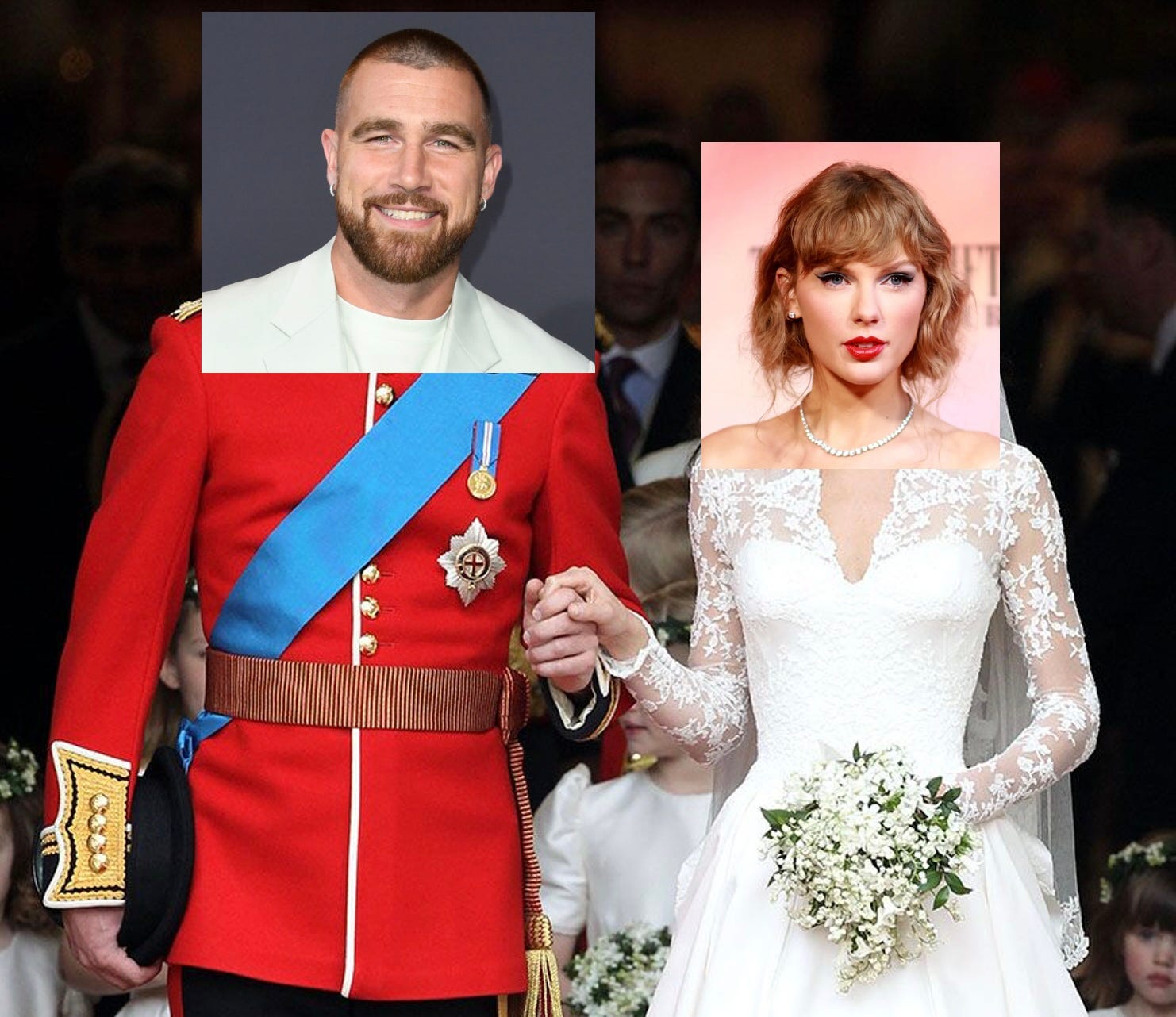
That’s why this engagement feels less like celebrity gossip and more like a royal wedding.
Other royals inherit crowns; Swift built hers in real time, verse by verse, album by album. Not in Westminster Abbey but in Arrowhead Stadium. Not by lineage but by relatability. Meghan Markle once hoped to embody America’s princess. Jackie Kennedy was briefly styled as our queen in the Camelot years. Diana, though British, was adopted into America’s imagination as a tragic fairy tale. Beyoncé has claimed cultural royalty, Oprah supposed moral authority.
But all of their crowns were conditional, borrowed, or contested. Swift’s is unassailable. In the most American twist possible, our queen is not crowned by bloodline but by popularity, not anointed with oil but with record sales, ticket stubs, and friendship bracelets.
Disney once gave us fairy tales but now feels like a corporation first; Swift has done what even Disney couldn’t: turn the ordinary into myth without losing intimacy.
And of course, it feels fitting that in America, the coronation wouldn’t come with velvet robes and horse-drawn carriages but with bleachers and eating chicken tenders and ranch with Mama Kelce.
These weren’t diminishment; they were the new pageantry. Proof that the ordinary, in Swift’s hands, can be mythic.
If Britain’s monarchy is Shakespearean, ours is Disney-esque. Except here, the princess wrote her own soundtrack, sold out every kingdom, and then chose the guy from the football team.
The Permission Slip
If relatability explains why Swift is ours, the permission slip explains what she gives back.
Her engagement announcement didn’t stop the internet and break Instagram because women suddenly cared about the Chiefs’ offensive line. It stopped because she modeled the most ordinary fantasy inside the most extraordinary life. Swift has always been a mirror, but this time the reflection wasn’t of heartbreak or revenge. It was of safety.
After the man who wouldn’t commit and the man who vanished, she chose the man who made it easy. Women everywhere recognized the story and exhaled: maybe it’s okay to want that, too.
This is Swift’s true cultural power. Not her politics. Not even her billion-dollar tours. It’s the emotional permission she gives her fans. She redefined the breakup album (“All Too Well” turned into a cultural monument). She redefined the revenge era (“Look What You Made Me Do” as thesis statement). She redefined resilience (Folklore and Evermore, written in exile during the pandemic, a cottagecore lifeline in a global crisis).
Now, she has redefined the happy ending.
And crucially, she didn’t make it glossy or unattainable. She made it familiar. “Karma is the guy on the Chiefs, coming straight home to me.” The lyric landed not as a pop star’s flex but like something you could text to your best friend, grinning.
This is the hallmark of Swift’s business acumen: she continually identifies the under-served emotional market and supplies it with precision. She cornered heartbreak (Red), then revenge (Reputation), then the wistful lockdown indie-folk demographic (Folklore/Evermore). The happy ending, oddly enough, was left wide open. Pop culture has cynicism in surplus. What it lacked was simple permission: the okay-ness of wanting love that feels easy, joyful, secure. Swift stepped into that vacancy like a company seizing unclaimed market share. She made optimism scalable again.
In business terms, she found the last unclaimed market segment (the happy ending) and scaled it to myth.
From a strategy standpoint, this is product-market fit at its purest. She built the emotional equivalents of a diversified portfolio: high-risk heartbreak, high-yield revenge, long-term resilience. What remained was the dividend nobody else had claimed- the market for uncomplicated joy. And Swift, more than anyone, knew that joy is not frivolous. Joy is demand. Joy is scale.
In doing so, she solved something even Disney hasn’t cracked.
For decades, the American fairy tale has been outsourced. Princesses with British accents, castles imported from Bavaria, coronations in London. Meghan Markle tried to embody the role of American princess, but her crown was provisional, tethered to an institution she couldn’t control. Swift’s crown is earned. She is our homegrown queen, ascending not in Frogmore Cottage but in Arrowhead Stadium, not by bloodline but by relatability.
And here lies the deeper paradox resolved: Swift has achieved what no multinational brand, no politician, no celebrity has.
Apple makes you feel clever, Coke makes you feel refreshed, Disney makes you feel nostalgic, but Taylor makes you feel seen. She is not “The Man,” though she’s sung about him; she is the sister in your kitchen, the teacher who slipped you a lyric, the best friend who texted you at 2 a.m., the mother humming in the carpool lane.
Her catalog is lifetime value incarnate: she captures you at fifteen (“’Cause when you’re fifteen…”), retains you through your twenties (“We are never ever getting back together”), and upgrades you in your thirties (“Anti-Hero”). No company in history has executed audience retention with such emotional precision.
Kelce is both man and metaphor; the boyfriend who shows up loudly, and the archetype of the partner women everywhere have been waiting for.
That’s why her love story with Kelce is not just personal but collective.
It isn’t gossip; it’s a permission slip written in glitter ink and broadcast from the fifty-yard line. A reminder that even the most powerful woman in the world can want what we all want: to be adored, out loud, without hesitation. That “peace” isn’t a concession; it’s the damn point.
Taylor Swift has always been Miss Americana. But this is her coronation. The princess didn’t wait in a tower for rescue; she wrote the soundtrack herself, turned the castle into a stadium, and chose the guy who actually showed up. In the end, that’s the most relatable power move of all.
Ordinary Without Ordinariness
In the end, Swift remains the most exceptional woman alive. And she did it by making the most ordinary choice: she picked the guy who’s obsessed with her.
It is not, of course, truly ordinary. Few women marry into Sunday Night Football, just as few men buy Cartier rings on their own salaries. But the narrative is ordinary enough that it reads like ours. That’s the point and the brilliance. The scale of her life never allowed for ordinariness, so she found something better: the illusion of ordinariness, the echo of a life everyone recognizes. It’s Our Song rewritten for stadium lights, You Belong With Me with a happy ending, Peace answered at last.
This is the paradox she’s resolved more cleanly than any CEO or politician ever could: ubiquity without dilution, expansion without alienation, scale without sterility. Most leaders who attempt it end up abstract, corporate, unreachable. Swift, through nothing more than the simple spectacle of choosing love that looks like ours, made herself more human as she became more mythic.
Taylor Swift is marrying Travis Kelce, and in doing so, she is pulling off the hardest move in both business and life: she is scaling without losing her humanity. The fairy tale is real not because it’s extraordinary, but because it feels, somehow, like it could have been ours.
Swift, Inc. solved the paradox no corporation ever could: she scaled infinitely and became more human in the process.
She became America’s queen not by inheriting a crown, but by choosing the love story so ordinary it belonged to all of us.