

Taylor Swift: The athlete whose salary outscores the strikers
Messi may have Adidas, but Taylor has the Swifties.

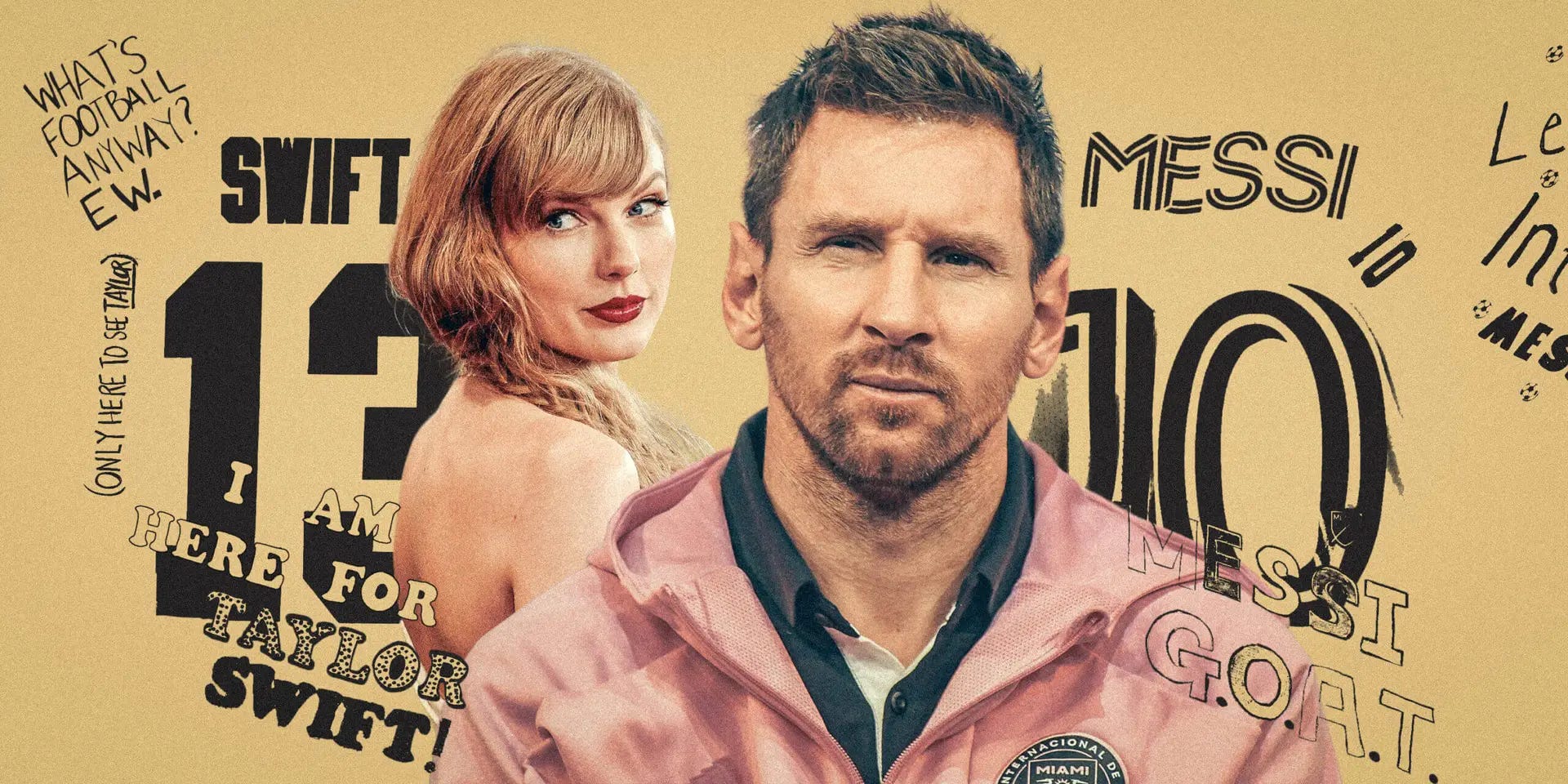
I gave a talk to an MBA class recently, and one of the students messaged me afterwards with a question that stuck with me:
“I’ve always found it interesting that musicians in general don’t make as much money as a really top athlete. For example, there’s this soccer player named Mbappé who is really good but not even close to Ronaldo or Messi. And he still has a bigger net worth than the majority of singers. Even more than Bad Bunny.”
It’s such a good point!
If you’ve ever looked at the Forbes list of richest athletes vs. richest musicians, the gap is eye-watering. I gave a short answer in my response to him on LinkedIn, but have spent way more time thinking about it in the few days since, and wanted to elaborate here, further.
(Yes, I had to google “Mbappé” and plenty more to write this post…)
ONE: Welcome to the Salary Hunger Games
So a quick google search confirms what WAGs have known their whole lives: top athletes are rich.
Cristiano Ronaldo signs a contract worth half a billion. LeBron James has a Nike deal that stretches into the afterlife. Lionel Messi earns like he’s the CEO of a Fortune 500 company.
Why is this so structurally different from music? Economics gives us two answers:
First: The Closed League Model.
Sports is basically an oligopoly. The NBA, NFL, Premier League, and FIFA operate like tightly controlled cartels: fixed supply of players, capped rosters, limited franchises, and multi-billion-dollar broadcasting rights. Scarcity → pricing power. If you’re one of the 20–30 global superstars, you tap into the full economics of that machine.
Second: Guaranteed Revenue Streams.
Athletes get contracts (predictable inflows), plus sponsorships (lumpy, but huge). It’s recurring revenue. Think of it like SaaS vs. project-based consulting: the SaaS founders always come out richer because their income is guaranteed, not conditional.
Musicians, by contrast, live in a fragmented open market. There’s no cartel guaranteeing fixed spots at the top. You’re competing with millions of artists worldwide. And revenue is conditional: you only get paid when people buy, stream, or show up.
The result? Athletes sit on stable, predictable cash flow structures; musicians operate on volatile, hit-driven economics.
TWO: Why Athletes Always Ate First
The music industry has always been structurally… leaky. Labels take most of the upside; artists rent rather than own their masters; touring is expensive; merch is unreliable. Let’s frame this with two concepts:
Value Chain Capture
In sports, the athlete is the product. The league can’t sell tickets, sponsorships, or broadcast rights without them. Athletes capture value directly, because their performance is inseparable from the league’s economics.
In music, artists are one input in a much larger value chain. Labels own masters, streaming platforms own distribution, Ticketmaster owns ticketing, Live Nation owns venues. Every intermediary skims value before it reaches the artist. Taylor Swift doesn’t make money when Spotify sells advertising to Coca-Cola… Instead, Spotify does.
Hit-Driven Economics
The music business is closer to venture capital than to professional sports. And… not in a good way. Ninety percent of artists lose money; 10% pay for the rest. (Or, if you’re the majority of modern day VCs, one hundred per cent of your portfolio loses money).
So as an artist, you can be the #1 performer in a given niche and still not earn athlete-level money because your niche? Yeah, it doesn’t scale.
When CDs collapsed and iTunes was undercut by Spotify, this dynamic worsened. Streaming made music infinitely accessible but also drove average payouts down to fractions of a cent per play (!!). Fame decoupled from fortune. You could be “the most streamed” artist in the world and still not break into multi-hundred millionaire territory.
So when this MBA student asked why Mbappé out-earns Bad Bunny, the structural answer is this:
Athletes are locked into cartel economics with guaranteed flows (Woo!)
Musicians operate in an open, hyper-competitive ecosystem where middlemen siphon most of the value (Boo!)
THREE: How Spotify Killed the Long Tail
Now consider that, for most of the 20th century, music was a long-tailed industry.
Chris Anderson popularized the idea in his 2004 book The Long Tail: in certain markets, the cumulative demand for niche products outweighs the hits.
Think about bookstores or movies: the majority of sales actually come from the endless catalogue, not just the blockbusters.
Music used to work the same way. The industry had megastars, sure, but most of the revenue came from thousands of smaller acts selling records, touring regionally, and owning loyal fanbases. If you were “number one,” you sat at the top of your genre or region, but the overall industry pie was fragmented. The superstar slice was large, but not dominant.
Then streaming arrived, and everything was irreversibly changed.
Algorithmic Consolidation
Duh, we all know this by now: Spotify, Apple Music, YouTube: these platforms didn’t just digitize distribution, they centralized it.
Instead of a fan walking into a record shop and browsing based on taste, they now get music from algorithmically curated playlists like “Today’s Top Hits.” In other words, the gatekeepers aren’t local DJs or regional stores, they’re global recommendation engines. That coincidentally also happen to belong to the platform itself. Cough, cough.
Network Effects & Attention Economics
In streaming, as in dating for anybody wondering, popularity begets more popularity.
A song on “Top 50 Global” gets streamed more → which pushes it further up the algorithm → which drives even more streams. It’s a “flywheel” as your local VC bro will tell you. Economists have a fancier name for this: a preferential attachment model. In other words, success compounds because attention is scarce and users gravitate toward what others are already consuming.
It’s the same reason why in America, it seems that people will join the back of a line outside a restaurant simply because of the fact that there is a line there in the first place, while assuming this must be a sign of good quality.
From Long Tail to Winner-Takes-All
The result is a collapse of the middle. The “fat tail” of mid-tier artists has eroded, and revenues concentrate into a handful of megastars. Being #1 today doesn’t mean dominating a corner of the pie; it means commanding a global audience of billions.
And this is where Taylor Swift’s strategy looks less like a musician’s and more like a CEO’s. She didn’t just ride this algorithmic wave; she engineered her business to supercharge it, as I write about my book Good Ideas and Power Moves:
Re-recordings = content flywheel (refreshing her catalogue so old songs chart again)
The Eras Tour = cultural monopoly (fans experience her discography as a cinematic universe, hello Marvel!)
Merchandising & Easter eggs = engagement loop (Swifties keep the fandom active between album cycles)
In other words: while streaming turned music into a winner-takes-all game, Taylor became the player who didn’t just win once; she figured out how to keep winning, over and over, and over.
(Casinos have another name for such players…)
FOUR: Hello, Taylor Inc.
Most musicians survive by catching waves of random and lucky popularity, and riding them for as long as they can. Taylor Swift builds the ocean.
What makes her unique isn’t just talent or luck; it’s that she’s essentially vertically integrated her career in ways that look more like LVMH than like a traditional pop star.
IP Ownership and Control
This could be a book by itself, and we all know the rough outline of the story.
When she re-recorded her first six albums after losing her masters, it looked at first like a sentimental revenge play. But maybe it was actually a masterclass in intellectual property strategy. By re-issuing those albums (the “Taylor’s Version” project), she reclaimed the royalty streams of her back catalogue and doubled its earning power. That’s like a tech founder buying back equity in their own company. (Again, your VC bro will call this “value re-capture”. Normal people will call it being very smart).
The Eras Tour as a GDP Event
Her tour wasn’t just a series of concerts, it was an economic ecosystem. The only possible people who could disagree with this statement do so because they were not at an Eras Tour concert.
Hotels, airlines, restaurants, merch sellers, Ticketmaster… all saw record-breaking revenues. Local governments put out economic impact reports. That’s something usually reserved for the Olympics or the Super Bowl. By scaling her tours to stadiums and multi-night residencies, she made live performance the anchor of a global business strategy.
The Swiftie Engagement Machine
I am a willing participant in this, for the record.
Athletes rely on broadcasters and leagues to sustain attention. Taylor owns her own attention economy. Every Easter egg, every coded lyric, every hidden hint is a form of user engagement loop, and we’re all hypnotized. Fans don’t just listen, we practically work for her: decoding, debating, evangelizing. That kind of active fandom translates directly into lifetime customer value (or, in Swift-speak, lifetime devotion).
Diversification Like a Conglomerate
Taylor doesn’t just release music because that’s so 90’s.
She drips endless variations and versions of vinyl, cardigans, limited merch, a concert film, and even rereleases of old work that chart like new albums. Each “era” is a new product line, but all of them plug into the same brand architecture. It’s Marvel Cinematic Universe meets Hermès meets SaaS retention metrics. At scale. With impossible-to-believe margins.
In business terms, Taylor has moved from being an input in the value chain (like most musicians) to being the platform itself. She controls IP, distribution, marketing, and fan engagement. She has transformed what was once fragmented and leaky into a closed-loop system where she (not the labels, not the platforms) captures most of the value.
And this is why, for the first time, a musician can credibly compete with the Ronaldos and Messis of the world on earnings power. (In fact, I believe she out-earns them both). She turned an industry notorious for chaos into a structure that compounds like a blue-chip stock.
FIVE: Taylor vs. Ronaldo: Same League, Different Game
For decades, the wealth league tables were clear: athletes at the top, musicians trailing far behind. LeBron had Nike. Messi had Adidas. Ronaldo had Saudi contracts. Musicians? They had Spotify paying them $0.003 per stream. Which is basically couch-cushion money, unless you’re Taylor Swift. In which case the couch is the size of Asia.
But Taylor broke the pattern. By, you know, breaking the industry.
She did it by turning her catalogue into an appreciating (instead of an historically depreciating) asset, her tours into GDP-scale spectacles, and her fandom into a self-sustaining engagement engine that seems to have no use-by date, she has created something unprecedented: a musician whose earnings power now sits comfortably beside the world’s elite athletes.
She doesn’t just make “musician money.” She makes athlete money. CEO money. And unlike athletes (who peak in their twenties and thirties) her career has the potential to compound for decades.
(Yes, I too am salivating at the thought of another two decades of Swiftness).
FINALLY: The First Billion-Dollar Athlete Who Never Played
Athletes peak and fade. Their earning power is a sprint, not a marathon. But musicians who figure out how to structure their economics (to capture value across IP, live events, merch, and fandom) can extend their careers indefinitely.
We’ve just never seen this happen before. Until now.
Taylor is, of course, the proof case that it’s possible. She’s not just playing the music industry’s game; she’s rewritten it so that musicians can finally compete in the same financial league as global sports stars. Or even corporations.
The first billion-dollar athlete who never played a game doesn’t wear cleats. She wears custom Louboutin crystal-studded knee-high boots
Very enjoyable, Sinéad!