


Okay, so with this latest post I am trying to carefully thread the needle between two very distinct subjects: finance and Taylor Swift. I suspect (hope!) there’ll be something in this for both subgroups.
This is a super long post. So, TL;DR:
Taylor Swift didn’t just date into the NFL; she pulled off a cultural reverse takeover, embedding herself in America’s biggest sports fortress and turning it into a new distribution channel for her empire, all without spending a cent.
Ok, let’s begin…
Taylor Swift just pulled off the kind of move that makes corporate strategists salivate and her competitors choke. In the space of 48 hours, she announced a new album on her NFL boyfriend’s podcast, announced an appearance in the Kansas City Chiefs’ documentary series, and had her name splashed across a GQ profile that doubled as a relationship tell-all. Sports pages, culture blogs, finance columns are all running the same headline in different fonts: Taylor is back.
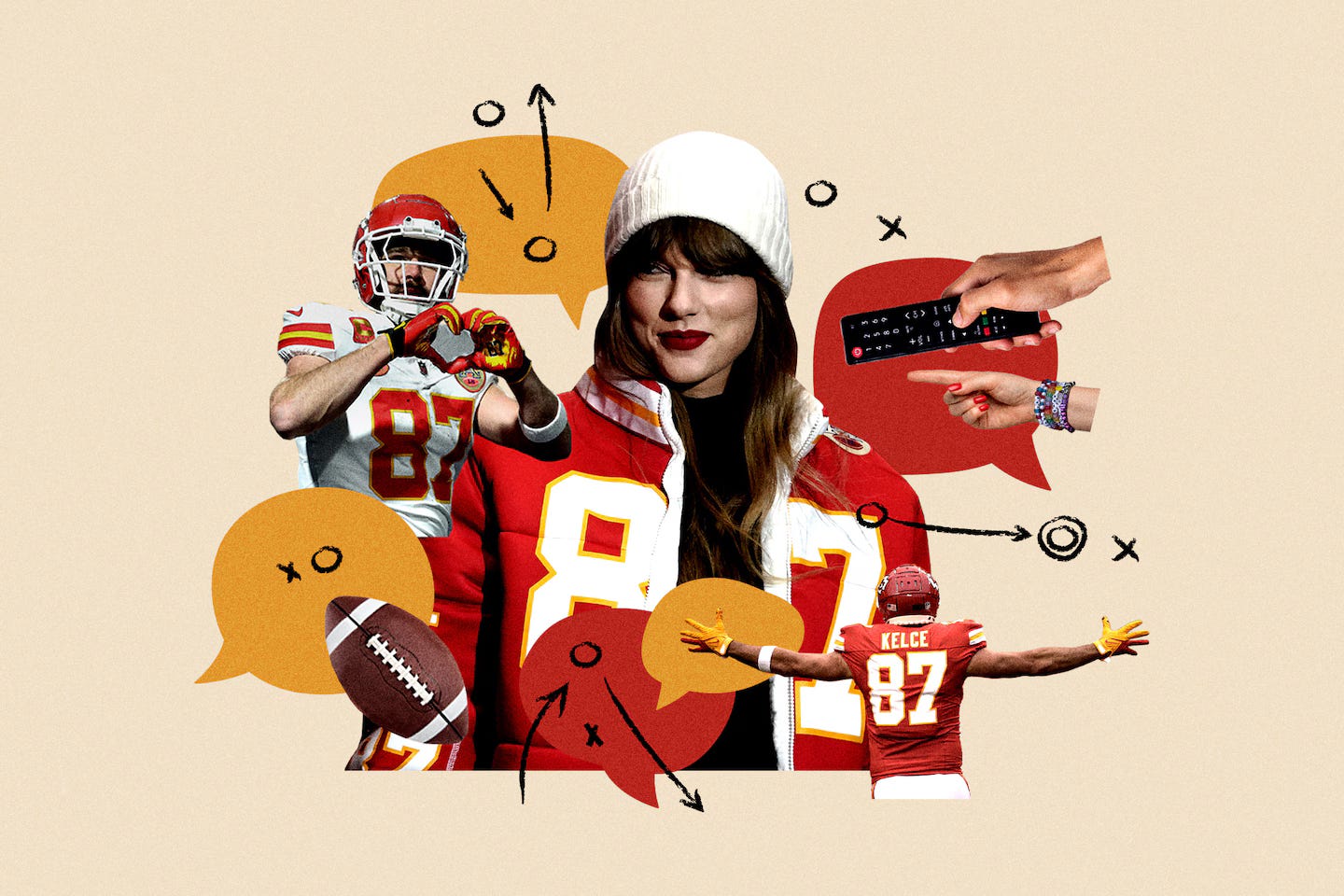
(Illustration: Emily Sabens)
To the casual observer, this is celebrity noise. To anyone who’s ever read an M&A term sheet, it’s a hostile-but-charming market entry strategy. Swift didn’t just “show up” in the NFL’s orbit; she embedded in one of America’s most insulated cultural fortresses, flipped the distribution network to her advantage, and started siphoning off an audience segment that takes most entertainers years and millions of dollars to court.
It’s a reverse takeover in sequins, and she’s doing it with a precision that would make Bob Iger, Elon Musk, and half the PE industry take notes.
Reverse Takeover as Market Entry Strategy
What Swift is executing here is best understood as a cultural reverse takeover.
In corporate finance, a reverse takeover (RTO) occurs when a smaller or unlisted company acquires a controlling stake in a larger, publicly listed company, thus bypassing the slow, costly route of building market share organically and instead using the larger entity’s infrastructure to accelerate legitimacy, distribution, and scale.
Swift’s NFL play is the cultural equivalent.
She’s not tiptoeing into sports media by booking halftime shows, licensing tracks for commercials, or doing small promotional tie-ins. She’s embedding herself inside one of America’s most insulated cultural institutions, co-opting its media channels (broadcast cutaways, NFL Films content, NFL social feeds), its most bankable personalities (Kelce, Mahomes), and its deep mythology (team loyalty, game-day ritual, “football as America” symbolism).
By doing so, she’s stepping into a male-dominated, sports-first audience that, for almost any other entertainer, would take years (not to mention tens if not hundreds of millions in marketing spend) to win over. And she’s doing it without paying for stadium ads, without signing media rights contracts, and without the kind of cross-promotional deals that usually lock a celebrity into rigid contractual terms.
This is not the standard playbook of entertainment growth. The normal growth model is vertical scaling: more of the same audience, more venues, bigger versions of what you already do well. Swift’s move is lateral market entry, i.e. stepping sideways into an entirely different cultural arena with its own rules, rituals, language, and revenue model.
The NFL, in this analogy, is the “listed company”: mature, market-saturated, with deeply entrenched distribution and brand loyalty. Swift is the “smaller acquirer”: nimble, founder-led, culturally explosive. The NFL gets a jolt of relevance with younger and more female demographics, plus a halo effect in the lifestyle/entertainment press that it can’t generate on its own. Swift gets something far more valuable: a plug into one of the most entrenched audience bases in American life.
And here’s the real asymmetry: once she’s woven into the NFL’s narratives via the highlight reels, in the post-game interviews, in the social content churn, she can re-import that exposure back into her own brand universe. When a broadcast cuts to her in the luxury box, it’s a Swift marketing asset masquerading as sports coverage. When Kelce discusses their relationship in GQ, it’s NFL fandom being funnelled through a men’s lifestyle publication and into Swift’s orbit.
From a strategy perspective, this is the M&A dream scenario:
High integration potential: NFL content slots easily into her storytelling architecture (“Life of a Showgirl” era) without brand clash.
Minimal acquisition cost: her entry leverages existing personal relationships and organic media coverage.
Accelerated time-to-scale: instead of years of gradual inroads into sports audiences, she captures mindshare in weeks.
Defensible positioning: no other artist of her magnitude is in this space, giving her a monopoly in “pop star embedded in NFL narrative.”
Once that audience is in her funnel, every subsequent release, whether a re-recorded album, a tour leg, a film, benefits from the expanded reach. The NFL may believe it’s getting access to her fan base, but structurally, she’s absorbing theirs into her network effect flywheel.
This is why it’s not a “crossover” in the usual entertainment sense, where two brands briefly intersect for mutual exposure. This is an acquisition in the cultural sense: with Swift as the acquirer. The NFL becomes her distribution partner without the transaction ever being formalised, delivering her a loyal, demographically distinct market in exchange for a cultural relevance boost.
And because she controls the integration narrative, the terms are entirely hers. The NFL can only absorb so much of her brand before it stops being the NFL; Swift can integrate the NFL as deeply as she wants without losing any part of herself.
In the hard-nosed language of corporate takeovers: she’s bought the company without paying for it, stripped the assets she wanted, and rolled them seamlessly into her own operating model.
The street calls that a fucking steal.
Case Comparisons: Reverse Takeovers in the Wild
What Swift is doing isn’t just a pop culture quirk, it’s straight out of a long-held corporate playbook. Reverse takeovers, in various disguises, have been used by some of the most aggressive operators in business to get around the cost, friction, and time of organic growth.
Tech: Facebook’s WhatsApp Acquisition (2014)
Facebook was already the dominant social network, but mobile messaging was eating into its user time. Instead of building a competing product from scratch, which would have meant years of engineering, UX testing, and user acquisition, it bought WhatsApp for $19 billion. The deal wasn’t about revenue; it was about absorbing a massive, entrenched user base overnight. Swift’s NFL move is a no-cash equivalent: instead of buying the platform, she’s embedding in it and siphoning the audience directly.
3. Luxury Goods: Louis Vuitton & the America’s Cup (1983 onwards)
LVMH didn’t build its prestige in sailing; it just attached Louis Vuitton to the America’s Cup, the world’s oldest international sporting trophy. By doing so, it injected its brand into the closed ecosystem of competitive yachting, gaining access to an elite, global audience it didn’t naturally serve. The sponsorship was the handshake; the association was the takeover. Swift’s twist? She’s doing the same with the NFL, but the entry point is a personal relationship, not a commercial contract- which makes it harder for the “host” to control the terms.
Tech Infrastructure: Apple & AT&T (2007)
When Apple launched the first iPhone, it didn’t build a mobile network; it cut an exclusive deal with AT&T. This instantly gave it distribution through an established carrier’s infrastructure, while Apple controlled the hardware and the user experience. Swift’s NFL play is almost identical: she’s controlling the creative and the narrative while using the NFL’s already-built infrastructure to reach millions.
5. Streaming: Amazon & Twitch (2014)
Amazon wanted dominance in live streaming but building its own platform from scratch would have been slow and risky. Twitch already had the community, culture, and monetisation channels. Amazon bought it, plugged it into Prime, and accelerated scale instantly. Swift is plugging into the NFL’s live-event ecosystem in the same way, except she’s getting the Twitch without paying the $970 million.
Ok, so those examples are the corporate crème-de-la-crème. But here’s the thin… Taylor’s Version is even more legendary.
Most corporate reverse takeovers require massive capital outlays, regulatory scrutiny, and long integration timelines. Swift’s approach avoids all of those. Her “transaction” costs are essentially zero. There’s no legal paperwork (that we know of). No shareholders to appease. No culture clash between teams. She’s personally managing the integration through her own brand, her own channels, and her own creative output.
In M&A terms, this is the holy grail:
100% control of the acquired audience integration
Zero debt or equity dilution
No operational overhead from the acquired entity
Immediate, compounding synergies
The NFL remains “independent,” but its audience is now partially Swift’s, and not because of a formal deal that we’ve been made aware of, but because the cultural narrative has made them interconnected.
And unlike most acquisitions, where the buyer eventually has to deliver shareholder returns, Swift’s “returns” are measured in attention, engagement, and long-term brand equity. All of which she monetises on her own terms, across her own portfolio of ventures.
This is why, in strategic terms, what looks like celebrity gossip is actually one of the most elegant, asymmetric market entries in recent memory.
(It’s also why, if you were teaching market entry strategy at a business school, you’d be negligent not to include it in the syllabus… hint, hint Harvard.)
Worldbuilding as Network Effect
So- what does she do with this new audience?
Swift doesn’t operate like a normal artist with a tidy product line. She doesn’t sell albums, then tours, then merch. She runs a network: an ever-expanding lattice of cultural real estate where every new territory she captures is wired into every other one. Music connects to fashion connects to film connects to politics connects to sports, and each new connection strengthens the whole.
This is not poetic metaphor, it’s network economics.
Metcalfe’s Law, the gospel of telecoms and social media founders, says that the value of a network grows with the square of its nodes. A phone network with two users is pointless. Add a third and you suddenly have three possible connections. Add a fourth and you have six. The bigger the web, the faster the value compounds.
Swift’s NFL manoeuvre isn’t just “Taylor does sports now.” By Metcalfe’s arithmetic, the NFL is another node- a giant, loud, advertiser-rich node, that connects to every other audience she owns. Football fans are pulled into her world, where they are quietly upsold on Eras Tour tickets, vinyl box sets, and a limited-edition cardigan they didn’t know they needed. Swifties are suddenly conversant in quarterback ratings and defensive plays, and will happily boost NFL-adjacent content because it now contains their primary cultural interest.
It’s not just cross-promotion; it’s cross-pollination.
A Chiefs game clip with a two-second pan to Swift’s luxury box becomes a meme on TikTok, which sends a casual sports viewer into a Swift rabbit hole, which ends in a merch purchase and a Spotify stream. Meanwhile, an NFL Films crew capturing Kelce for a documentary has to mention his pop-star girlfriend, which means one of the most mainstream American sports institutions is now producing free Taylor Swift content on its own dime.
This network logic also explains why Swift’s universe feels so sticky. You might enter through one fandom (maybe you only liked Folklore?) but over time you’re pulled through all the others because the connections are engineered to be porous. You can’t buy a tour T-shirt without being handed a QR code for exclusive streaming content. You can’t read a GQ interview about Kelce without learning the name of her next album. Even the NFL is now a feeder channel for Swift’s world.
And this isn’t a one-way flow. Her fans, arguably the most mobilised consumer base in entertainment, are not passive endpoints in this network. They’re nodes themselves. Every time a Swiftie makes a reaction video to an NFL play, or posts a photo in a Chiefs jersey, they extend the network’s reach into new micro-audiences. Each of those micro-audiences has its own compounding potential.
Here’s the thing: most brands try to do this and fail. They think “synergy” means slapping a logo on something outside their category. Swift’s approach is different. She doesn’t just “collaborate” with a new world, she integrates into its narrative. In sports, that means she’s not just performing at a halftime show; she’s part of the storyline: the player’s girlfriend, the documentary cameo, the podcast guest.
That’s a much deeper integration point. It allows her to access the NFL’s own emotional arcs and media reflexes. Every touchdown, every sideline shot, every mic’d-up banter session is now potential Swift content.
If you zoom out, the NFL is just her latest acquisition. She’s done this with fashion: locking in luxury brands by wearing them strategically so that her fans (and resale markets) explode on cue. She’s done it with film: turning her concert movie into a box-office event that had cinema chains rearranging their entire schedules. She’s done it with politics: a single Instagram post about voter registration spiked sign-ups by hundreds of thousands.
What makes the NFL move so interesting is that it’s one of the few remaining American cultural fortresses that hadn’t already been pulled into her gravitational field. And now that it has, it’s permanently wired in. You’ll see it in the off-season, when NFL documentaries mention her. You’ll see it in the way sports journalists now have to field Swift-related questions at press conferences. You’ll see it every time a network cuts to her mid-game because they know the clip will get more traction online than the play that just happened.
Metcalfe’s Law tells you the value of the network has gone up exponentially. Swift’s career tells you she knows exactly how to extract that value. She doesn’t need to convert every NFL fan into a concertgoer, she just needs enough of them to cross over that the connection becomes self-sustaining. Once the link is forged, it will keep producing returns without her having to do anything more than show up occasionally and let the cameras find her.
It’s corporate strategy in sequins: identify an insulated market, gain access through narrative integration, and let network effects do the compounding.
The NFL thinks it got a pop star in the box seats. What it actually got was a new owner in the cultural sense; one who’s already folding it into a much bigger empire.
Attention Economics & the “Drip” Strategy
And once you own the network, the next battle isn’t territory, it’s attention.
Attention, as Nobel Prize–winning economist Herbert Simon noted decades ago, is the real scarce resource. Not capital, not raw materials, but attention. And in today’s markets, where it’s splintered across platforms, time zones, and subcultures, you don’t win by making one big impression; you win by staying in the room longer than anyone else.
Sustained share of voice outperforms raw reach.
Enter Swift’s “drip” strategy. The old-school playbook- the MBA-inspiration one-drop launch- looks quaint. That model piles budget, hype, and messaging into a single release, hoping it dominates enough to justify the investment. But in our distracted, algorithm-driven ecosystem, that’s the “bulk shipment” of hype: loud, explosive, but quickly dissipated.
Swift rejects that.
Instead, she operates on a just-in-time hype inventory model. Her strategy isn’t just about announcements; it’s about releasing actual product with deliberate cadence. She’s dropped nine studio albums in the 2020s alone, including Evermore, Folklore, Midnights, Speak Now (Taylor’s Version), 1989 (Taylor’s Version), and The Tortured Poets Department, each spaced to keep her ecosystem buzzing year-round.
Compare that to Beyoncé, her most obvious peer. Beyoncé has released eight solo studio albums in total. She averaged fewer album drops in the same period, with gaps of several years between Renaissance (2022) and Cowboy Carter (2024). Though she delivers product with heavy thematic power, Swift’s sheer cadence gives her drip strategy superior momentum.
It’s not limited to music. Elon Musk epitomizes “drip in practice.” At SpaceX, launches are teased, livestreamed, celebrated with triumphant landing shots, and almost immediately followed by teasers for the next mission. Each step, from static fire tests to booster re-flights, is a public micro-event, keeping attention high.
But here’s the key: these aren’t just marketing beats. They’re actual rockets, built and launched constantly. That cadence of real-world output is what has pushed SpaceX years ahead of competitors.
Blue Origin, by contrast, spends long periods in internal design and iteration, surfacing only for occasional suborbital flights or project updates. The result isn’t just a weaker media presence, it’s a weaker technical position. Without the feedback loop that comes from constant, public, high-frequency launches, Blue Origin falls further behind on both capability and perception. SpaceX’s drip is hype plus execution; Blue’s is neither frequent nor compounding.
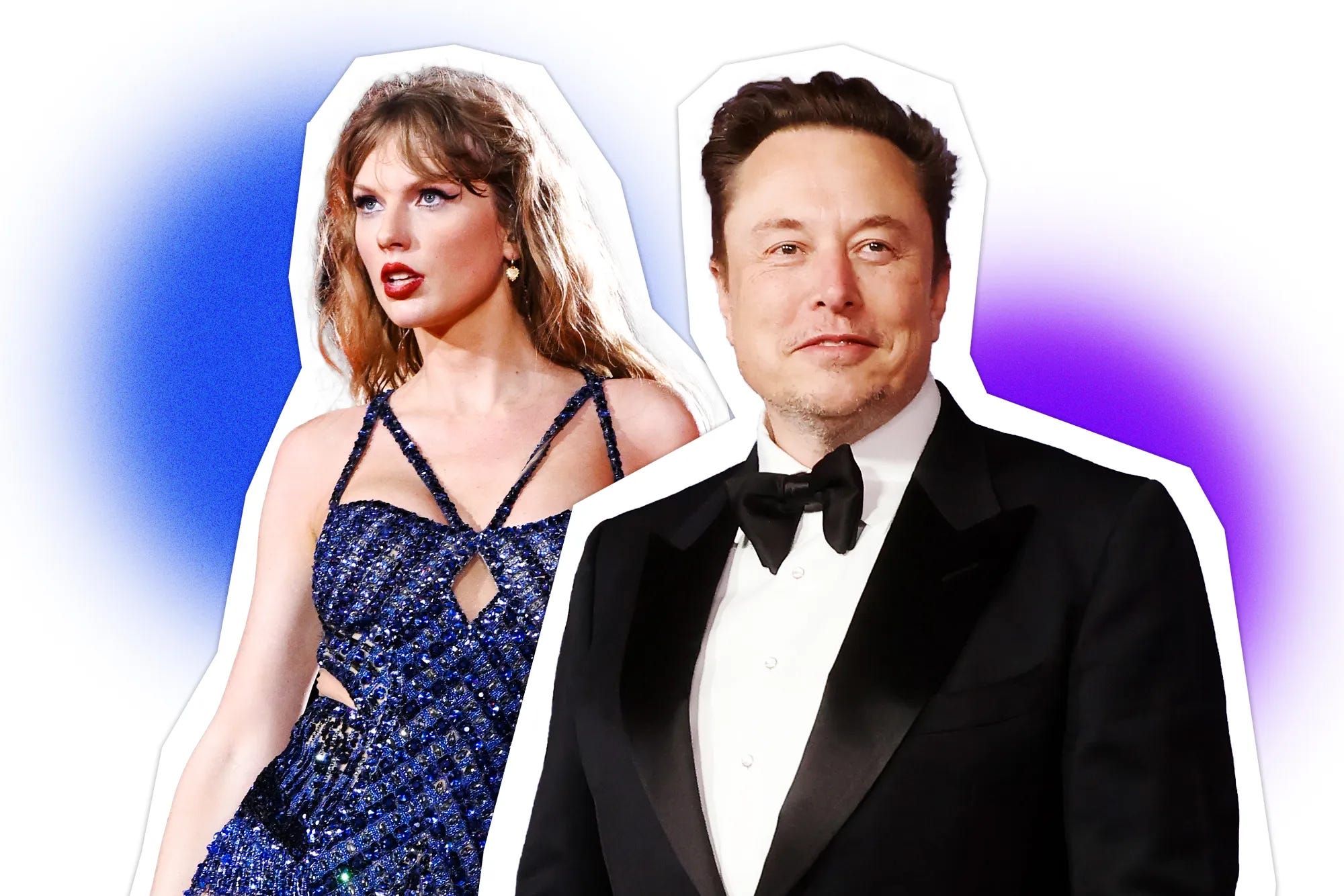
(Illustration: Getty Images)
Look at software. Gone are the days of Big Version 5.0 releases. Today’s tech companies live and die on continuous updates that dribble out features, bug fixes, and experiments in April, June, August. It’s expectations managed, engagement sustained.
Swift’s NFL play isn’t a one-off headline; it’s a campaign built on the same operational logic that keeps SpaceX ahead of every other space company. Each NFL-linked drip, such as an album title reveal on the Kelce podcast, a Chiefs docuseries cameo, a GQ interview, is both a product and a proof point.
It’s not “just” content; it’s a structural reinforcement of her brand inside the NFL’s cultural ecosystem. Every appearance deepens familiarity, normalises her presence, and tightens the connection between her and the league’s audience.
Think of it as “hype portfolio optimization.” She doesn’t place all her chips on one launch. She spreads risk across multiple yield-bearing mini-events. Some blow up. Some don’t. But the portfolio works: she stays relevant for months.
The Nike model applies here too. In fashion, mainline Spring/Summer or Autumn/Winter drops are the big events, but the real culture-shaping happens in between, with collaborations, capsules, and limited editions.
Each one is a mini-surge of attention and revenue that keeps the brand in constant circulation. Swift’s equivalent? Between her “mainline” studio albums, she drops re-recordings, documentary films, tour extensions, and now NFL tie-ins, each one a different point of entry into her universe, each one reinforcing the others.
This is why the reverse takeover works. The NFL is the distribution network: vast, loyal, and culturally entrenched. Swift is the founder-operator with a hyper-agile release model. Instead of one big splash and a fade-out, she drip-feeds the NFL audience into her ecosystem over weeks and months. Some will enter through the podcast. Some through the documentary. Some because they saw her in a luxury box during a game. Each micro-event is another handhold for the climb, and once they’re in, they don’t leave.
In M&A terms, this is post-acquisition integration done in public, at speed, with no operational drag. In cultural terms, it’s how you make a takeover feel inevitable.
Cultural M&A: Integration Without Cannibalization
So sure, the drip can build an empire. But without discipline, it can just as easily dissolve one.
The danger in diversification is dilution.
Expand into the wrong market, in the wrong way, and suddenly your brand doesn’t stand for anything. It’s the corporate equivalent of a band “going experimental” and watching half their fan base quietly ghost them. In strategy terms, this is why diversification is often value-destructive, and why cultural M&A, like corporate M&A, has a graveyard full of failed integrations.
Think of AOL–Time Warner, or when a luxury fashion house buys into a mass-market streetwear brand only to watch both lose relevance.
Swift’s approach avoids that trap because she’s not just buying market access; she’s absorbing it into her existing architecture.
Every NFL-related appearance is unmistakably hers. Sequins. Storytelling. A female-centric point of view. Even when she’s framed in the cutaway shots on a football broadcast, she’s not “doing sports”, she’s doing Taylor Swift in the context of sports. That’s brand architecture discipline. It’s no different from when Apple launches a product in a new category, whether it’s a phone, a watch, or an augmented reality headset; the design language, retail experience, and marketing are so tightly integrated you never mistake it for anyone else’s work.
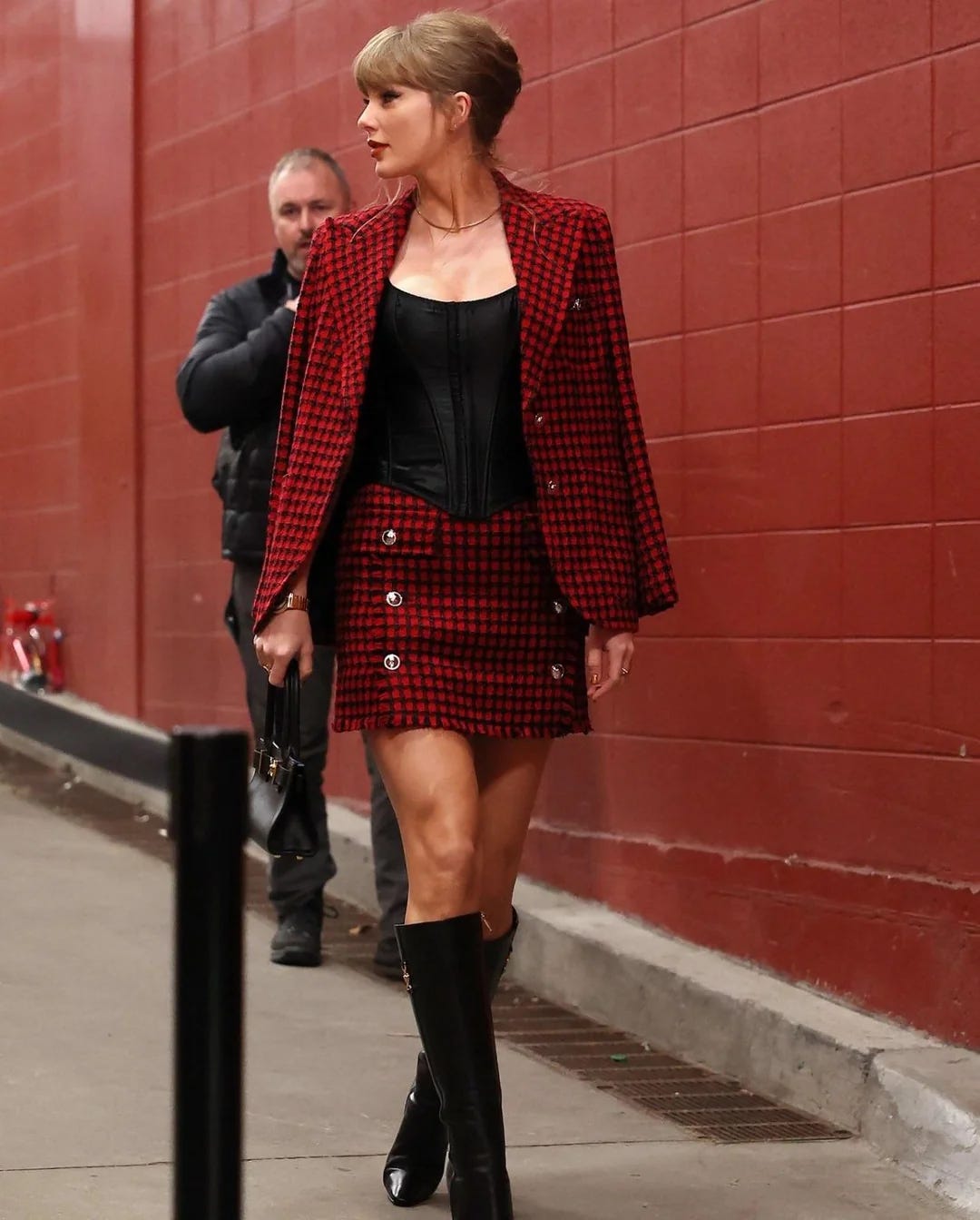
Narrative integration matters here.
The NFL beats aren’t random cameos; they’re written into the arc of Life of a Showgirl. This is crucial, because when you frame a market expansion as part of your main storyline, you avoid the “side hustle” problem. It doesn’t feel like she’s moonlighting in sports for novelty’s sake; it feels like sports is now a chapter in the same saga she’s been telling for over a decade. She’s done this before: Folklore and Evermore expanded her reach into indie and folk audiences without alienating her pop base because they were positioned as intentional “eras” in her mythos, not departures from it.
And now, given my work with Professor Michael Porter’s on competitive strategy at Harvard Business School, there’s no way I could get to this stage without running this through the Five Forces lens!
Barriers to Entry in the NFL are about as high as they come. The league is a fortress of cultural insulation: broadcast rights locked up, personalities controlled, traditions guarded. Yet Swift has slipped in without filing for permission, bypassing the traditional gates entirely. This is similar to how Netflix used content partnerships in its early days to gain footholds in markets where local regulations or entrenched players made direct entry difficult.
Supplier Power lies with the NFL, simple as. It owns the media rights, the licensing, the players’ images. Swift sidestepped that by entering through the one supplier the NFL doesn’t fully control: the personal lives of its athletes. A podcast, a GQ profile… these are outside the league’s formal distribution but still ride its reach. In business terms, she’s secured an exclusive distribution channel without paying for it.
Buyer Power rests with the fans, who are notoriously loyal but also suspicious of outsiders. This is not unlike hardcore gaming communities reacting to non-endemic brands trying to buy their way in. Swift’s challenge isn’t getting their attention once. Instead, it’s embedding in a way that feels authentic enough that they accept her as part of the ongoing story, rather than a novelty cutaway.
Threat of Substitutes is practically zero. There’s no other artist of her scale even attempting this type of cultural integration into professional sports. If you want “global pop phenomenon embedded in NFL media narratives,” there’s exactly one provider. In corporate terms, she holds a monopoly in a newly defined market segment.
Competitive Rivalry in sports entertainment is intense (leagues, teams, athletes, and broadcasters all compete for mindshare), but Swift’s offering isn’t really substitutable. Music and celebrity culture operate on a different competitive plane. By adding herself to the mix, she’s not increasing rivalry within the existing market; she’s expanding the market to include a new category only she can occupy.
The result is a market entry that strengthens her core brand instead of weakening it.
In M&A terms, she hasn’t overpaid for a bolt-on that doesn’t fit; she’s acquired a strategically valuable asset, folded it into her operating model, and made it throw off cash (or, in her case, attention) from day one.
That’s something most companies can’t do, and it’s why, unlike so many corporate diversifications, this one looks accretive from the moment it hits the tape.
Competitive Moat: Building a Multi-Genre Cultural Monopoly
Which is why the real story here isn’t just the NFL; it’s how every new market she enters becomes another wall in an already unbreachable fortress.
Swift’s ultimate competitive advantage isn’t just that she’s good at making music or selling tickets. It’s that she’s systematically building what amounts to a multi-genre monopoly on attention: a portfolio of cultural verticals so interlinked that competing with her in one means competing with her in all.
Music is the core, and it’s fortified.
She doesn’t just top the charts; she dominates touring revenue to the point where her Eras Tour is projected to be the highest-grossing tour in history. On streaming platforms, she’s a constant fixture in the global Top 10, not just with new releases like Midnights, but with catalogue albums she’s re-engineered through her “Taylor’s Version” re-recordings.
That re-recording project isn’t just about reclaiming masters; it’s a recurring revenue engine. Every re-release, such as Fearless (Taylor’s Version), Red (Taylor’s Version), Speak Now (Taylor’s Version), and 1989 (Taylor’s Version), resets the streaming clock, generates a new physical sales wave, and floods the charts with multiple albums simultaneously. Few artists can get their own past work to compete with their current work and win.
Media is the second fortress. She’s not dependent on music press cycles; she generates her own. The Miss Americana Netflix documentary reframed her public image in 90 minutes. The Eras Tour concert film turned a live show into a cinematic event that broke AMC’s pre-sale records, reshaping the economics of theatrical releases. Her viral content is calculated, from surprise guest appearances to Easter egg–laden Instagram posts, and designed to travel across platforms without paying for distribution.
Merchandise is both a revenue stream and a cultural signal. Her fashion choices double as fan goods, from the Folklore cardigans that sold out instantly to the friendship bracelet phenomenon that turned into an on-site microeconomy at Eras Tour stops. Every object is part of the brand mythology: not just a product, but a piece of the narrative. She’s essentially turned merch into a distributed brand identity, with her fans acting as unpaid (and enthusiastic!) street-level advertisers.
And now… Sports, with the NFL as her newest vertical.
This isn’t just about being seen in the luxury box; it’s a foothold in an entirely new live-events ecosystem. The league has its own media apparatus, merchandising power, and an audience that is demographically distinct from her traditional fan base. By integrating herself into NFL narratives via the Kelce podcast, the Chiefs docuseries, and the GQ cover, she’s treating the league as both a new distribution network and a fresh market for her broader universe.
The key here is that this isn’t about squeezing out a few more ticket sales or downloads. It’s about increasing her total addressable market (TAM) in the global entertainment economy. If TAM is the sandbox, Swift is hauling in more sand from adjacent playgrounds like sports, cinema, fashion, and then owning the shovel.
Other industries offer parallels, but few with this level of integration. Disney’s flywheel, where films feed theme parks, which feed merchandise, which feed streaming, is a corporate analogue, but here’s the fucking massive difference:
Swift is doing it as a single individual.
Amazon’s expansion from books to cloud computing to entertainment is another, but again, that’s an empire built by a corporation with thousands of employees. Swift is a single founder-operator executing across multiple verticals in real time, with each reinforcing the others.
The genius of her moat is that each vertical strengthens the others. NFL exposure drives curiosity about her music; her music fuels streaming and tour sales; tours produce merch and viral moments; merch deepens identity and loyalty; documentaries and films capture new audiences and refresh old ones. The loop is self-reinforcing.
Most artists build careers in one lane. Swift is paving highways between lanes, and then charging tolls on all of them.
Why This Works Now
Of course, a monopoly only works if the market tilts in your favour. And right now, the attention economy is practically begging for someone like Swift to run it.
The old “big reveal” model belongs to the pre-fragmentation era- the 2010s, when a blockbuster film trailer or album drop could dominate a monoculture for a single news cycle and then keep cashing in on that awareness for weeks.
That world is… gone.
In fact, the monoculture itself is gone. The attention market is now a mosaic of competing feeds, overlapping time zones, algorithmically sorted niches, and parallel cultural conversations. People aren’t watching the same shows, reading the same papers, or listening to the same playlists at the same time.
In that environment, you don’t get one big bang; you get a rolling series of controlled micro-detonations. Each one is designed for a specific subculture or demographic cluster, and the overlaps between those clusters become the force multiplier. A single “moment” burns bright and disappears; a sustained sequence of moments builds habit, anticipation, and mindshare.
Swift’s drip strategy is purpose-built for this fractured landscape. An album title reveal on a football podcast targets NFL fans and gossip media at once. A cameo in a Kansas City Chiefs docuseries taps the sports documentary audience, which Netflix has shown is global and highly engaged. A high-gloss GQ profile with her partner drops her into the men’s lifestyle and fashion circuit. Each event runs its own media cycle, but also acts as a breadcrumb leading to the next one. It’s the marketing equivalent of a months-long precision campaign: the former makes noise, the latter takes territory.
There’s also a hard-to-miss geopolitical layer.
For decades, America’s most potent cultural exports have been sports and music- the NFL and the Billboard charts. They are soft-power delivery mechanisms: symbols, aesthetics, and narratives that travel further and last longer than most policy initiatives. Swift’s NFL play is a vertical integration of those two export industries into one self-reinforcing storyline.
It’s the same logic that drives conglomerates to stitch together seemingly unrelated properties for combined market dominance: Disney cross-promoting Marvel films during ESPN broadcasts, Tencent pushing gaming IP through its streaming platforms. But where those corporations need sprawling teams, billion-dollar M&A, and multi-year integration timelines, Swift executes in one clean shot.
This is why the CEO of Disney, Bob Iger, comparison matters. Disney employs roughly 230,000 people to run its global parks, studios, networks, and licensing operations. Swift is pulling off the functional equivalent of a Disney roll-up (music, film, merchandise, sports) with a small, tightly coordinated team.
She is a one-woman Disney, without the board politics, activist shareholders, or antitrust lawyers sniffing around.
In terms of efficiency, she is scaling soft power faster than any U.S. cultural institution in play today. Which is why, in strictly cultural-economic terms, she is a single-shot threat to China’s global entertainment ambitions. The U.S. Air Force and Navy can project hard power; Swift projects something they can’t: a voluntary, emotionally sticky form of American influence that moves freely across borders, is embraced rather than resisted, and leaves local audiences feeling they opted in.
From a financial markets perspective, Swift operates like a founder-led brand. And in this market cycle, founder-led beats institutional nine times out of ten. Look at Tesla under Musk, Nvidia under Jensen Huang, Apple under Jobs. Founder-led brands trade not just on product fundamentals but on vision, charisma, and unpredictability. They are seen as riskier but more likely to deliver breakthrough performance. Swift’s fans (and in a very real sense, her investors, in the form of ticket buyers, merch purchasers, and streaming subscribers) are buying her as the growth asset, with the music functioning as both product and proof-of-execution.
And she’s doing this in the middle of a brutal consolidation cycle in global entertainment.
Media companies are merging to survive: Warner Bros.–Discovery, Amazon–MGM, Disney absorbing Fox. The logic is always the same: capture synergies, cut costs, shore up market share. Swift is effectively rolling up verticals herself of music, film, fashion, sports, without bankers, without regulatory filings, and without the integration headaches that sink most corporate deals.
And this consolidation is happening not in corporate ownership but in attention.
Economically, she’s building a diversified portfolio with low correlation between assets, giving her resilience in downturns. If touring underperforms, as it did for the entire industry during the pandemic, streaming and merchandise can offset the dip. If algorithms choke music discovery, a documentary release or high-profile media moment creates fresh entry points. It’s the celebrity-empire version of sovereign wealth fund logic: diversify across asset classes, geographies, and sectors to smooth returns over time and hedge against macro shocks.
Live entertainment is cyclical. Streaming revenue is vulnerable to changes in platform economics. Merch is tied to consumer confidence. But… operating across multiple cultural industries with different demand drivers and geographic reach reduces exposure to any single risk.
Swift isn’t just a pop star riding the cycle; she’s built a multi-sector cultural asset base that can withstand it.
In geopolitical terms, her NFL integration is the equivalent of securing a new strategic ally: high GDP, strong domestic market, unmatched distribution reach, and entrenched global visibility. In corporate finance terms, it’s a low-cost acquisition with exceptionally high integration potential and zero regulatory drag. In cultural economics, it’s the consolidation of two of America’s strongest export sectors into a single, founder-operated brand: one that is already globally distributed, highly liquid, and still scaling.
The Reverse Takeover, Complete
Taylor Swift’s NFL play isn’t just a flirtation, a publicity stunt, or a happy coincidence of romance and sport (although it may be all of the above).
It’s a case study in how to execute an asymmetric acquisition without spending a cent, and then lock in the gains through relentless, multi-channel integration. She’s running a one-woman Disney, a sovereign wealth fund of attention, a founder-led roll-up of America’s most powerful cultural assets. And doing it in public, in real time.
The NFL gets a pop star in the luxury box; Swift gets one of the most loyal and demographically distinct audience segments in the country. They get a season; she gets a permanent node in her network. And because she understands both the mechanics of attention and the compounding power of network effects, she’ll keep extracting value long after the cameras stop cutting to her.
If you strip away the sequins, what’s left is a masterclass in market entry, post-merger integration, and competitive moat-building.The sort of thing you’d expect from a seasoned corporate CEO, not a touring musician.
Which is why, when the dust settles, this won’t be remembered as Taylor Swift “dating an NFL player.” It’ll be remembered as the moment she quietly acquired America’s game and added it to her empire.