


Konnichiwa from Japan, where my book is being translated into Japanese; I’m up to my eyeballs in fresh backcountry powder; and I’m mostly thinking deeply about the Japanese food system!
Let’s stick with the last point: food! Because I want to discuss in detail the emerging trends of Japanese haute cuisine, and how this connects to fast fashion like Uniqlo, and dating, and other seemingly unrelated topics.
BUT unfortunately before I can get to “what next” for Japanese culinary innovation, I need to explain how our political economy brought us to where we are today (Part 1), and what that means next for the oh-so-very-exhausted Michelin star restaurant systems of the West (Part 2). Then, and only then, will the Japanese system make more sense (Part 3)!
First, a quick HELLO! to the many people who signed up for my Substack recently (and thanks!).
A lesser known fact about me is that I recently attended culinary school, and subsequently spent a year at a top 2* Michelin restaurant as a pastry chef while I was doing my wine sommelier exams. In fact I recently had my first, one-night-only London popup restaurant with a seven-course tasting menu with wine pairing!
But back to the 2* restaurant I worked in, which was a French classic cuisine, where every “mother sauce” and variation of its children sauces were made daily (béarnaise, bordelaise, beurre blanc, beurre noisette, etc etc), while there was a similar output of French dessert delicacies from my team.
Other than the enormous amount about food and heat and acid and sugar that I learned, my favorite part of being taught by Chef Kieran was actually the culinary history and culinary culture knowledge that he imparted on me, which I found simply fascinating. And that’s what I’m going to get into the weeds about here!
So, let’s get started…
There is a story we tell about culinary history that goes something like this: food got better because chefs got better:
Escoffier famously refined French cooking.
Alice Waters pushed fresh ingredients in the USA at Chez Panisse.
Adrià deconstructed everything at Spain’s El Bulli.
Our arc of culinary progression bends us toward flavor, toward beauty, toward ever-more-exquisite plates. It’s a history of the traits of genius and taste. And thankfully, as increasingly intelligent mammals, we have both of these traits!
But it’s also mostly wrong.
I mean, those chefs mattered of course, but this framing is backwards. We treat culinary history as aesthetic evolution, as if the central question has always been how do we make food more delicious? Or, indeed, we treat it as personality-driven, told through a parade of great visionaries who saw what others couldn’t. While both versions flatter us mere mortals into being seemingly smarter than we are, neither really explain our culinary progress.
So here’s the correction: leading chefs emerge when something upstream of dining breaks, and they are able to resolve it.
In other words, cuisine doesn’t change because someone has a better idea about plating or ingredients or technique; it changes because ingredient inputs fail, labor reorganizes, logistics shift, class relations crack open, or 2008 suckerpunches you in the face. The chef is not the author of these changes. Indeed, the chef is just a responder! (Albeit an important one).
Just as economic “innovation” often appears when existing constraints become untenable, chefs emerge when supply chains break or labor markets shift. The innovator chefs aren’t conjuring change from pure creativity, they’re responding to the changing circumstances of the world around them. This is akin to when credit freezes, new financial instruments appear. Or when trade routes collapse, import substitution begins. Or when meat becomes unaffordable,vegetarianism becomes cool.
I’ve mentioned something similar about airlines recently, and I want to say it again for restaurants: Cuisine makes this kind of innovation visible because food sits at the intersection of so many systems: agriculture, trade, labor, class, technology.
Surprisingly, even something as “cultural” as what tastes good is shaped by economic relations. The noble chef, then, is working within constraints that are fundamentally economic and institutional! What’s available? Affordable? Legal? Valued by paying customers whose own tastes are economically determined?
Like all art, culinary expression isn’t some sort of randomized, autonomous culture floating above the economy. It is the economy, expressed through the medium of food.
And so what follows is a history of chefs as adaptive problem-solvers inside modernity. The people whose real job was never “making delicious food” but actually diagnosing and repairing whatever the prevailing economic system had most recently broken about eating!
Feudal / Foodal?
This is when food and chefs were boring, so allow me to be brief.
The first problem food had to solve had absolutely nothing to do with flavor, and everything to do with survival. It was about showcasing power in order to enable legitimacy.
Let’s go back to the times of feudal and imperial systems, where land was concentrated, labor was violently coerced, and genuine food abundance existed only at the top. You’ll remember from your history books that the agricultural surplus of entire regions flowed upward into courts and estates. As such, the question facing anyone who controlled that surplus was not what should we eat? but how do we convert this abundance into political authority?
The answer was the banquet, which was about hierarchy, ritual, and an insane display of power. A medieval feast communicated who sat where, who was served first, which dishes signaled rank, and how the structure of the meal mirrored the structure of elite status as a medium of governance.
The chef, in this context, was not an artist. Far from it! He was a court technocrat, and his job was managing scale by feeding hundreds of people within the elite communities without poisoning anyone (at least, unintentionally!). His job was to manage the symbolism of the Lords by ensuring the right dishes appeared in the right order for the right people, all while managing food preservation in an age without refrigeration. And of course simultaneously making the whole thing look like an expression of divine order rather than what it actually was (cough: a redistribution of stolen agricultural output).
Taste, in this world, was secondary. Maybe even tertiary. You didn’t eat a banquet to enjoy it but to label yourself within a dog-eat-dog system.
Feeding the Bourgeoisie
The first great rupture in culinary history was one of “too much”, not “too little”. And this came with urbanization, with its brutally practical problems of sudden overpopulation: how the hell do you feed a rapidly growing urban bourgeoisie, reliably, outside the home?
Industrialization pulled people from the countryside into cities, and as such household kitchens largely either shrank or disappeared. Thus domestic labor reorganized, and the old model (of food being prepared in private homes by household servants or family members) simply couldn’t scale to a city of strangers.
Enter a new technology of the industrial age: The restaurant!
The restaurant emerged as an entirely radical new social institution which sought to solve one of the largest logistical problems of industrialization, the problem of urban eating.
But, as happens sometimes, restaurants created their own crisis, which was that of coordination. (If you’re familiar with my writing at all, you should be starting to see a pattern in terms of how I think about coordination problems! Like here and here and here).
Previously a court kitchen cooked for one household, on one timetable, and according to a single set of expectations. Now, however, a restaurant had to do something else entirely: serve many diners at once, each ordering differently, all expecting the same result. Consistency, under concurrency, became a huge engineering problem.
Enter Auguste Escoffier, who is typically celebrated for elevating French cuisine. But elevation is the wrong word. Or at least elevation was not his primary innovation. Because what Escoffier actually did was industrialize refinement. In fact, he did to cuisine what Le Corbusier did to architecture: stripped out the unnecessary fluff, imposed order, and replaced artisanal idiosyncrasy with a structure that could later be taught, replicated, and enforced at the Bauhaus.
Escoffier’s “brigade system” was quite literally an early form of cooking industrial policy; it divided the kitchen into specialized stations, each with a clear hierarchy and a defined scope of responsibility. Menus were hence standardized. And sauces (as I said earlier, the backbone of classical French cooking) were organized into “mother sauces” and derivatives, modular units that could be recombined predictably. The kitchen became a factory floor with a management structure, Henry Ford style.
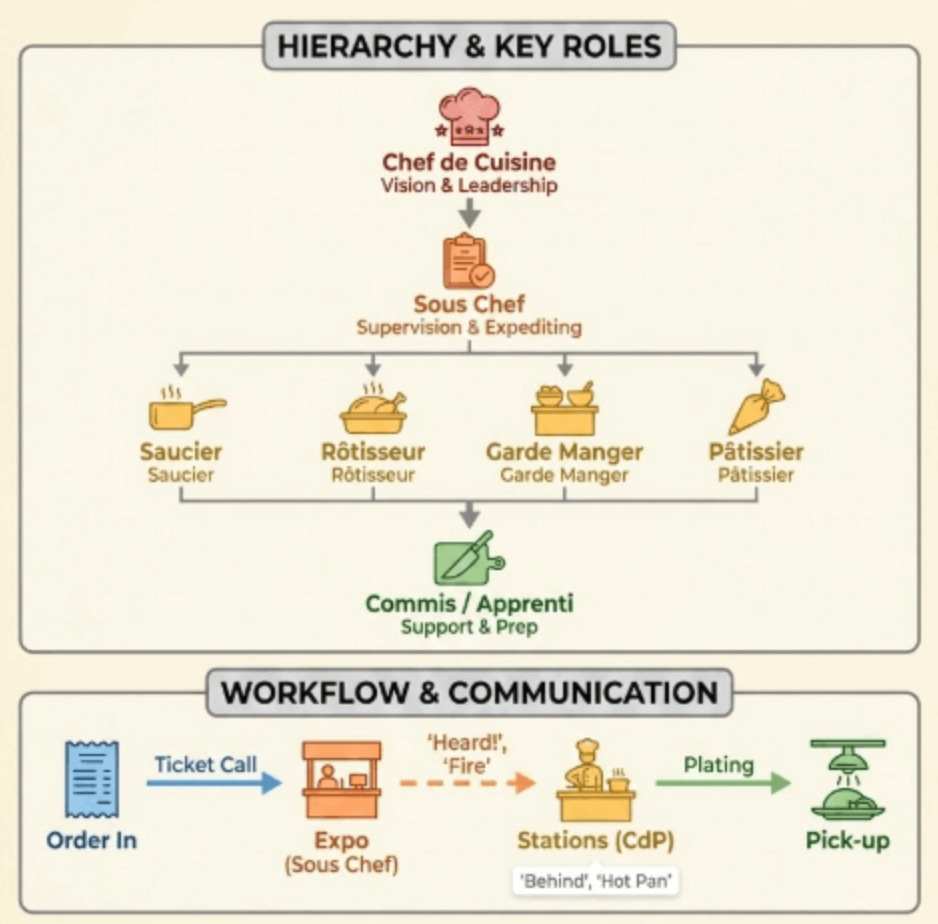
This was essentially the Taylorism of taste. Efficiency, predictability, alongside a managerial hierarchy, where the same principles being applied to steel mills and assembly lines were applied to kitchens. Escoffier didn’t make food more beautiful. But what he did extraordinarily well, was to make complex food reproducible at scale. He solved the coordination crisis that restaurants had created!
And of course, what still really matters, with or without the best management system in the world: that the ingredients, in Escoffier’s era, were still good. French butter was still French butter and the chickens still tasted like chickens (more on this in Part 2!). The problem Escoffier was solving was entirely organizational, and had little to do with style or quality, which existed outside of him already.
Serious Food for Serious Times
The Second World War broke European food systems in ways that are difficult to fully appreciate from our very comfortable distance of the present.
Consider that entire cities were devastated, while agricultural land was damaged and/or depopulated at scale. In fact, when I was visiting Hiroshima a few days ago, my questions around the re-emergence of productive agricultural land were top of my list (because without this, you cannot rebuild an entire city that you cannot feed). So in Europe, postwar recovery meant that rationing persisted in many countries well into the 1950s. National identities, which are driven of course by culinary identities, were under reconstruction. Again: not just repair, but entire reconstruction! The political economy of food was defined by scarcity, enormous trauma, and the impossible work of rebuilding absolutely everything, including (importantly) meaning itself.
In this context, cuisine underwent a moral turn through which culinary excess for obvious reasons felt obscene. The elaborate, multi-course showstoppers of pre-war dining seemed definitively grotesque against the backdrop of rationing and recovery, meaning that simplicity became synonymous with ethical. And in this way, restraint across culture, art, and behavior signaled a much-felt seriousness. A perfectly roasted chicken with good vegetables was a declaration of values which stated: we have survived, and we refuse to be frivolous about this survival.
As would be the case, the chef’s role shifted accordingly. No longer a technocrat tasked with scaling culinary production, the postwar chef became something closer to a custodian of memory. Figures like Fernand Point in France (Lyons) or Gualtiero Marchesi in Italy were engaged with innovation in the form of preservation: teaching older, classical forms, conserving and institutionalizing regional recipes, and transmitting a sense of national culinary identity at a moment when that identity felt unusually fragile. Their kitchens functioned as schools while cooking, in this period, was very much a specific cultural repair.
It’s tempting to romanticize this period and to see it as a return to “rustic” food. But that reading is sentimental, because what actually happened was more austere, as “simple food” in postwar Europe was not rustic romance. It was post-catastrophe discipline amidst a cultural annihilation. It was what cooking looked like when all resources had been destroyed entirely, and when the memory of destruction made sophistication feel morally damaging.
Rage Against the Machine
By the 1960s and 70s, the postwar recovery was largely complete. Yay! Growth had returned, prosperity was spreading, and the wider culture was in extreme motion. If you’re old enough to remember (I am not– a true humble brag!), across art, music, architecture, and politics, inherited hierarchies were being ripped open and smashed apart.
So yes, the same institutions that had once stabilized postwar economies now felt too heavy for this new era of confidence and wild experimentation.
Haute cuisine, however, remained governed by the Escoffier system (still the dominant organizational logic of serious European kitchens today!) which had by this point calcified into something closer to extreme bureaucracy (another dominant feature of Europeanness today!).
What had once been an elegant solution to the coordination problem of the restaurant had become a way to implement austere and rigid hierarchies, canonical preparations, exhaustive sauce lists, and a reverence for tradition that was actually just a hidden hostility toward deviation. So at the same moment when creative fields elsewhere were breaking down authority and embracing good vibes only, the professional kitchen remained disciplined, repetitive, and anonymous.
And as with all institutions that outlived their original purpose, the system began to feel (to be?) authoritarian. The very structure whose role was to scale excellence was now crushing experimentation. The coordination machine had become a ball and chain.
Enter the rebellion: nouvelle cuisine!
It is crucial, though, to understand what this rebellion was actually against, because it was not a revolt against bad ingredients or a lacking technique. It was a revolt against institutional burden.
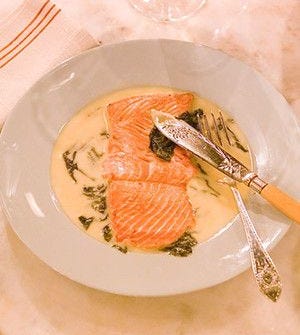
You can see this clearly in the chefs who came to define the movement. At Troisgros, the brothers Jean and Pierre Troisgros famously abandoned flour-thickened sauces in favor of reductions and acidity, as a direct rejection of the labor-heavy mother-sauce architecture that anchored Escoffier’s system. (Yes, this is quite literally a French civil war against sauces!). Their cooking was shown to move faster, taste brighter, and required less institutional scaffolding (read: bullshit) to sustain.
At the infamous L’Auberge du Pont de Collonges, Paul Bocuse (often misremembered as a traditionalist) undermined classical rigidity by stripping dishes back and foregrounding ingredients. Meanwhile, Michel Guérard pushed even further, developing cuisine mince not primarily as diet food, but as a way to escape the gravitational pull of Escoffier’s sauce-and-starch-heavy canon.
Seen through this lens, the reforms of nouvelle cuisine make total sense.
Shorter menus reduced the overhead of endless preparation.
Seasonal emphasis reconnected cooking to actual supply.
Lighter sauces rejected the labor-intensive systems that had once made sense in hotel kitchens serving hundreds.
Chef influence (the idea that a chef might have a recognizable voice, a signature, a vision) was a direct assertion of individual agency against The Institution ✊.
Nouvelle cuisine was liberation theology for the kitchen. And like most liberation movements, what it was liberating cooks from mattered more than what it was liberating them toward. The positive vision was often vague and even unserious. But the negative vision of “not this”; not the old way, not the dead weight of inherited systems; was sharp and seen as necessary.
Oh, and one final point matters enormously for what follows. The ingredients were still pretty damn good! European agriculture, while increasingly modernized, had not yet undergone the full industrial consolidation that would later hollow out flavor (again, Part 2 for this!). The raw materials of cooking remained, for the most part, unharmed.
(This fact, which is often overlooked, would later determine post-modern cuisine, and why our recent culinary revolutions look very different depending on where they occurred.)
Running Out of Things to Be New About
Nouvelle cuisine succeeded perhaps too well because, in its success, it exposed a new problem! Once this institutional rigidity had been dismantled, and once chef prominence was normalized, and lighter, seasonal, ingredient-forward cooking dominated fine dining, the scarceness was no longer food or production-line outputs of fine-dining kitchens, but of novelty itself. Liberation from Escoffier had worked so well that fine dining… got boring.
Consider that by the late 1980s and 1990s, European agriculture was still largely intact with fabulous ingredients, and culinary technique was widely diffused, meaning that the whole “excellent ingredients, treated simply” phenomenon had become the baseline expectation at the top end of the market for quite some time.
In this context, the problem facing ambitious chefs was no longer bureaucracy or scarcity, but sameness, boringness and a lack of ability to differentiate. I mean, how do you surprise a diner when everything already tastes good, and multiple Michelin-starred chefs have the same menu?
The answer for a brief but intensely influential moment, was to turn away from ingredients and toward perception itself! (And I’ve written about this exact movement in the art world, albeit to respond to a different problem, here!).
At the famous El Bulli, Chef Ferran Adrià did not rebel against Escoffier so much as take the assumptions of nouvelle cuisine and set them on fire, when he decided that flavor should be decoupled entirely from form. He turned to science and, in doing so, took familiar dishes and dissolved, reconstructed, foamed, froze, or inverted them.
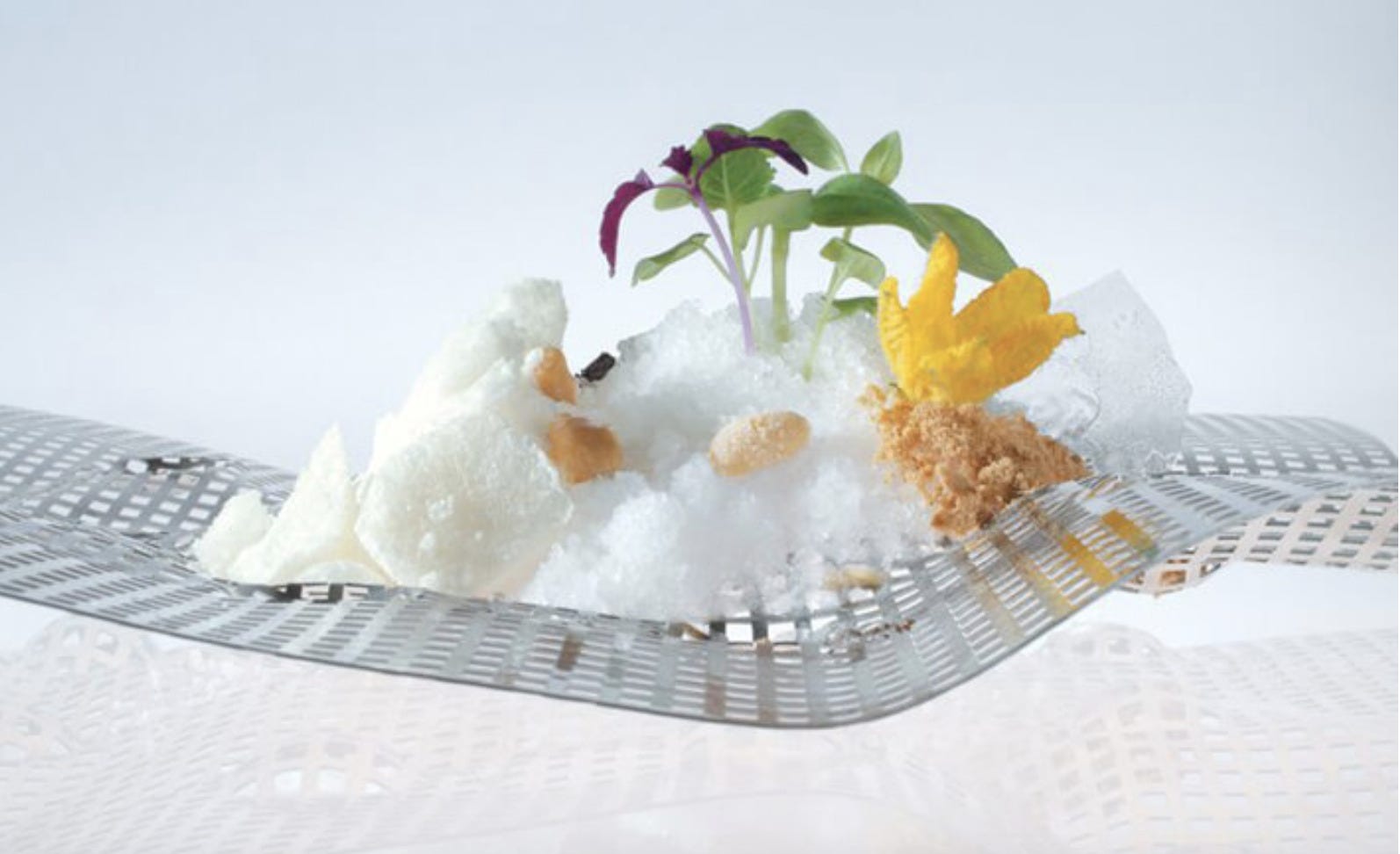
He experimented in a “lab”, not a kitchen, and his genre of food science was called Molecular Gastronomy (which also happened to be my favorite part of my culinary school syllabus!).
This is really where you start to see the emergence of what many people believe to be the “bullshittery” of dining being turned into a series of 12-course cognitive exercises; a set of perceptual disruptions designed to make the diner notice again.
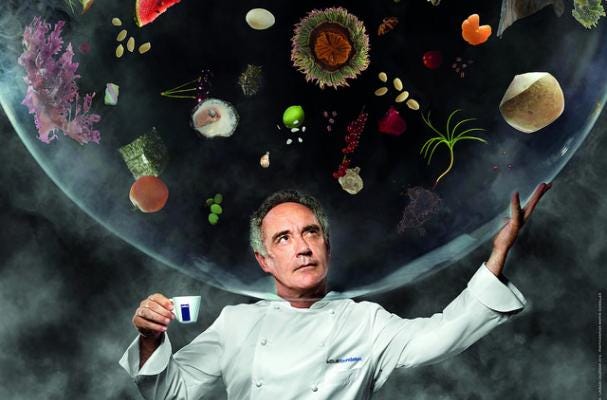
But unlike nouvelle cuisine, molecular gastronomy was not anti-systemic. It was actually the opposite. It was hyper-systemic: dependent on laboratories, research teams, documentation, and technical expertise. If you imagine that nouvelle cuisine stripped structure away, molecular gastronomy rebuilt it entirely (again: read my piece on Kazimir Malevic!), this time in the service of novelty rather than tradition. If nouvelle cuisine was some sort of crazy French liberation theology, molecular gastronomy was a surrealist modernist art: thrilling, intellectual, alienating, and ultimately… .entirely unsustainable as a dominant mode of eating!
But let’s look at what it achieved: It solved the problem of surprise under conditions of relentless abundance. However, it did so at a cost. Emotional warmth, cultural continuity, and repeatability were sacrificed in favor of what felt to many like a bizarre dining-stimulation. Molecular gastronomy produced enormous influence (the techniques, tools, ways of thinking are used heavily today), but very few people wanted to eat that way regularly.
It was peak Michelin absurdity, I suppose.
Post-Modernism
A different response emerged in the aftermath of molecular gastronomy, that accepted its technical advances while rejecting its emotional austerity and laboratory coldness. At the famed Spanish 3* El Celler de Can Roca, the Roca brothers used many of the same tools pioneered in modernist kitchens, but used them to serve a different goal that was far from pure shock value.
…. In theory.
I visited El Celler last year and, other than spending an hour discussing the restaurant’s new hotel and dining strategy (which was at one stage the person in charge admitted to being, and I quote, “fucked”), the tenth course of twelve appeared on my table with an accompanying foam that tasted like “the smell of goats” wich quite literally floated across several feet through the air and onto my plate. It was perhaps my most insane culinary experience to date.
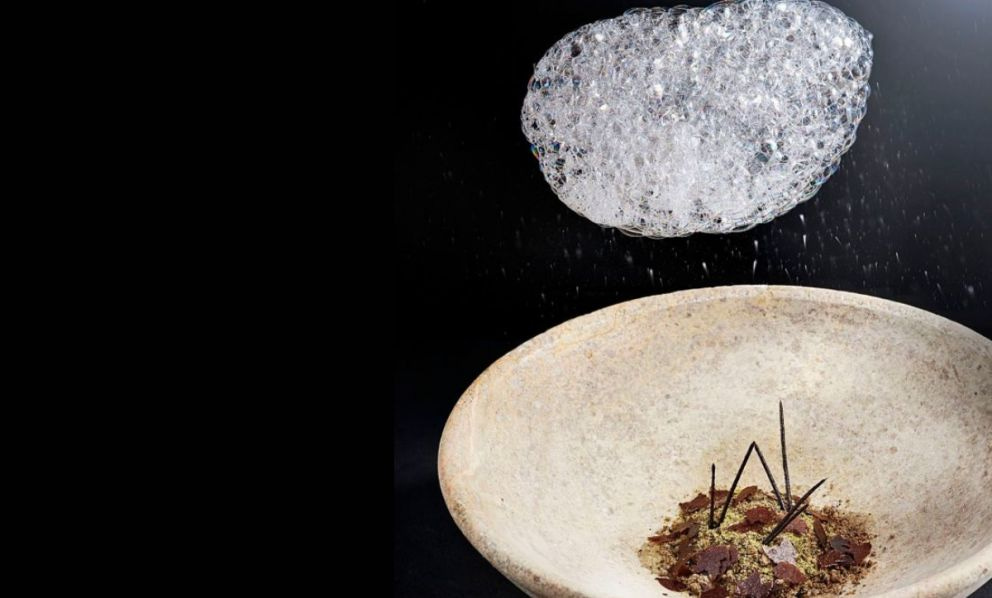
Other than that, it was a much more “normal” experience than El Bulli! For one important reason; the Roca brothers’ technique is not deployed to destabilize perception, but to do the opposite: stabilize meaning.
Smell, memory, landscape, and family history became the organizing principles of the meal and in this light, bring us back somewhat to the postwar era. Dishes referenced the chefs’ childhood and regional Catalan traditions, but with a modern interpretation that felt fresh; a translation of sorts into a contemporary language. Where El Bulli asked “what else food could be?”, El Celler asked “what does food remember?”. It is a distinction that feels obvious in the dining experience.
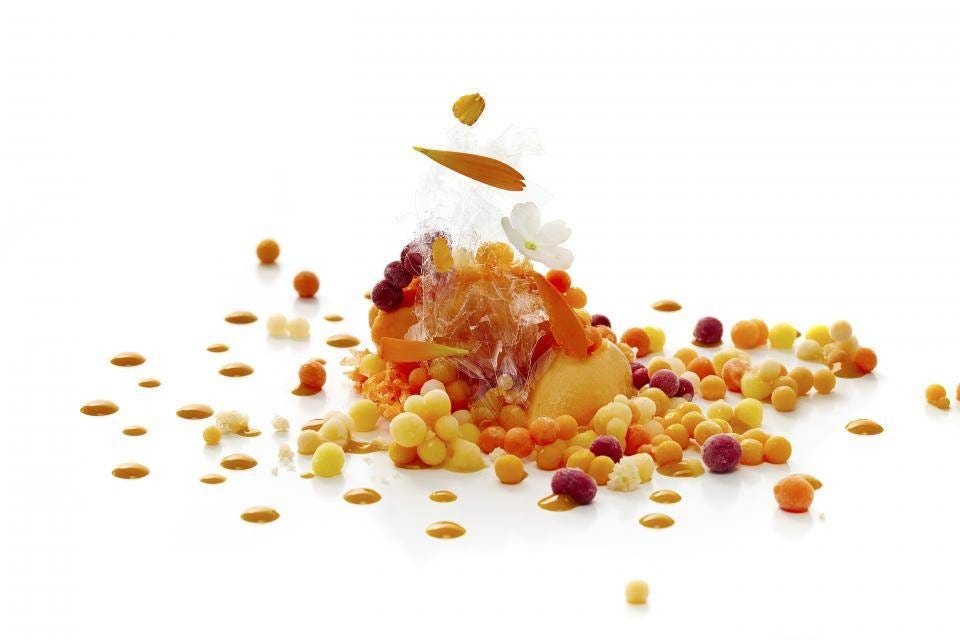
And sure, some of the technical flourishes were undeniably excessive. I mean the drifting clouds of foam bordered on absurd, but the anchoring sensations, the smells and flavors (and even sounds of the dish!!) tied to place, were unmistakably real. This restaurant, by the way, is by far my favorite of any Michelin I have experienced, and is well worth a two-day trip to visit it!
So in this way, the Roca brothers took the molecular and science-based showmanship of cuisine and marked an early recognition of the next constraint fine dining would face.
I.e.: Once ingredients were good, techniques were being shared and learned globally, and novelty was achievable, the next problem to be solved became existential:
Why are we here?
What does this meal mean?
What story does it allow the diner to inhabit?
El Celler de Can Roca did not resolve these questions fully. But it certainly named them, and in doing so, created the idea that the future of fine dining in the West would no longer be about disruption alone, but about meaning.
This in turn became hugely important because, I mean, consider the background against which it unfolded! This was the late 1990s and early 2000s: of accelerating globalization in which shops, fashion, architecture, music, culture and even cities were beginning to look increasingly similar everywhere.
Cuisine, however, moved in the opposite direction.
By tying meaning to specific memories, places, and geographies (all of which are things that resist standardization at the hands of capital flows, supply chains, and multinational corporations), fine dining began to move in the opposite direction of most global consumer culture.
So while Capital-C Culture began converging toward a shared, interchangeable aesthetic in the massive machine of globalization, cuisine actually fragmented and became niche.
What mattered to restaurants increasingly at this stage was where a dish came from, whose memories it encoded, and what local conditions made it possible. Because those elements cannot be easily scaled, replicated, or exported without losing their force, fine dining became one of our first and perhaps only sites of cultural divergence rather than global convergence!
And thus, to talk seriously about “what’s next,” I can no longer talk about global cuisine. I have to talk about specific places, specific food systems, and specific histories.
Reading Culinary History Differently
If this account is right (I hope I got it mostly correct, but I await an internet sleuther to tell me otherwise!), then culinary history is not a story of aesthetic progress as we often think. It is a story of crisis and response, in very much the same way that we would think of interest rates or economic booms and busts, and even innovation theory:
Chefs arise in new ways when systems twist to bend or break.
Cuisine moves in a similar pattern to our political economy.
Fine dining is about re-imposing solutions when existing systems can no longer provide them.
Banquet chefs addressed the gap between surplus and legitimacy.
Escoffier closed the gap between urban demand and kitchen capability.
Postwar cooks stabilized the gap between devastation and cultural continuity.
Nouvelle cuisine pushed back against the gap between institutional weight and creative agency.
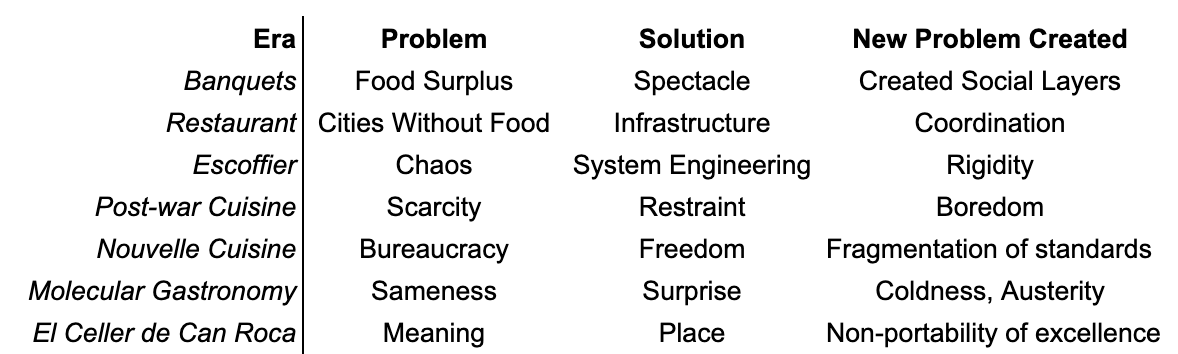
Which raises a question that this essay has been building toward:
If chefs are no longer needed to recover ingredients, guarantee quality, or standardize excellence; if the old problems have been substantially resolved, then what human problem is dining supposed to solve now?
Through this lens, why are Michelin starred restaurants seemingly in crisis, and what does the next bout of culinary disruption look like?
That is exactly what I want to discuss in Part II, for the United States and the West!
Thanks for reading if you made it this far!
If you liked what you read, consider subscribing (for free!) or sharing with your pals.
Very interesting introduction to the history of haute cuisine!
Great piece - interesting that in different political structures, where patronage and espionage are still rife, the Chef still plays a more Medieval role, and accordingly can become a powerful actor - thinking of Yevgeny Prigozhin, and of Putin's own grandfather.