

Eight Ways a Railway Dies
How Ireland's railway upgrade will likely die a long, slow death.

A few people have been asking me some specific questions relating to my last post on Ireland’s Delivery Inability. I had been thinking about how best to explain some of the failures to deliver large projects at scale, and had a few examples swirling around in my head, when the perfect gift of a billion-euro train upgrade was dropped into my lap today!
An Irish company called Iarnród Éireann (“Irish Rail”, translated into English) just outlined a project called, uninspiringly, FourNorth. It is essentially this: the fourteen kilometers of track running north out of Dublin, from Connolly Station (from the main train station) in the city center to the seaside town of Malahide, will be doubled, from two tracks to four.
Hence: FourNorth. (At least we didn’t spend €100k on marketing costs, I suppose).
Ok, so I hope your first question is the following one: why spend so much money on only 14km of railway?!
Because: the line going north of Connolly is the busiest in the country, ranking one of the most congested anywhere in Europe. On the same two tracks it carries three entirely different kinds of train!
The DART, which is Dublin’s electric commuter service, which stops everywhere;
Longer-distance commuter trains from the towns up the coast, which stop often;
The Enterprise, an intercity express to Belfast, which would prefer to stop nowhere at all.
You know that adage that says — your team is only as strong as your weakest member? Well, the same is true of these three trains, because since they all share the same pair of rails, they all travel, in effect, at the speed of the slowest. The “express” crawls behind the train that stops its way through every hole in the hedge.
Four tracks would create a “fast” lane, allowing the faster trains on one pair of lines, with the stopping trains on the other. And yes, London, Paris, and nearly every other functioning railway city did this more than a century ago. A child could engineer up this solution.
As I outlined in my last post, the announcement came, unsurprisingly, with the fanfare that is typical of such announcements. There was a cost, “more than a billion euros,” that suggested that a figure had actually been calculated (it had not). And there was even a schedule — construction running “into the early 2030s”! that seems impossible on precedent. There was even recognition that “some gardens and other private property along the line will be needed,” which is the official way of saying that the back gardens of the coastal suburbs along the track (Clontarf, Killester, Raheny, Sutton) are on a list that’s being checked twice.
The CEO mentioned words like: resilient; high-capacity corridor; and of making space today for the needs of tomorrow.
The extra tracks were first drawn by Irish Rail’s engineers in the 1990’s; and the idea has been uncontroversially excellent for thirty years. Nobody, thus far, has opposed this plan. In fact, everybody is for it, the same way that everybody is for road safety reform that I mentioned in my last post.
Which is, if you know Ireland, exactly the worrying part.
OK, so I mentioned what information we have so far.
But what about the information we don’t have?
There is no route; this comes after a consultation “later this year.”
No approved business case.
No planning application.
No compulsory purchase order.
No contracts for delivery.
No line in any multi-annual budget that reads FourNorth: €X, years Y to Z. And “more than a billion” is not an estimate; it is a floor, announced before anyone has drawn the thing that would need to be costed.
So what is the distance between this week’s announcement and an actual railway? It is, effectively, this:
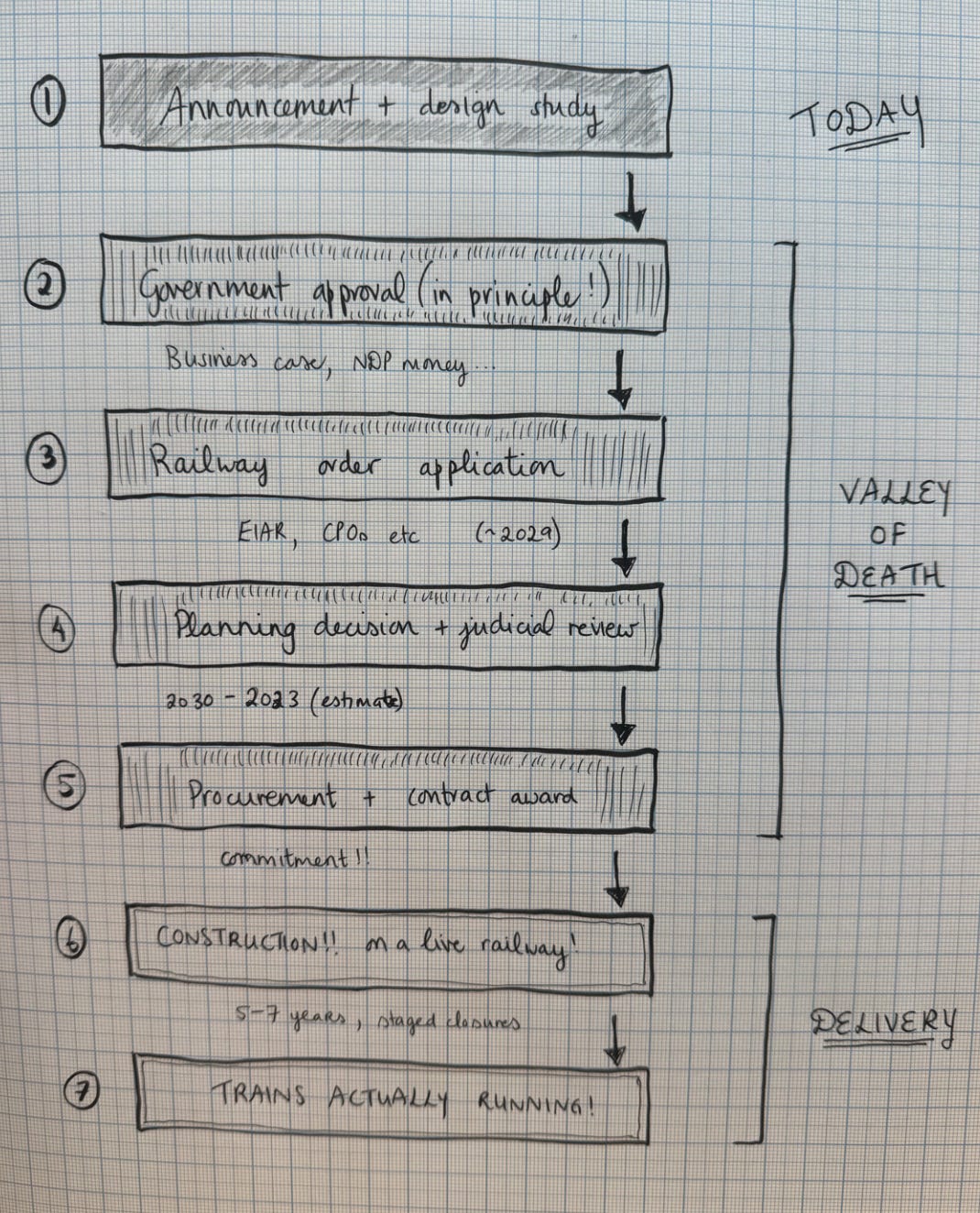
This morning, I tried to figure this out, and came up with seven stages that stand between this week’s press conference and me actually sitting on a train.
The shaded box at the top is where we are today, while the two boxes at the bottom are what everyone imagines when they read the “billion-euro upgrade” headline, with machines digging, tracks being laid and – dare I say it – trains running.
And everything in between is a government decision with actual money attached, statutory planning applications, subsequent planning decisions, plus the numerous near-certain court challenges, and a procurement process ending in a signed contract that may or may not bankrupt the state.
This diagram, in effect, is the headline that came out this week, which I outlined based on what I know from train precedents: what the last two comparable projects actually took at each equivalent stage, applied to this one.
The DART+ expansion spent two years awaiting its planning consent and was then challenged in the courts; MetroLink took three. So putting FourNorth through the same assumptions and its consent might appear in the early 2030s, around the time the press release says construction will be finishing.
(When an announced date and the procedural maths disagree, the math has never lost yet, fyi).
And the box that says “the only real commitment” is the most important stage on the paper, because a project is not committed until a main-works contract is signed. However, consider that Metro North had planning consent in 2011. Yet… Metro North does not exist.
Now, the Valley of Death is where this entire project will either happen or not. Why? Because every functioning state runs the same seven-step machine for turning problems into solved problems.
One: somebody notices the problem.
Two: somebody diagnoses it and designs a response (reports, whitepapers)
Three: somebody is made responsible (a single body with the authority, mandate and money to deliver).
Four: the responsible bodies are wired together, because big projects cut across half a dozen agencies.
Five: somebody measures feedback about whether it’s working and corrects course when it isn’t.
Six: the thing gets built.
Seven: we learn from it, and then do it again..
Ireland is world-class at steps one and two, woo! And Ireland is catastrophically, HORRENDOUSLY bad at three, four and five – every goddam time, in every goddam sector, under our same government, for forty years.
So look at this seven-step process of “how to get shit done” against “what needs to happen”.
This week’s announcement is Steps 1 and 2, so they are done! However, they are also the parts we always finish. What about the rest? Well, there are eight very specific ways this project can fail, and they all get sucked into the part of the process that Ireland can never quite handle, which also corresponds to being in the Valley of Death.
So in case you wanted to celebrate the announcement of a train project (who doesn’t love a train project!), here are eight things to consider that could go sideways before getting too excited.
1. The Damned Absorption
The most likely death of the project, and also the most boring way to die.
FourNorth is an Iarnród Éireann project, developed with EU study money. But there is another project on those same fourteen kilometres: the DART+ Coastal North, which will electrify the train line out to Drogheda. And that one is funded and controlled by the National Transport Authority, not Irish Rail.
So, to be more explicit: we have two state bodies; two projects; on one corridor; overlapping mandates; no single authority between them.
This is the textbook “First Lock” problem that I talked about in my last post; the lock where nobody is made responsible. And here it is, visible to us all, on Day One! The most predictable failure of the project exists openly at the very start. And people seem… ok with that. Which means, in about fifteen years time, somebody might actually notice it and do what has happened with the Metro: decided to put someone in charge of it, after decades.
Therefore, the “project-going-sideways” scenario isn’t that it’ll get canceled, because nobody cancels anything in Ireland – this would require a decision, and decisions require strategies! The sideways scenario is this: “elements of FourNorth will be delivered through the DART+ programme.”
It will sound like integration, but it will actually mean de-scoping. Four tracks becomes “phased four-tracking” which becomes “a third track on the core section” which becomes, eventually, the passing loops we were getting anyway.
What to watch for: whether FourNorth appears in the next National Development Plan revision as a named project with its own budget allocation. A project without its own budget is not a project that will ever be delivered.
2. Building the Wrong Thing First
The spikiest risk is physical, and this failure mode is already scheduled into this, but without a workaround yet.
DART+ Coastal North wants to electrify the existing two-track alignment. So that includes the masts, that overhead wire, and the substations. But these will be in exactly the corridor where FourNorth wants to lay two more tracks! Now, I’m no quantum physicist, but there’s an obvious issue here of two things not being able to coexist directly on top of each other.
Meaning that if these two projects are not joint re-designed as one railway, the State will spend the next twenty years electrifying precisely where the third and fourth tracks need to go, and then will inevitably have to pay to rip it out and move it.
→ This is exactly how you end up, many years later, saying things like “How could nobody have foreseen this! How could this be so dumb!”.
Bookmark this, please. Because I can nearly guarantee you that this is exactly the same mechanism which led to the dumbest infrastructural failures of modern day Ireland; two Luas lines not connecting, roads getting resurfaced right before the water mains go in, and the many cycling lanes that ends at a hedge.
What to watch for: the drawings! When the Railway Order designs are published, look at where the overhead line masts are positioned. Is it for two tracks, or four? That single drawing will answer whether any single body owns this corridor as a whole. My money says… well, you probably already know what my money says.
3. The Announcement Was the Achievement
This week’s headline released the pressure, which was its job. This is what I already told you in the last article.
The Northern Line has been one of the most complained about transport issues in the country for a decade. But now that there is a billion-euro answer, the media can move on and people will stop complaining because… it’s coming! The emotional problem is, in effect, solved. PHEW. The physical one, of course, is still there; but the pressure that forces states to act has been vented. And since the announcement is the system’s relief valve, nobody has to actually build these train lines to make the pain go away. Because remember: the pain to the political class is not the slow train; it is the people who complain at them.
Your problems are not their problems. Or as I said in the last post:
The people who would suffer from these problems are not in the room, and the people in the room do not suffer from these problems.
What to watch for: Silence. The consultation is promised for “later this year.” If it happens in 2027 and nobody reports the slippage (because the announcement already did what it needed to do in 2026), you’ll know the system is working perfectly fine, and just as it was intended to.
4. The Land Just Repriced Itself
Guess what? This announcement did exactly one concrete economic thing, which sadly had nothing to do with transport. It repriced every garden-end, garden-shed, garden-tenancy, side plot and sliver of land from Clontarf to Malahide… Before the State could buy a single square meter of any of them, with your money!
Announcing the need to acquire land before securing the asset is the founding move of the Failure Premium. It is the HAP mechanism applied to land: the moment the State declares it must buy, whoever already holds the asset can set the price, and compulsory-purchase compensation will be assessed in that new reality. This expensive premium is structural, automatic, and it acquired a date of birth: today.
What to watch for: the land-and-property line of the budget, when detailed cost estimates eventually appear. The gap between what that corridor of garden-ends was worth in June 2026 and what the State pays for it is a Tier 1 Failure Premium, whereby a cheque written by the government is captured entirely by the asset holder.

5. The Consultancy Stack
Forty years ago this country built Moneypoint, which was a three-billion-euro power station (in today’s money) on both time and on budget. It did this because ESB owned the engineering in-house, with accountable managers designing to a cost alongside a permanent staff of engineers who had built the last project and would build the next one, retaining and reusing institutional memory that I also discussed in my last post.
FourNorth will be delivered the modern way, which is to say the catastrophically worse way: with external design consultants, external project managers, external cost consultants, external planners, external contractors, external bullshit artists, each one coming in with a big margin, and none of them accumulating assets (like memory! or skills!) that the State gets to keep. So when the project ends, if it ends, that learning walks straight out the door in the consultants’ laptops, ready to be rented back to us at day rates for the next one. Again, the Failure Premium, Infrastructure Edition™, and it’s why every Irish project starts from scratch.
And there’s more. MetroLink, DART+ and FourNorth will all tender into the same thin Irish civil-engineering market, in the same half-decade, for… you guessed it, the same contractors. Three mega-projects bidding for one construction industry is a scarcity premium by design!
What to watch for: Forget about spending for a moment, look at staffing. Does Irish Rail hire a permanent FourNorth engineering team that will still be there for the next corridor? Or does it issue letters of engagement to the usual firms?
6. The Tunnel Demand
Here’s is where it’ll get… spicy.
This line runs through Clontarf, Killester, Raheny, Sutton, Malahide. If you don’t know much about Dublin, let me just tell you this: this stretch of land homes some of the most organized, articulate, well-lawyered constituencies in the country. And it is their garden parties that are about to be inconvenienced by the acquisition schedule. It is also their elected officials that sit, in several cases, on the government benches.
As Taylor Swift once sang: I’ve seen this film before; and I think I know the ending.
So yes, TDs will be more than happy to lead the opposition to their own government’s project, which is what happened on BusConnects and DART+ West, before pulling out the “appeasement mechanism”, which is always, always the same thing: move the thing underground! And tunnel the contested section!
But examining “sensitive design alternatives” multiplies the cost of the affected section many, many times over, which then detonates into the failure mode I will discuss next.
So, who is the villain here. Residents? Well, their gardens are being taken away from them, I suppose, maybe I should be sympathetic. However, if this was a state that had built trust by delivering something (anything!) over the last fifty years, it could probably ask for that sacrifice from locals with some authority. Needless to say, a state that hasn’t, can’t. The tunnel demand is what forty years of the Failure Premium looks like when it comes to the leafy roads in Raheny.
What to watch for: the first local representative calling for “an examination of tunneling options” for their section. It’s coming within eighteen months of the route maps appearing, guaranteed. If not shorter.
7. The Sticker-Shock Review
“More than a billion” is a pricing floor, announced before designs have even been delivered.
Again, four-tracking an important part of a line through dense Victorian suburbs, while rebuilding ten live stations, throwing in the rebuild of a few dozen bridges, plus the cost of buying a corridor of Dublin residential land that is now twice the price because of failure mode four.
The cost? It will plausibly be a multiple of that figure. Everyone involved knows this. I’m not even involved, and I know this! The pricing floor exists to get the project through the door, after which it is allowed to become the Children’s Hospital, round two.
And if you’re into jokes, here’s a cruel one for you: when we finally built a feedback loop for infrastructure projects, we made sure that it makes things worse, not better. Here’s what I mean: since the Children’s Hospital, a cost increase no longer leads to an adjustment of a project, it leads to a review of the project. In other words, a suspension and re-examination. Which is why my last essay began with a list of things that, after they exceeded costs, were canceled in their entirety. Meaning we had (over)spent the money already, but then never actually got to receive anything for that money spent!
Note, also, a mathematical dissonance already making itself known in this week’s marketing material: construction “into the early 2030s.”
But if you look at precedents, DART+ West took two years in planning and was then judicially reviewed, while MetroLink took three. So FourNorth’s planning consent alone will arrive around 2031-33. Construction can barely have started by the date it’s supposedly finishing. Either the organization doesn’t believe in its own schedule, which is “announcement theater”, or it hasn’t done the maths, which is… worse.
What to watch for: the first revised cost estimate, and the response to the number. When you see the word “review” attached to a cost update, the project has entered the long grass.
8. The Leadership Reset
A twelve-to-fifteen-year project will pass through three or four governments, half a dozen ministers, and at least one CEO change at both Irish Rail and the NTA. And because no single statutory body owns this corridor (see failure mode one) every single transition is a fresh opportunity to re-prioritize, re-sequence, or park the project entirely.
This is the Fourth Lock I mentioned in my last post: the inability of projects to survive successive leadership.
If you think planning consent protects it, then boy do I have two words for you: Metro North. Planning consent was granted in 2011 and it was cancelled anyway, at exactly such a junction. The project that became MetroLink was first proposed when the twenty-five-year-olds now swarming onto the Malahide DART were in montessori, and it still doesn’t exist. Consent is not commitment. Hammer this into your mind. Consent is not commitment.
What to watch for: any incoming Minister for Transport announcing “a review of transport capital priorities” when they first move into the office.
What do these failure modes have in common?
This might be the most important part of this piece.
Go back through that list and you’ll realize: not one of these failure modes requires anyone to oppose the project!
This is an infrastructure project that will fail with or without villains, grinches, conspiracy theories or illegal and nefarious activity. The Damned Absorption is two agencies doing their jobs, exactly as they’re supposed to. The mistimed electrification is two funded projects proceeding on the schedule they announced. The land repricing is literally just the market reacting to information, as it always does. The consultancy stack is standard procurement; we’ve literally designed it this way. The tunnel demand is democracy, and politicians doing what they are asked to do by those who voted them in. The spending review is sage because we complain too much about spending.
Every single failure mechanism comes about when the system is simply operating as it was designed to, which is precisely what I have told you throughout these essays about Ireland, in various different ways.
Ireland doesn’t cease to function because it has a corruption or a competence problem, even though it certainly suffers from both. It has a design problem.
The institutions that convert inputs (money) to outputs (infrastructure) were never built. And a project entering a fifteen-year Valley of Death without that institution isn’t “taking a risk,” as Jack Chambers would like us to believe; it’s taking the best-trodden route through the same grounds we’ve traversed for nearly half a century. Except this time doing it even faster and with even less accountability along the way.
And no, the answer is not that somebody should just be brave. I made this point in the last essay: the demand for bravery isn’t just inadequate, it’s wrong, because bravery was never the missing ingredient – leverage was. A brave executive with no authority, no visibility into the system, and no institutional memory behind them cannot build anything. All they can do is fail more visibly and faster than everyone else.
So if FourNorth dies, it will die the way Irish projects always die: of nothing in particular; as a system doing exactly what it was built to do. Which was never, in the end, to build anything at all.
Brilliant essay, uttterly infuriating. It seems to me that Ireland has created a well paid technocracy that is incapable of doing anything other than spin pointlessly in circles. Jonathan Swift had written about something similar in Gulliver's Travels:
A First or Chief Minister of State, whom I intended to describe, was a creature wholly exempt from joy and grief, love and hatred, pity and anger; at least made use of no other passions but a violent desire of wealth, power, and titles; that he applies his words to all uses, except to the indication of his mind; that he never tells a truth, but with an intent that you should take it for a lie; nor a lie, but with a design that you should take it for a truth; that those he speaks worst of behind their backs are in the surest way to preferment; and whenever he begins to praise you to others or to yourself, you are from that day forlorn. The worst mark you can receive is a promise, especially when it is confirmed with an oath; after which every wise man retires, and gives over all hopes."
No wonder he founded St Patrick's Hospital for the Insane.....
Another brilliant essay Sinéad. This analysis is hauntingly applicable to the UK too.