

Trickle-Down Gastronomy: Japan
How Japan solved the problem that Western dining is only now discovering

In Parts I and II, I argued that culinary history is an economic story of crisis and response, as most economic stories are. More specifically, that chefs emerge when something upstream of dining breaks, whether it’s supply chains, labor markets, institutions, or meaning; and that their real job is to diagnose and repair whatever the prevailing economic system has become most broken about eating.
I did this by tracing culinary history through feudal banquets, to Escoffier’s industrial kitchen, to postwar austerity, to nouvelle cuisine, to molecular gastronomy, and then finally to the current Western exhaustion with the Michelin system (which is very, very real). And I ended Part II with the claim that the current structural problem that defines our current era is existential, in that we have more food options than any civilizational era in history, and everything tastes good; but the thing that’s broken is meaning of food (and even life!) itself.
(Apologies to the people who told me this was the most depressing thing they had ever read).
So now, Japan, because the Japanese food system has been solving this exact problem, of how to create meaning under abundance and excess, for centuries. And how the Japanese have handled this can tell us a lot about Western dining and where it is headed next, which is really what I want to figure out!
How Japan Got Here
Meaning First
The Western culinary arc I traced in Parts I and II followed a consistent pattern that is pretty much the following: a structural crisis appears, and then a chef responds to that crisis. It is precisely this solution to the crisis that creates new culinary institutions, which will eventually become mainstream, before breaking and produce the next crisis. The whole history of food and restaurants is just a long sequence of something being broken and eventually being fixed, much like our “regular” economy.
Interestingly, though, is that Japan’s culinary history does not follow this pattern.
Because where the West’s culinary history is defined by break after break, the Japanese arc is defined by continuity, and the lack of breaks; a difference that is structural. It is the reason the two systems — East versus West — produce such different relationships between food and meaning; a difference that is so enormous that even someone without an interest in the culinary economy will find it impossible to realize it after a day or two in Tokyo!
Ok so let’s start at the beginning:
The Western restaurant emerged from urbanization. As industrialization moved hoards of people into cities, household kitchens began to get smaller, and a new institution was needed to solve a very practical problem: how do you feed a rapidly growing population of urban-living strangers, reliably, outside of the home? And so emerged the restaurant. As I discussed in Part I though, they immediately created a second-order problem (that of how to coordinating actually making this amount of food) which Escoffier’s brigade system then solved by industrializing the kitchen.
Now consider that Japan’s high culinary tradition emerged from a completely different place. Kaiseki, the formal multi-course cuisine that sits at the top of Japan’s culinary hierarchy, emerged from the very ancient tea ceremony, which is a ritual “technology” that reliably produced attention and presence in people’s busy days. The tea ceremony was not trying to solve a logistics problem, like most of the restaurants I have discussed, but rather a spiritual one. How do you create a closed space in which every gesture and every object, can carry flavor which is saturated with deliberate meaning?
The “meal” which came out of this was an extension of that original project. As in, food existed in service of consciousness! Not the other way around. Contrary to the West, wherein we have tried endlessly to retrofit some sort of consciousness into food (e.g. veganism).
This means that Japan’s culinary tradition began from meaning and worked backwards toward formal techniques, while the West began on the other side — from solving problems around logistics that has spent four centuries trying to create a semblance meaning. Now, the two systems are converging on the same point, but from opposite directions, and… clearly, Japan got there first!
The Shokunin
The figure embodying this tradition of meaning in Japan is the shokunin, the master craftsman, who is the Easters counterpart to the Western chef-celebrity.
And actually, you could probably say that the shokunin is very much an inversion of a Western celebrity. I mean, the entire concept of a shokunin is the antithesis of what we do in the West. A shokunin might spend ten years learning to make rice, or fifteen years cutting fish, in a country where entire careers are dedicated to the preparation of a single ingredient!
Consider that the word “shokunin” itself carries connotations that “chef” does not, of duty, some sort of spiritual discipline, and a moral obligation to pursue mastery regardless of being recognized for that mastery.
There is a famous Japanese concept, shokunin kishitsu, which roughly translates as “the craftsman’s spirit” and describes the obsessive, almost religious commitment to perfecting this single form over a lifetime.
So the interesting question for me, especially after having been to Japan, asks what institutional conditions produced this model, which is so starkly different from ours — because it didn’t happen to emerge from some mysterious Japanese reverence for craft. As I outline constantly in these posts, these things emerge from specific economic structures and incentives that made this an entirely rational strategy.
I’ll start with the za, Japan’s medieval guild system. (I should add, by the way, that a lot of my pre-Japan history around this came from this excellent podcast, Isaac Meyer’s History of Japan).
The za were monopoly organizations that controlled production and trading in specific crafts, and which created exclusive rights for designated artisan groups in exchange for answering to powerful patrons, including temples, shrines, and even feudal lords. So if you belonged to a za, your livelihood depended on maintaining your position within a defined domain, and only that domain. Meaning that you simply didn’t diversify, and you certainly didn’t innovate laterally; instead you deepened your mastery within the boundaries that the guild had drawn up for you, because those boundaries were the source of your only economic protection.
This became more intense under the Tokugawa shogunate (1603–1868), which imposed a rigid four-tier social hierarchy: (1) samurai, (2) farmers, (3) artisans, and (4) merchants. And since mobility between classes was largely impossible, this meant that if you were born into an artisan family, the outcome of your economic life was fixed; you could thankfully not move down to become a merchant, but nor could you move up to become a samurai.
In fact, the only way to advance your lot to accumulate social capital and economic security, was to go deeper within your inherited craft. Given that breadth was structurally not possible, depth was the only option.
And so this is the political economy of the shokunin, which is essentially a labor model produced by closed markets and impossibly rigid class structures, in which mastery of one thing (and one thing only!) was the rational response to a system that punished deviation.
Thus, the shokunin is an adaptation to a constraint that was subsequently culturally kept even long after the constraints were lifted and even when people could economically have more freedom. Obviously, the Tokugawa class system was abolished a long time ago in the Meiji Restoration of 1868, but the craft culture it helped to create, along with the the structural worship and reverence for depth (plus a deep suspicion of novelty!), had by then become so deeply sewn into Japanese institutional life, that it became entrenched with moral standing to this day.
Now, that was the ideology. But how did this filter through society?
The transmission mechanism through Japanese life was the ie, known as the household system, which kind of designated this craft knowledge as an intergenerational inheritance, so to speak (and we kind of see this in the West as well, with intergenerational family businesses).
But the ie shouldn’t be confused with “a family”, as it was more of an economic unit in which the business, the techniques, the reputation, and even the social identity were all inherited as a single package. Today, obviously, we’d call this “corporate synergies and brand values” and something Brooklyn Beckham recently had a lot to say about (ha!).
But what this means is that the sushi master’s counter is not his personal achievement, but the ie‘s productive asset, held in a trust across generations. Thus an apprentice does not aspire to open a competing restaurant with a different vision when he works with a sushi master; his aspiration is to become the master, and to inherit that very counter, in order to reproduce the form with even greater fidelity than the generation before. It is a reproductive model, much more than the competitive one we see in the West.
Let’s compare this with the Western chef’s path, which Escoffier’s brigade system made feasible. In the Western kitchen, you start as a commis at a junior station (vegetables, cold prep), and work your way through the stations. If you’re good enough you eventually reach saucier, which is the most prestigious position before sous chef and eventually chef de cuisine. And once you’ve peaked at a restaurant, you leave, opening your own place and developing a personal style that is needed in order to build a brand. The incentive structure rewards ambition, movement, and differentiation; all of which accrue to create individual expression, the thing that makes the West, the West.
Thus, the whole trajectory is a competitive career ladder that terminates in self-prominence. Me, myself, and I.
The Japanese system has no equivalent ladder! There is no moment of liberation against the cruel boss that makes you clean floors until midnight, and certainly no break from the inherited form that you are given. There is absolutely no assertion of individual voice against the institution.
And this maps onto broader structural differences between Japanese and Western capitalism. We can see it in the keiretsu networks that produce long-term institutional relationships in favor of market-based competition; and even the curious lack of hostile takeovers and disruptive entrepreneurship in traditional industries. Even notice that they don’t have the cultural suspicion of the founder-hero figures that dominates Western business (which, honestly, we should probably all find suspicious by now).
So the shokunin and the Western chef-celebrity are both products of their respective economic systems, and those systems reward fundamentally different things. Like everything, this comes down to incentives!
This is why the shokunin’s excellence through repetition is structural, and why you will go to Japan and struggle to find a signature dish or a personal brand among the restaurants. You’ll find that ego and the culinary form are the same, which feels non-differentiated, meaning that the only thing that remains is the form of culinary technique itself, executed with a precision that only decades (or generations) of repetition can produce.
Actually, you could even go further to say that the shokunin is actually liberated by constraint (!). And that the inherited form is the freedom, because it eliminates the entire burden of originality and replaces it with depth!
And this is enormously relevant for understanding the generational crisis I’ll discuss later, because what is at risk today, in Japan, is not simply the loss of skilled individuals, but the collapse of the ie as a transmission mechanism.
Because when a young person declines to takae up a ten-year apprenticeship, they are not just choosing a different career, but breaking the institutional chain that produced the shokunin model in the first place. Hence you are not losing a chef, you are losing the economic structure that made that kind of chef possible. And as I saw in Japan myself, this is a very, very, very real problem.
Seventy-Two Seasons
If the shokunin provides the labor model, and kaiseki provides the template from which all of this was derived; it is the very thing that binds the entire Japanese food system together. The kaiseki is, strangely, a relationship to time that has no real Western equivalent.
(And yes, I am sober as I write this…)
As if the world is not already complicated enough, the Japanese calendar traditionally recognizes seventy-two micro-seasons, called shichijūni kō. This kind of sounds like a marketing hype that you might expect from a weekly menu change at Noma or the French Laundry, but in Japan it is a very real calendrical technology, rooted in Shinto and Chinese naturalist traditions, that pre-determines what can be cooked, when, and why.
So, basically: each micro-season basically lasts roughly five days and describes a specific natural phenomenon:
“East winds melt the ice.”
“Hibernating insects open their doors.”
“Paulownia trees produce seeds.”
(In fact, maybe French Laundry should steal some of this)
Meaning that a kaiseki menu in early March is structurally different from a kaiseki menu in late March, because March has moved through the season. The cherry blossom that appears on a plate in the first week would be completely, embarrassingly erroneous in the third week. And the fish that defines this five-day window will be replaced by a different fish in the next one. The menu is a function of time itself! It is time. The menu is a technology in the same way that a watch is a technology.
So, I was in Japan during the last week of January and the first week of February, which turns out to sit on one of the most significant hinges in the entire calendar! The micro-seasons I ate through were:
“Ice thickens on the streams,”
“Hens begin to lay eggs” (the final micro-season before the calendar year turns),
“East wind melts the ice,” which marks Risshun, the official beginning of spring on February 4th.
The food reflected this. In late January I was in deep winter, meaning fatty kanburi (cold-season yellowtail, at its richest because the fish have fattened migrating south through cold water), fugu, winter tuna, daikon, yuzu.
By early February, the first butterbur sprouts had supposedly started appearing, meaning that the calendar had moved quickly on. The menu in the first week of February could not have been the menu I ate in the last week of January, because January and February are different worlds.
This produces something that the Western culinary system has struggled to achieve: real-world non-repeatability!
Every meal is temporally indexed because it belongs to this moment and cannot be reproduced next month, because the season will have shifted, the ingredients will have changed, and the entire framework that structured the meal will have moved on. The non-repeatability I identified in Part II as the new luxury (experiences that cannot be replicated or repurchased) is, in Japan, simply the default condition of cooking well.
The Western Michelin system, by contrast, rewards exactly the opposite: consistency!
A starred restaurant must deliver the same level of excellence every time an anonymous inspector arrives, which means the ideal Michelin dish is hugely time-invariant. In other words, it should be as good in June as in October, and for many multi-starred Michelins, this involves having many of the same dishes to perfection.
Japanese Smallness
One more piece of institutional history is important for understanding where Japan is today, and it’s the one that strikes every Western visitor most immediately when they are physically in Japan: the restaurants are tiny.
Six seats, or maybe eight. The chef will prepare in front of you, often alone, and there is one service per evening during which there is one “menu”, which tells you that you will eat what you are given.
This is typically discussed as an aesthetic choice and as an expression of Japanese minimalism or cultural preference, but it is actually an economic structure, with very old roots.
The Japanese tradition of counter dining evolved from yatai (street food stalls) and kappo (chef-driven cooking performed in front of guests), both of which predate the Western restaurant concept; and these styles never needed to solve the biggest problem that defined Western dining — of how to feed so many people at once — as there was no moment equivalent to European urbanization where a sudden population BOOM required feeding hundreds of strangers simultaneously.
So the problem that produced Escoffier’s brigade system (“how do you serve many diners, ordering differently, all expecting the same quality?”) simply did not come about in Japan. The kitchen never industrialized, and the chef never needed Escoffier’s brigade, meaning that the management system that defined Western fine dining for a century was totally unnecessary in Japan because the structural decision, which was maintained across generations, was to serve fewer people, not more.
This smallness also meant that the relationship between a chef and their diners was personal in a way that the Western system very sadly abandoned very early on. Consider that at a six-seat counter, the chef knows who is eating and that meal can be adjusted in real time. (Those of you reading this with kids, particularly picky ones, will know this).
The experience of eating in Japan therefore is conversational and there is no front-of-house team mediating between kitchen and table, no dizzying choreography of service à la The Bear, and no separation between how food is cooked and how it is consumed, which is where the hierarchy between chef and its patrons is entirely created in the West.
Where Japan Is Today
Toyosu at 5am
On one of my first mornings in Tokyo, after trying and failing to beat jet lag, I decided at 3am to get up and go meet some fishermen. Eventually, I found myself in the Toyosu fish market at 5am watching the tuna auction, feeling overwhelmed by the smell of fish (both raw and cooked) being handed out to those finishing their night shifts.
In a literal sense, Toyosu is a wholesale fish market where Bluefin tuna are laid out in rows, with chefs and buyers inspecting tail cuts with flashlights, as an auctioneer moves through the lot at a dizzying speed.
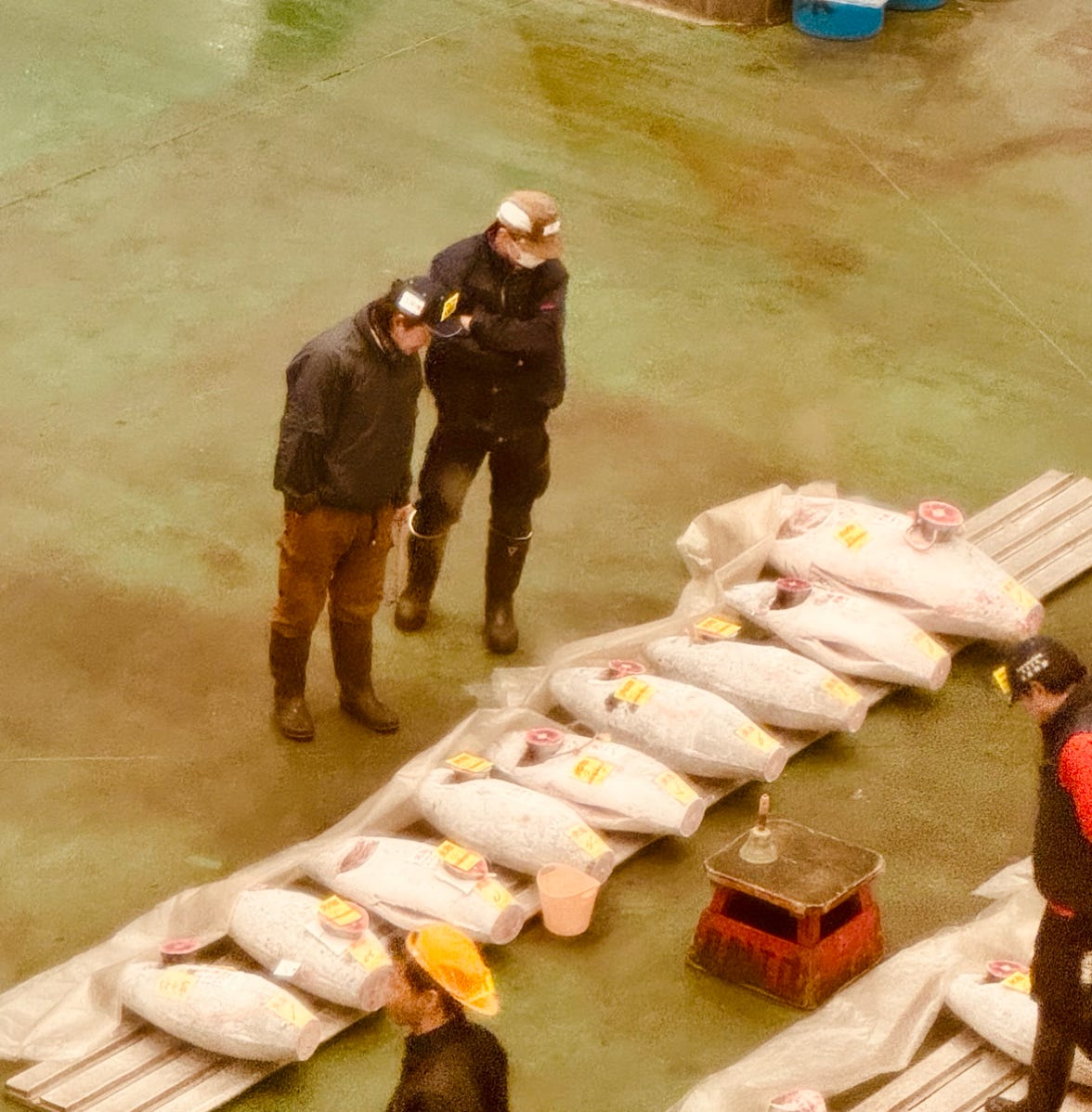
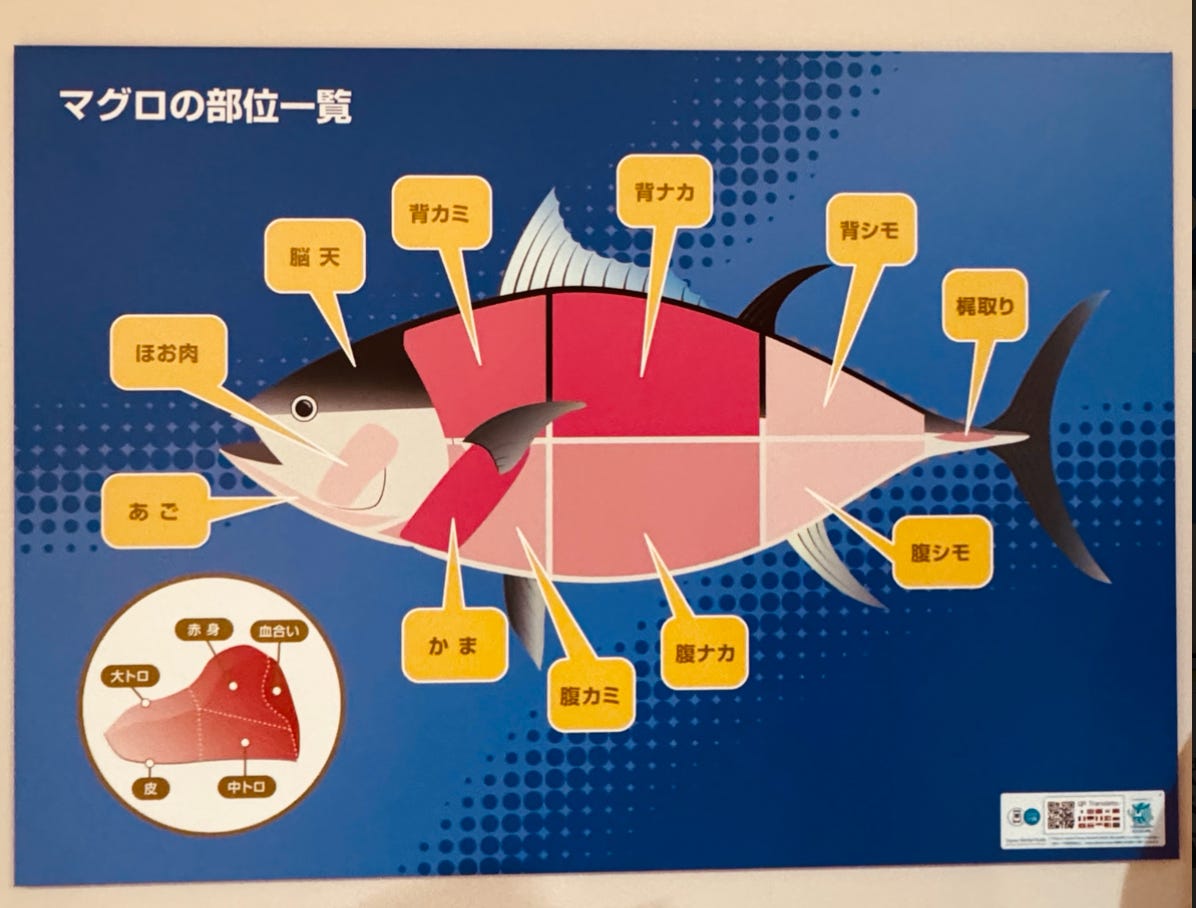
But what struck me was how little this market resembled a commodity market in any Western sense that you may have seen on tv. There was no negotiation or haggling, and the prices that morning took an approach that Western commodity markets do not: this tuna was caught this morning, in this water, at this temperature, at this point in the season. Tomorrow’s tuna will be a different animal, literally and economically. The same cut from the same species will cost wildly different amounts next month, because it will be a different month.
The first bonito of the season (please forgive me for saying this, but bonito = dried tuna flakes that are put as often as salt and pepper into Japanese food, and is indistinguishable in taste for me from fishfood) carries enormous cultural and economic value precisely because it is the first, and because it marks a temporal threshold that the entire food system recognizes.
When the season for a particular fish ends, it ends. The supply chain does pretend otherwise. There is no FedEx workaround as with many global Michelin restaurants to get far-flung ingredients into kitchens daily. The constraint is as absolute as time (because the menu, again, is time!).
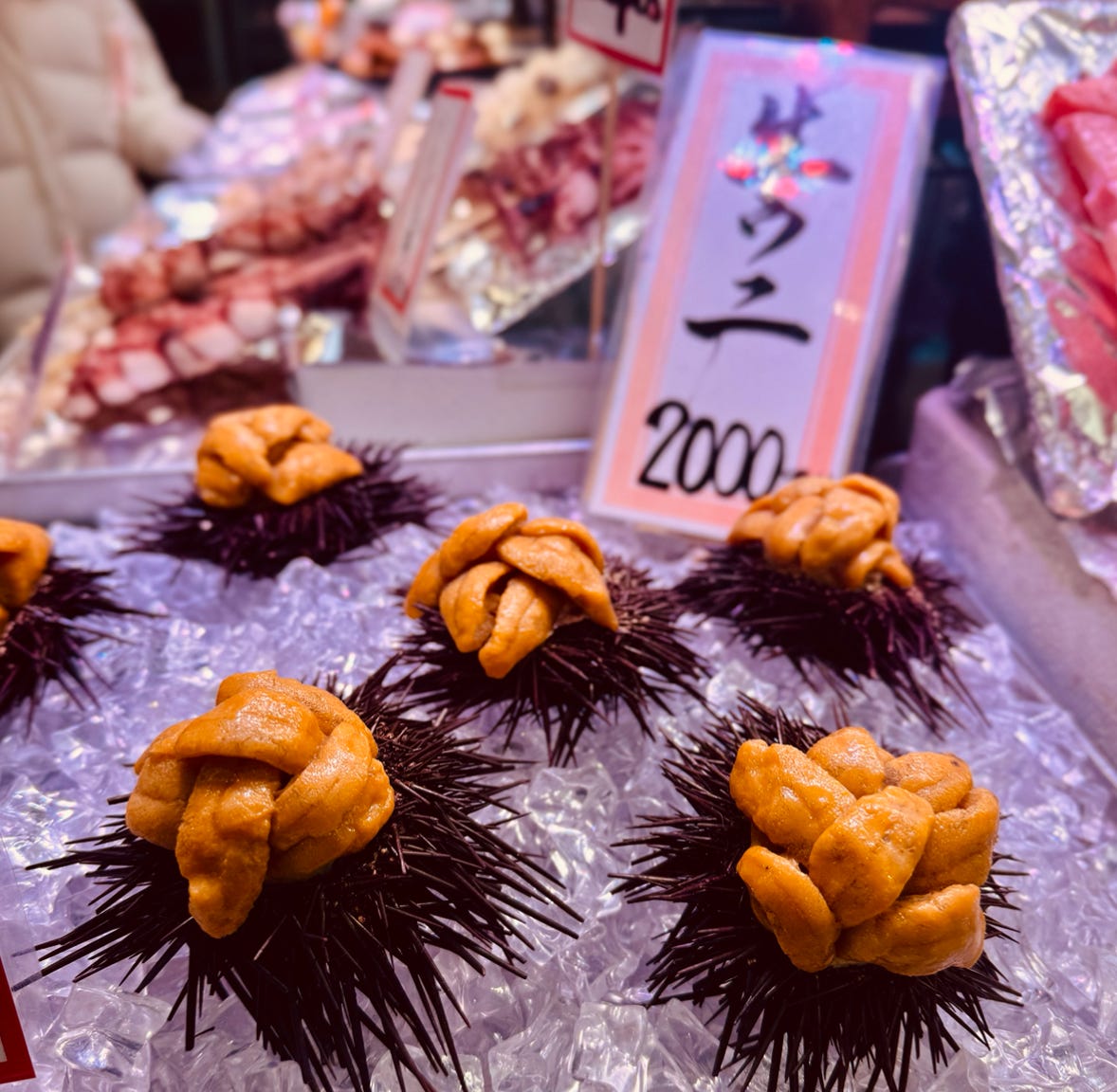
The Toyosu auction is, in other words, the seventy-two-season system seen as a form of financial-markets infrastructure. Prices, menus, commodities, and time are all the same thing here, viewed through different lenses!
The tuna is expensive because it is January, and it is on the menu because it is expensive, and it is expensive because this particular fish exists only in this particular five-day window of cold water and migration patterns. Remove any one of these variables and everything else becomes meaningless. This is very much the opposite of the globalized Western supply chain, which is organized to bypass entirely the natural seasons and ensure that nothing is ever unavailable. In the West, this means that price is a function of logistics costs; and menus are a function of customer preference. Time is, very strangely if you think about it, irrelevant to both cost and preference.
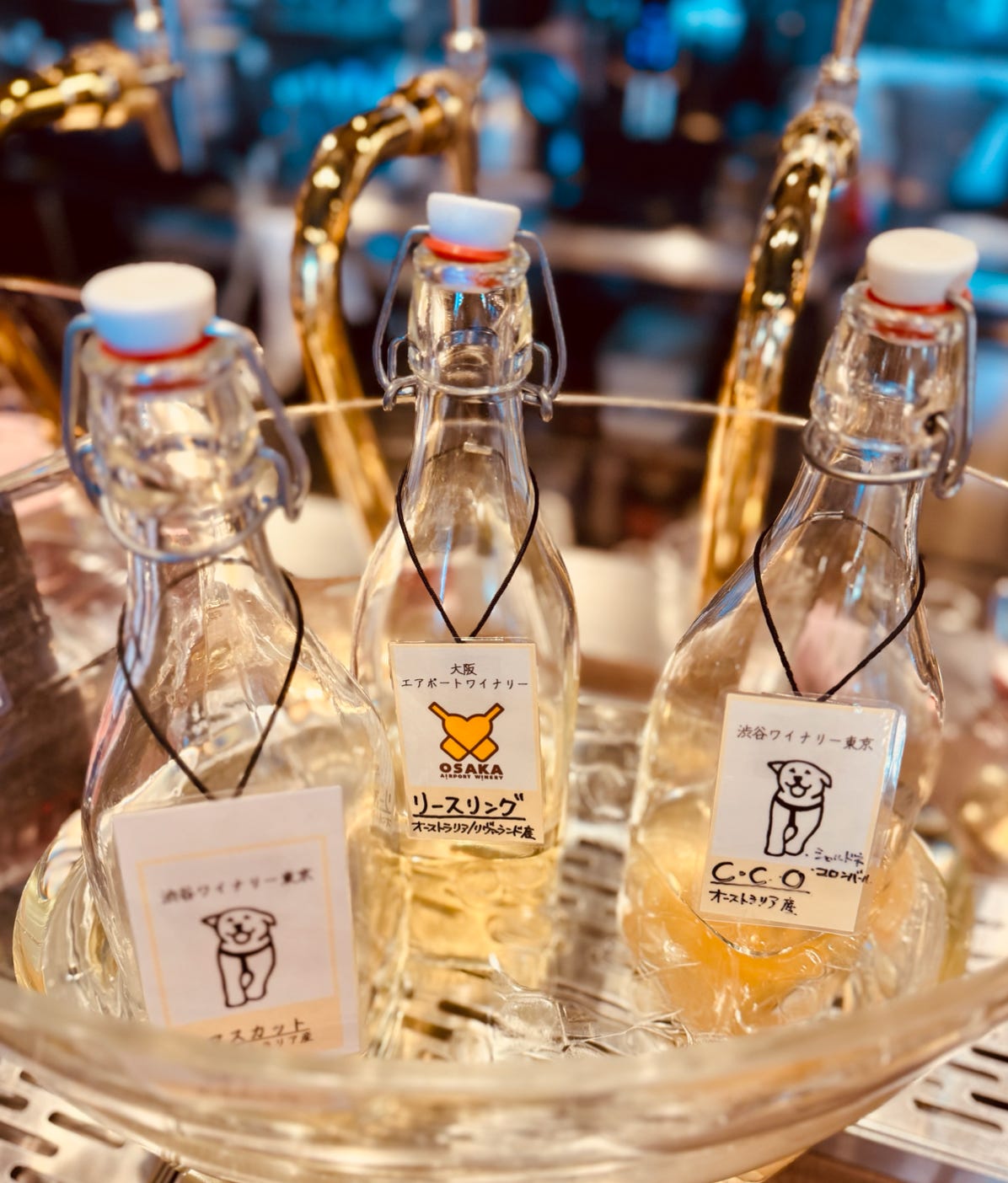
Adding quickly to this as a sub-note, I also spent some attempting to understand Japanese wine while I was there, which is interesting (and unfortunately tastes as good as you suspect it might taste…). Japan obviously has no natural advantage in winemaking and yet it produces wine anyway, at small scale, with obsessive local specificity. Would it be cheaper and objectively easier to import? Yes. But I suppose Japan is a culture that defaults to locality and temporality even when efficiency argues against it!
What The Experience Actually Feels Like
Right. So… describing the inherited system is one thing. Sitting and eating inside it is another beast entirely.
At a great omakase (“to entrust”) counter in Tokyo, the experience is roughly the following: you arrive, you sit, there is no menu or choices, and the chef places a piece of fish in front of you. You eat it, and he places the next one. The pacing is entirely his, just as the sequencing is entirely his. The peak of the meal (the moment of greatest intensity) arrives when he decides it will arrive, not when you are ready for it.
This is the movie-director model I discussed in Part II, taken to an extreme. The chef controls timing, sequence, pacing, and the customer’s emotional arc with total authority. The diner’s role is to receive food. And this act of surrendering choice and preference turns out to be inseparable from what creates culinary pleasure.
This solves the attention problem I identified in Part II, in which I argued that the modern Western diner is so cognitively overwhelmed; that everything competes with a social media feed, and that dining must justify three hours of full presence against the entire internet. At a six-seat counter where the chef is working eighteen inches from your face, this problem is entirely gone! You cannot scroll through a phone when someone is personally slicing fish for you while making eye contact. This structure forbids distraction; and anyway, the restaurant’s physical design produces the close-form presence that Western restaurants are increasingly desperate to manufacture through theatrical interventions such as phone-locking pouches and elaborate multi-sensory experiences.
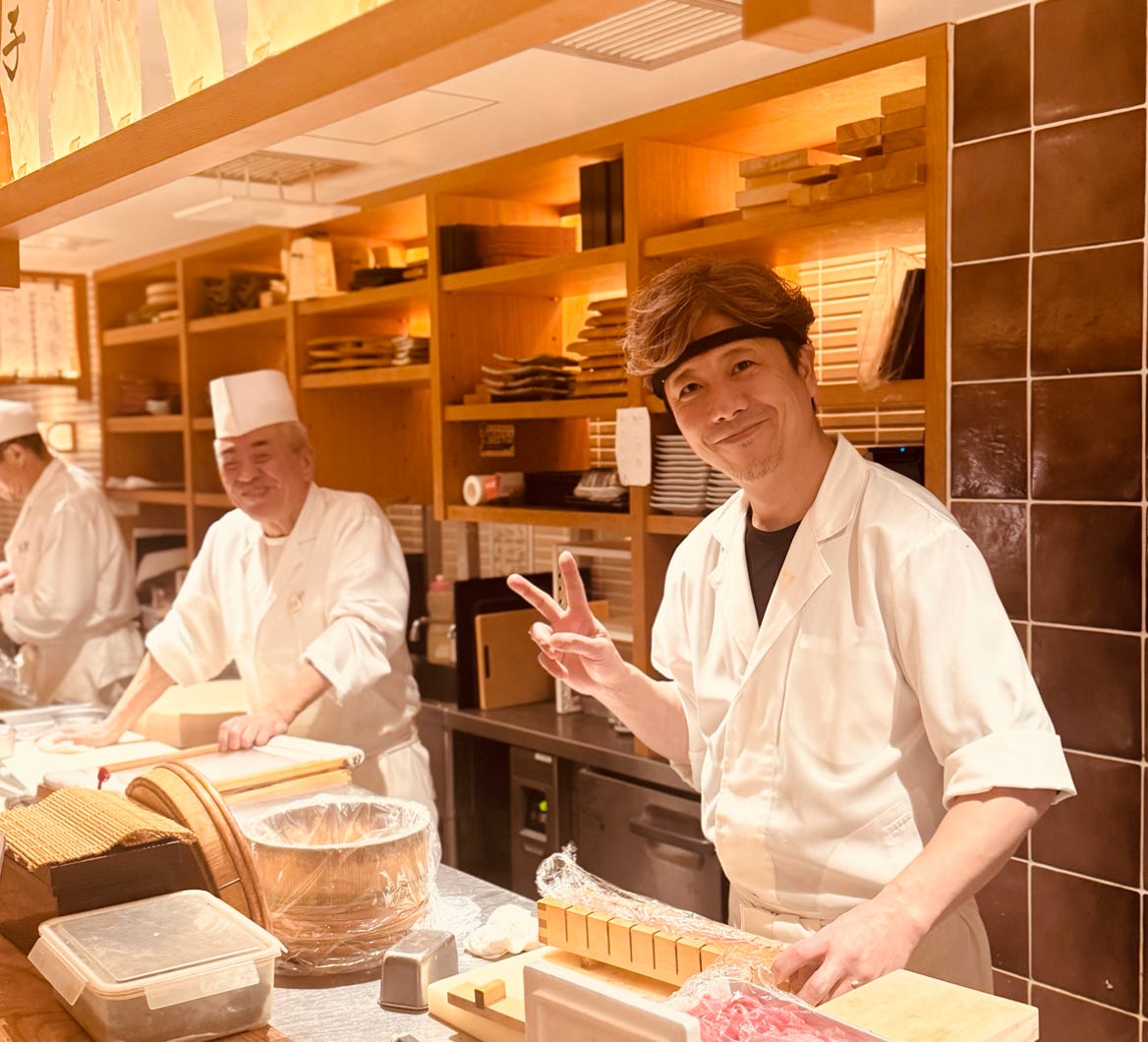
The status dynamic is different too, considering that the scarcity at a six-seat restaurant is real because, well… there are literally six seats. You cannot buy your way past this constraint by knowing the manager (who is the server and also the chef). Many times, I was just told NO before my face had even looked past the front door. This is scarcity as a byproduct of craft, and it is completely different from the manufactured scarcity of a members’ club!
Where It Breaks
It would be easy to romanticize all of this into a story whereby Japan represents some kind of culinary paradise untouched by modernity’s problems, because that’s just not true. Japan’s food system has its own crises, and like the West’s, they are every bit as serious.
The first is what I would call Michelin-ification. When the Michelin Guide arrived in Tokyo in 2007, it gave the city more stars than Paris which caused a brief and delightful Franco-Japanese diplomatic incident.
Of course, (French) critics questioned whether Michelin was being too generous to gain acceptance with Japanese customers in order to help its parent company sell tires in Japan. (How dare you equate yakitori grills with grand Parisian establishments like La Tour d’Argent!!).
But of course the deeper problem was structural. Consider that the Michelin framework is designed to evaluate restaurants that optimize for consistency and reproducibility. Japanese restaurants that optimize for intimacy, temporal specificity, and the disappearance of the chef’s ego into tradition do not fit int this framework! In addition, a Michelin star actually does little more than create a different kind of pressure; of unwanted international visibility, unlimited tourist demand, and reservation scalping and its ensuing financialization.
In response, some restaurateurs actually asked Michelin to revoke their stars because of this! And in fact, I experienced this myself first hand. When I found myself in a remote part of Japan’s north island close to Russia, many restaurants there were extremely unwilling to let me in; at one stage even pretending to think that I was trying to buy the dining table when I pointed at it, instead of acknowledging that I wanted to be fed, and just saying no!!
The second crisis is generational. The shokunin model obviously depends on apprenticeship pipelines that are disappearing. The economics support the disintegration of this model; a young person must now commit to a decade or more of low-paid, physically demanding work, in order to master a single form, in an economy that offers vastly better alternatives.
And this is an existential threat to the entire system, because the economics of smallness depend on a labor supply of people willing to accept the terms of craft mastery, and to spend a decade learning how to slice fish. Verifying this, the chefs I worked with in a European 2* restaurant that had worked in similar Tokyo establishments, spoke of twenty-hour days with never-endingly brutal labor to… make rice.
This rice, by the way, is entirely impossible for us mere Westerners to properly even taste; I would consider myself to have a very strong palate given my adventures in food and wine, and it all tasted identical to me (again, sorry!).
The third crisis is the Uniqlo problem, which I teased in Part I. Uniqlo solved a similar question that has defined Western culinary history: how do you make quality accessible at scale? The answer was to strip away everything that didn’t contribute to function and to standardize production, before distributing globally. This produced excellent basic clothing at democratic prices.
Applied to food, this produces conveyor-belt sushi! It is good, it is everywhere, and it coexists with the six-seat counter where the chef has been cutting tuna for thirty years, in the same way that Uniqlo coexists with a Kyoto tailor who makes three kimonos a month by hand.
The question then is whether the small-scale system can survive alongside the industrialized one forever (especially when people like me can’t taste the difference?); or whether the economic desire to scale an economy will eventually consume it.
Japan’s food culture is, along this thinking, a live experiment in whether craft and mass production can both find their home within the same economic system without one cannibalizing the other. The vibe on the ground suggested, unfortunately, that perhaps it could not.
What the West Is Borrowing
The most interesting Western restaurants I discussed in Part II (Ultraviolet, Freixa, Gohar, Tuna Fight Club) are all independently reinventing pieces of the Japanese model:
Smallness
Sequencing
Non-repeatability
Meaning through constraint.
They are discovering these solutions through trial and error, often without explicit reference to Japanese precedent.
Freixa seats a handful of strangers at one table, meaning the entire restaurant is a dinner party. Tuna Fight Club fits thirty people in a basement with one fish; this was essentially restaurant standard practice in Japan. Ultraviolet has ten seats and sequences the room itself around the diner. These are conscious design choices made by chefs who have independently arrived at solutions that Japan embedded in its restaurant architecture generations ago!
Incidentally, my neighbor in London has been trying to get us tickets for Tuna Fight Club (which, again, is around the corner from us), for quite some time. Could I now feel OK with paying $450 for one meal, that I had every day in Japan for $15? I’m not so sure…
But the institutional need beneath these experiments is fundamentally different, and this difference will ultimately determine how far the growing similarities between Japan and the Western restaurant structure can go.
Japan’s culinary meaning is embedded in deep cultural infrastructure that has been borne from the Shinto’s seasonality as a timing framework. The Buddhist ideology, too, lends everything a philosophical orientation toward impermanence and absolute restraint. And of course, centuries of craft lineage provide the labor model I’ve discussed. Then, the tea ceremony provides the original template that led to all of this.
The meaning of food, therefore, comes from outside the restaurant, from a long-standing civilizational context that existed long before any of today’s restaurants did.
The West does not have this infrastructure. Western culture is optimized for scale, novelty, content production à la Instagram, and individual expression. (Yes, if ever you thought we sounded like dumb capitalists, this is it). A Western chef who wants to create a meaningful dining experience must build the entire meaning architecture from scratch, inside the restaurant, and in a culture that will immediately try to content-ify it, scale it, and strip it for parts before selling it to Private Equity.
While Japan’s challenge is sustaining an inherited system that has significant meaning under the pressures of modernity; the West’s challenge is constructing any meaning at all without any inherited infrastructure to build on.
The Netflix Problem
Which brings me to something I have been thinking about since I started writing this series, and which connects to a much larger observation about Western life.
The West has built a food system that mirrors Netflix, with infinite options, frictionless access, and algorithmically surfaced recommendations. It is a billion-dollar industry of restaurant reviews, ratings, rankings, lists, and credit card reservations. You can eat anything, anywhere, at any time, because the supply chain is global. The dominant experience, the one that defines how most people interact with this overwhelming abundance, is of paralysis.
You scroll endlessly through photos, compare different places, reading the reviews. You look at the tagged profiles and you check the price. And finally, after all of the above, you second-guess the entire meal away about whether the other place would have been better, as you await your dessert. This is the decision-fatigue problem that exists everywhere, applied to eating, and it is identical in structure to what seemingly happens these days in dating, which has undergone an identical structural transformation of too-muchness yet never-enoughness.
The apps provide infinite choice among frictionless matching. And the prevalent experience, as my friends who use them tell me, is of complete exhaustion. Endless scrolling through human beings, comparing options, keeping alternatives open, wondering whether someone better is one more swipe away.
What people actually want, visibly and desperately, is to be chosen. They want omakase in their lives; to be decisively told: “Here. I choose you, and only you!” and for the scroll to stop. People want the omakase to surrender their preferences to someone who is serious about the craft of paying attention, and to sit back and trust the sequencing.
Because, you see, endless choice turns out to be a surprisingly effective mechanism for destroying enjoyment.
Japan’s food system is the structural opposite of Netflix. It is closer to someone handing you a single film and saying: this is what we’re watching tonight, because it is March, and this is what March means, and you’ll do it without your phone or any other distraction, beginning to end. The constraint is the product that you are being sold. And the relief of not choosing is itself a luxury that is increasingly impossibble to find in the West.
What I Could Not Read
I should be honest about something, though, because the experience I just described of a constraint as being luxurious, is the experience of someone who can understand the food system they’re actually dealing with.
I… Could not.
What I actually found in Japan was, embarrassingly, the type of paralysis I just described in the West. I walked into restaurants and could not tell if they were extraordinary or ordinary, because they all looked the same to me.
The menus, where menus existed, were identical to each other. The meals themselves tasted indistinguishable. Breakfast, lunch, and dinner frequently felt like the same plate of fish and rice served three times a day in three different rooms, and all I could taste was bonito (aka fishfood for people like me, the unlearned). I could not figure out if one sushi counter was better than another, because the differentiation that a Japanese person understands effortlessly (e..g this chef’s rice is superior, or this particular piece of yellowtail is exceptional because of where it sits in the migration cycle) was something I simply could not perceive.
In short, I lacked the cultural literacy to decode any of the Japanese system. And without that literacy, the entire restaurant system merged into sameness and boringness. I went the whole way to Japan, and felt starved of the excitement of a culinary explosion I was anticipating!
This turns out to be the most important thing I learned in Japan, because it proves the argument I have just made from the other direction!
The meaning in Japanese dining is not in the food itself; it is in the cultural infrastructure that surrounds the food. It is the seasonal knowledge, the craft literacy, plus the ability to perceive micro-differences that only generations of embedded dining culture can be understood. But if you don’t experience that infrastructure, you are left with a tourist (me) eating what appears to be an identical meal on repeat, unable to differentiate the extraordinary chefs from the merely competent, completely paralyzed by the absence of all the Western differentiation signals. Different menus, different cuisines, different price points, different atmospheres… all the things that I have been trained my entire life to navigate by.
Thus, the Japanese system’s greatest strength is also its greatest barrier to entry!
“Meaning through constraint” only works if you these constraints mean anything. And this is exactly why Michelin’s arrival in Tokyo was so structurally disruptive; it offered to make Japanese restaurants comprehensible to outsiders like me by imposing Western identifiers (stars, rankings, categories); but in doing so it began to erode the very qualities that made them work for the Japanese insiders.
So yes, when the first Tokyo guide launched in 2007 as I mentioned, the system that was supposed to recognize excellence had, in practice, made excellence harder to sustain.
And perhaps this is the point I want to reach during this series on food and the economy.
The chef’s job has always been to solve what the prevailing economic system has most recently broken about eating. And what is broken now, in the West, is the capacity to choose meaningfully from infinite abundance. In other words, we have more options than any civilization in history and less ability to commit to any of them (which is clearly not just a food problem!).
The Japanese food system suggests, however, that the answer is counterintuitive. The Japanese are saying: build structures that make choice unnecessary, and create constraints that are so embedded in time and place and philosophy that the question of “what should I eat?” doesn’t actually exist. Because when a meal arrives, it is exactly what this moment requires, because the chef, the season, and the architecture have already decided long before you were born.
But those structures only work if you can read them. And most of us, trained like dogs to accept abundance, trained by Netflix, trained by endless scrolling, cannot. My pal, a movie critic, sent me a message a few days ago discussing the term “algorithmically trapped”; which is horrifying and, perhaps, for people like me, true.
The restaurants that will define the next era will be the ones that solve this abundance and meaning problem from both directions. Japan and the West have converged on the same question, despite arriving from opposite sides, of “how do you build constraints understandable enough for outsiders like me to read, without destroying the depth that made them worth reading in the first place?”
The future of dining, it seems to me, is therefore the end of the menu.
You should at least read Ted Bestor on Tsukiji [the location before Toyosu], and Katarzyna Cwiertka on the development of modern Japanese cuisine – there's a large subsequent literature, but my university let its asian studies program die by neglect so I stopped teaching about Japan and shifted my focus to China and the auto industry ca 2010, and haven't read much in that area since then. I did look for and find a review of Eric Rath, Food and Fantasy in Early Modern Japan, 2010. He looks at chefs, elite cuisine and cookbooks from the mid-1600s through the 1800s. Katarzyna focuses on the 20th century and the rise of "national" cuisine. Ted and his wife now have a couple books on food. And there's a long list of more recent scholarly (and popular) work. I've looked at franchising and also at the growth of malls, where food is part of the story – McDonalds and Dennys and KFC were all important in diffusing the franchised retailing business model. Dennys biggest innovation was restricting shops to a roadside location with parking.
You might also find the movie Tampopo great fun, and the Netflix series La Grande Maison Tokyo and The Midnight Diner.
As to small restaurants, that's a function of the old economic geography of how people moved around, before the diffusion of a car-centric lifestyle that began in rural Japan and then spread to suburbia as economic change freed up large blocks of real estate (and institutional change removed legal strictures on large floor-space establishments). In addition, those small restaurants that refused you entrance were likely local social institutions with a regular (perforce small!) clientele – there's even a term, jōren. I was a jōren at 2 places during my last extended residence, and when traveling I ask [in Japanese] before entering whether a hole-in-the-wall restaurant whether it has space, and try not to take it personally if they appear to have empty seats but say no. Fewer and fewer small restaurants remain, the last time a friend said let's eat sushi he drove us (he has 4 kids!) to a 100 seat place alongside a major road. OK fish, mediocre rice, and at that shaped by a machine. But you could go as a family and never have to wait long to get a seat, and you could stuff your face for not a lot of money.
Note the widespread perception is that Hokkaido has had challenges with rude Russian visitors, so getting in the door without an introduction is hard. Even then, if you don't speak Japanese, it changes the ambience unless you can be stashed in the corner, and many have wall stickers with current items but no printed menus.
At one point my son ended up living in a small town where the regional yakuza were headquartered, which had its own set of social issues. He had to be careful not to accept favors that would incur an obligation to do a favor in return. He was also sometimes told "don't come tonight" as business was to be discussed. And then the other half of town was HQ to a right-wing uyoku group who would be delighted to beat him up given any excuse, such as entering one of "their" restaurants. The yakuza and the uyoku did not get along, the job of the local police was to keep them apart and otherwise keep away. To that end, both groups saw to it that there was no petty crime, they didn't want to create reasons for the police to nose around. So as long as he stayed away from the uyoku it was an extremely safe place, even for Japan. There were chain restaurants, but the small local ones, like it or not, either excluded both groups, or aligned with one or the other, never both.
Be careful of stereotypes. Into the early 1900s the language wasn't mutually understandable, between regions, bigger difference than between Italian and Spanish. Even today there's strong regionality in food and drink, as the climate varies from tropical to northern Hokkaido, with lots of local variations in soil and rainfall and climate. With a population of 120+ million, there's also a staggering number of subcultures, I knew devotees of enka (a singing tradition), an opera singer and a soprano specialized in Elizabethan music, a pip organ builder and a virtuoso recorder artist. Irish musicians. Shamisen and koto players. A cigar-smoking Japanese female CEO. On and on. I like to speak of japanese people, and not Japan.
Creating a "nation" was a long process that gained momentum with the imposition of mandatory elementary school attendance with a national curriculum in the early 1900s. Oh, and I knew the main academic pushing the ie idea, I was at one of the early conferences, but it proved to have very little explanatory power so didn't get much traction. There are a lot of "invented traditions" in Japan as elsewhere.
Kaiseki was partly regional, Kyoto and high-end Buddhist cuisine, not something you would casually encounter in Tokyo (I've lived in Tokyo ≈7 years across a 50 year timespan). Urbanization was rapid: just after 1600 Edo was a fishing village, by 1720 it had 1 million residents, and the elite had their own chefs and the power elite had kitchens to prepare banquets. I do have a woodblock print from the 1860s, part of a series of ukiyoe that were advertisements for restaurants in Edo, but I only have the one so can't try to deduce whether the artist was commissioned by a local restaurant association or simply solicited until he had enough to make it worth creating a series of prints.
reallty great cover art